Key takeaways
- Standalone operation—no laptop required at any point in the workflow
- Proven reliability backed by years of owner satisfaction feedback
- Interface feels dated compared to newer touchscreen alternatives
Choosing a drum machine in the 808 tradition means deciding between authentic analog circuits, practical step sequencing, and how far you intend to push a groove before it starts to feel generic. The market in 2026 offers options from a $40 pocket unit to a sampler that costs ten times that, which makes a shortlist essential before you commit.
The best 808 drum machines nail three things: convincing low-end punch, immediate workflow (no menu diving between beats), and enough variation to avoid sounding like every other track in the same genre. A unit that fails on any of those—whether it’s muddy bass response, clunky sequencing, or too few sounds for the price—isn’t worth the desk space regardless of brand loyalty.
Our top picks


As an Amazon Associate we earn from qualifying purchases at no extra cost to you.
Quick Picks
| Product | Best for | Price |
|---|---|---|
| Alesis SR-16 | Standalone reliability | $159 |
| Korg Volca Drum | Layered digital percussion | under $150 |
| Stylophone Beat | Ultra-compact sketching | under $40 |
| Behringer RD-78 | Classic analog voice | under $150 |
| Korg Volca Beats | Affordable analog workflow | under $150 |
| Medeli MR101S | Portability on a budget | under $150 |
| Alesis Accordion (SR16) | Same SR-16 platform, alternate listing | $159 |
| Akai MPC Sample | Sampling plus drum programming | $399 |
How We Picked
We evaluated each unit on four criteria: sound character (does the kick have body and the snare crack without external EQ?), sequencing depth (16-step grids with parameter locks versus simple loop playback), build and portability (enough for live use or just studio shelf decoration), and value relative to the number of usable voices it provides. Owner feedback weighted heavily where spec sheets were vague.
The 8 Best 808 Drum Machines in 2026
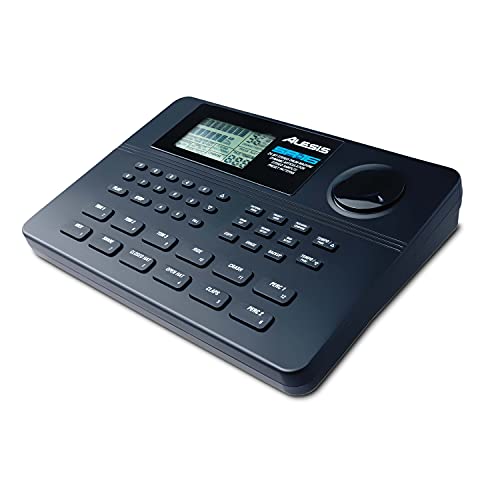
Alesis SR-16 Standalone Drum Machine
The SR-16 remains the go-to for producers who want a dedicated, no-nonsense unit that works without a computer. It delivers a wide palette of analog-voiced sounds and enough pattern memory to build full arrangements on the fly.
- Standalone operation—no laptop required at any point in the workflow
- Proven reliability backed by years of owner satisfaction feedback
- Interface feels dated compared to newer touchscreen alternatives
Skip it if you need modern effects processing or deep per-step parameter editing; this machine favors straightforward beat building over sound design.
Korg Volca Drum Digital Percussion Synthesizer
A digital take on drum synthesis with a 16-step sequencer and Korg’s Active Step feature, which lets you isolate one step during playback for focused tweaking. The layered digital voices offer more sculpting headroom than a fixed analog circuit.
- Active Step makes groove editing unusually fast and visual
- Digital architecture allows richer timbral variation per voice
- Lacks the immediate low-end thump that analog purists expect from an 808-style kick
If your priority is that unmistakable analog boom, this digital unit won’t satisfy—pass it for the Volca Beats or RD-78 instead.
Stylophone Beat Compact Stylus Drum Machine
A novelty turned practical: four drum kits and four bass sounds driven by a stylus, making it the smallest option here by a wide margin. It excels as a pocket sketchpad for rhythm ideas wherever you are.
- Truly portable—fits in a coat pocket and runs on batteries
- Stylus interface is intuitive for fast, tactile rhythm experiments
- Sound quality is lo-fi by design, not suited for final-track drum duties
Skip it for serious production output; it’s an idea generator, not a performance instrument.
Behringer RD-78 Classic Analog Drum Machine
Behringer’s 15-sound analog engine with 34 rhythm presets and a 16-step sequencer aims squarely at the vintage boom-bap character. The analog circuits deliver warmth that digital recreations still struggle to match at this price point.
- Genuine analog voices with authentic low-end weight
- 34 built-in rhythm presets provide instant starting points
- Limited to 15 drum sounds, which narrows genre flexibility
If you need variety beyond classic hip-hop and electro patterns, the sound palette may feel restrictive quickly.
Korg Volca Beats Analog Rhythm Machine
The Volca Beats pairs real analog bass drum and hi-hat voices with an Electribe-style 16-step sequencer at an aggressive price point. It’s the most cost-effective entry into genuine analog drum synthesis in this roundup.
- Real analog circuits for kick and hi-hat—none of it is sampled
- Electribe step sequencing is familiar and fast for pattern programming
- The small rubber keys can feel cramped during live performance
If you plan to perform standing up in front of a crowd, the tiny pads may frustrate; consider the SR-16 for a more comfortable live layout.
Medeli MR101S Portable Drum Machine
A white, pocket-friendly option that prioritizes travel convenience. It packs enough sounds and patterns for practice sessions and idea capture on the move.
- Compact and light enough for a backpack side pocket
- White finish stands out aesthetically among typical black gear
- Sound quality sits below the analog options in this group
Skip it if your output will be mixed down for release; this is a practice and sketch tool, not a final-track source.
Alesis Accordion (SR16)
Listed separately but built on the same SR-16 platform, this unit shares the proven standalone workflow and analog voicing that made the original popular among beat makers. The identical price suggests it’s an alternate configuration or bundle offering.
- Inherits the SR-16’s battle-tested pattern engine and sound bank
- No computer dependency keeps the signal path simple
- Confusing listing makes it harder to confirm what differs from the standard SR-16
If you’re already considering the SR-16, buy whichever listing offers the better shipping and return terms; the underlying experience should be the same.
Akai Professional MPC Sample Portable Sampler
At $399, this sits above every other entry here and earns its place by blending drum sequencing with real sampling. You can resample the analog units around it or load your own one-shots for maximum sonic control.
- Sampling capability eliminates the fixed-sound limitations of the other seven units
- Portable form factor with modern touch controls
- Price is nearly triple that of the best dedicated analog option here
If your budget caps at $160 and you only need a single analog kick character, the extra sampling features won’t change your sound enough to justify the cost.
Buying Guide
Analog Versus Digital Voices
Analog drum circuits produce the harmonic distortion and resonance that define the 808 sound—particularly the kick’s long sine decay and the snare’s noise-burst snap. Digital units (the Volca Drum, Stylophone Beat, Medeli MR101S) simulate these traits with more parameter flexibility but slightly less immediate punch. If genre authenticity matters, lean analog; if sound design exploration matters more, digital gives you more to twist.
Sequencer Workflow and Step Resolution
A 16-step sequencer is the minimum standard here, and all major units deliver it. The difference lies in per-step editing: Korg’s Active Step lets you tweak one step at a time during playback, while the SR-16 and RD-78 use more traditional step programming. Live performers will value parameter locks and on-the-fly editing; studio producers who sequence in a DAW may care less.
Portability and Build for Real Use
Pocket units like the Stylophone Beat and Medeli MR101S trade output level and pad size for carryability. If the machine will sit on a desk or stage, prioritize comfortable keys and a headphone output that can handle the room. The Volca line hits a middle ground: small enough to gig but built with enough structure to survive a backpack commute.
Our Verdict
The Korg Volca Beats is our top pick for most buyers: real analog voices, a proven sequencer workflow, and a price under $120 that undercuts every direct competitor on sound quality per dollar. The Stylophone Beat is the best budget choice for under $40 if you need a sketchpad more than a studio instrument. However, the Akai MPC Sample wins outright the moment you want to resample other machines or load your own drums—no fixed-voice unit here can match that flexibility.
FAQ
Do I need an analog drum machine for authentic 808 sound?
For the closest match to the original TR-808 character, yes—real analog circuits reproduce the sine-wave kick and noise-sweep snare more naturally than most digital engines. That said, the digital options in this list can get close with some EQ and saturation applied in post.
Can these units sync with a DAW?
Most of them support MIDI clock or audio sync, but the implementation varies by model. The Volca line uses analog sync jacks for chaining, while the SR-16 and RD-78 include MIDI outputs for conventional DAW integration. Check the specific unit’s MIDI documentation before assuming plug-and-play behavior.
What’s the practical difference between $40 and $400 here?
At $40 you get fixed sounds, basic step programming, and limited output level—fine for ideas. At $400 you gain sampling, deeper editing, more usable voices, and build quality suited to daily professional use. The middle tier ($100–$160) is where analog character meets reliable standalone workflow.
Are these good for live performance or just studio use?
The SR-16 and RD-78 have enough output and a robust layout for stage use. The Volca units work live in a small setup but feel cramped for standing performance. The Stylophone Beat is best kept in your pocket for practice, not under stage lights.