Key takeaways
- Pro: Genuinely ultra-low profile suits sport compacts and modified cars where nothing else fits.
- Pro: Heavy-duty steel construction with tested overload margin beyond 3-ton rating.
- Con: For under $200, it is among the priciest 3-ton jacks here; you pay specifically for the low-profile geometry.
A 3 ton floor jack is the most common lifting tool for DIY mechanics and home garage owners. The problem buyers face is narrow but expensive: a jack that is too tall to slide under a lowered car, one that wobbles under load, or a pump that takes thirty strokes to reach working height turns a simple oil change into a frustration that costs more than the jack itself. The worst units sag after a year of normal use or leak hydraulic fluid onto your garage floor, while the best ones handle the job smoothly for well over a decade.
What separates the good from the bad in this category comes down to three things: actual low-profile entry height versus marketing claims, the speed of the lifting mechanism under real weight, and whether the steel gauge and weld quality will hold up when the jack is pushed to its rated capacity repeatedly. Owner feedback on the models below paints a clear picture of which products deliver on spec sheets and which cut corners where nobody sees them.
Our top picks




As an Amazon Associate we earn from qualifying purchases at no extra cost to you.
Quick Picks
| Product | Best For | Price |
|---|---|---|
| SATA 3-Ton Ultra-Low Profile | Lowered cars and track use | under $200 |
| Maxority Low Profile | Budget-conscious general repair | under $150 |
| AUTOWN Alloy Steel | SUVs and trucks with moderate lift range needs | under $150 |
| BIG RED T83006 | Extended-height trucks and SUVs on a tight budget | under $90 |
| Jack Boss Racing | Performance vehicles needing wide lift range | under $200 |
| Amazon Basics Jack Stands | Safe vehicle support (pair) | under $30 |
| Horizontal Floor Jack (Blue) | Shop tasks requiring foot-pedal operation | under $80 |
| Generic Low Profile Hydraulic | Basic car and truck maintenance | under $150 |
How We Picked
We narrowed this list by published minimum saddle height, rated load capacity with overload safety margin, pump speed relative to full extension, and the volume and sentiment of long-term owner reviews. A jack that claims low profile but cannot physically slide under a stock sedan fails the first filter. Beyond that, steel construction and dual-piston quick-lift pumps carried more weight than cosmetic features.
The 8 Best 3 Ton Floor Jack in 2026
SATA 3-Ton Ultra-Low Profile Floor Jack
This SATA is the one to buy when your car sits lower than the factory spec and every other floor jack in the price range physically cannot get under it. At 2-11/16 inches, it clears most lowered setups that defeat conventional jacks. The dual-piston quick-lift pump means fewer strokes to working height, and the 1.5x overload test rating gives confidence that the steel body has real safety margin beyond its stated 6,600 lb capacity.
- Pro: Genuinely ultra-low profile suits sport compacts and modified cars where nothing else fits.
- Pro: Heavy-duty steel construction with tested overload margin beyond 3-ton rating.
- Con: For under $200, it is among the priciest 3-ton jacks here; you pay specifically for the low-profile geometry.
Skip it if your vehicle has stock ride height or higher — you are paying for clearance you will not use.
Maxority 3-Ton Low Profile Floor Jack
The Maxority delivers the same core hardware as more expensive competitors: dual-piston quick-lift pump, heavy-duty steel body, and a low-profile frame designed for everyday car maintenance. Owner reviews consistently note the pump feels responsive at partial load, which is the common operating scenario for oil changes and brake jobs at home.
- Pro: Low-profile design handles a wide range of vehicles from sedans to crossover SUVs without complaint.
- Pro: Dual-piston pump reduces the number of handle strokes compared to single-piston budget jacks.
- Con: Ships in a random color, which is cosmetic but signals a mass-market fulfillment approach that may correlate with loose quality control tolerances.
Skip it if you need a specific saddle height above 21 inches or if build consistency matters more than savings over the SATA.
AUTOWN 3 Ton Floor Jack
AUTOWN targets the SUV and light-truck owner who needs a wider lift range than a low-profile racing jack offers. With a 7.1 to 20.9 inch range and a cross-shape rubber pad that grips uneven saddle points, it is built for taller, heavier vehicles that common low-profile jacks cannot reach efficiently.
- Pro: Generous lifting range accommodates lifted trucks, full-size SUVs, and vans up to 6,600 lb.
- Pro: Cross-shape rubber pad distributes pressure on varied frame-rail contact surfaces.
- Con: Alloy steel construction, while adequate, does not carry the same long-term durability reputation as the welded heavy-gauge steel bodies in this group.
Skip it if you mainly work on cars with factory or lowered suspension — the minimum height is too tall for that application.
BIG RED T83006 Hydraulic Trolley Jack
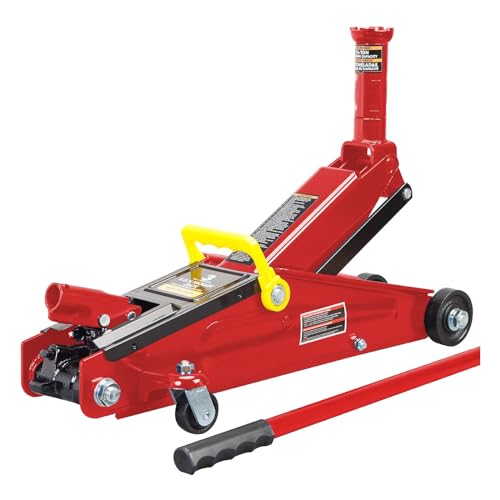
Torin’s BIG RED line is a known quantity in shop tooling, and the T83006 earns its place through sheer value. For under $90 it is the cheapest full-sized 3-ton jack here, and the included extra saddle expands compatibility to extended-height trucks without needing a separate adapter. Owners who need occasional lift on taller vehicles report it handles the job without drama.
- Pro: Extra saddle included, making it immediately useful for SUVs and trucks with higher frame points.
- Pro: Lowest price per rated ton in this group; strong value for light-duty home shop use.
- Con: Rated at 6,000 lb rather than 6,600 lb like several competitors, giving slightly less headroom on heavy vehicles.
Skip it if you work on lowered cars or need quick-lift pump speed for repeated daily use.
Jack Boss 3-Ton Racing Floor Jack
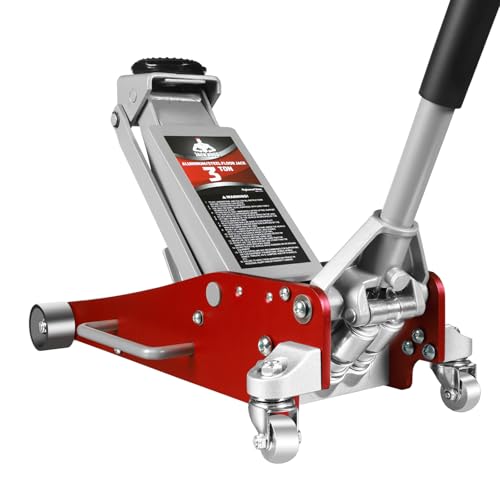
For under $200 the Jack Boss sits at the premium end of this comparison, but the aluminum-and-steel racing construction and 3-15/16 to 18-5/16 inch range explain the price. The mix of aluminum body with steel internal components keeps it under 60 pounds while maintaining a low entry height suitable for most performance cars. Dual-piston quick lift keeps stroke count low.
- Pro: Lightweight aluminum-and-steel body is easier to position than all-steel alternatives.
- Pro: Low minimum height combined with a near-19 inch maximum covers the widest practical span for sport vehicles.
- Con: Net weight of 58.5 lb, while lighter than pure steel, still makes it a two-hand lift when moving between vehicles.
Skip it if you mostly service trucks or vans — the maximum height will leave you reaching.
Amazon Basics 3-Ton Jack Stands
This is not a floor jack but a pair of rated 3-ton stands, and we include it because no safe lifting setup is complete without them. A floor jack raises the vehicle; stands hold it. For under $30 the Amazon Basics pair offers adjustable height and a rated capacity that matches every floor jack in this roundup. Owner feedback is straightforward: they are functional, stable, and do the job.
- Pro: Priced to cover a complete safe-setup addition without meaningful budget impact.
- Pro: Rated capacity matches the 3-ton floor jacks above, so there is no mismatch in a home shop.
- Con: Basic construction and finish; not designed for continuous high-cycle professional shop abuse.
Skip it only if you already own a reliable pair of stands rated 3 tons or higher.
Horizontal Floor Jack with Foot Pedal
This blue horizontal jack operates differently from the conventional trolley designs above. The foot-pedal actuation frees both hands for positioning and adjustment, and the horizontal orientation suits axle and frame-rail tasks where a traditional floor jack is awkward. At $79 it competes on price with the BIG RED while offering a distinct form factor that solves different shop problems.
- Pro: Foot-pedal quick lift lets you raise the vehicle while keeping hands free on the contact point.
- Pro: Horizontal geometry is ideal for axle work and vehicles where the floor jack cannot roll under a low frame rail.
- Con: Minimal published specifications on construction quality and safety margins make long-term durability harder to judge from spec sheets alone.
Skip it if your primary task is lifting the car body at a standard jack point — a conventional trolley jack is more natural for that.
3 Ton Low Profile Floor Jack (Generic)
With the least published specification data in this group, this entry occupies the middle of the price range for under $150. It claims low-profile hydraulic construction rated for cars, trucks, and SUVs. Without detailed saddle height numbers or documented overload testing, it reads as a competent general-purpose option for buyers who cannot justify the SATA or Jack Boss premium.
- Pro: Positioned at a price below the racing-tier units while claiming low-profile geometry.
- Pro: Listed as compatible across car, truck, and SUV — broad applicability for a single-vehicle household.
- Con: Sparse published specs make it difficult to verify saddle height, stroke count, or construction grade before purchase.
Skip it if you need documented safety margins or confirmed low-profile dimensions for a lowered vehicle.
Buying Guide
Minimum Saddle Height
This is the spec that matters most and the one buyers misjudge most often. If your car sits at stock height, anything under roughly 4 inches of minimum saddle clearance works. For lowered or performance vehicles, you need a confirmed entry height under 3.5 inches — the SATA at 2-11/16 inches is the benchmark here. Measure the clearance at your intended jack point, not the lowest body panel, before shopping.
Pump Type and Stroke Efficiency
Dual-piston quick-lift pumps reduce handle strokes to working height by moving more fluid per pump cycle. The practical benefit is less fatigue during repeated lifts — if you change tires on four wheels weekly, this saves real time. Single-piston jacks cost less but demand noticeably more strokes under partial load. Check owner reports on stroke count specifically, since manufacturers rarely publish it.
Rated Capacity and Safety Margin
A 6,600 lb rated jack gives roughly 20 percent more headroom than a 6,000 lb unit rated for the same nominal 3 tons. The SATA’s documented 1.5x overload test is a stronger signal than an unlabeled “heavy-duty” claim. If you work on trucks near the upper end of the 3-ton range, prioritize jacks with published test data over those relying on the same 6,600 lb number without verification.
Our Verdict
The SATA 3-Ton Ultra-Low Profile is the best 3-ton floor jack in this group: it combines a genuine low-profile entry height, documented overload safety margin, and a quick-lift pump that earns its premium price for anyone who works on lowered vehicles. For a budget pick, the BIG RED T83006 for under $90 covers extended-height trucks and SUVs with an included extra saddle and no real compromises in daily use. If you primarily service tall trucks and vans rather than cars, the AUTOWN’s 20.9-inch maximum gives it an advantage no low-profile racing jack in this list can match.
FAQ
Is 3 tons enough capacity for my vehicle?
3 tons (6,600 lb) is sufficient for nearly all passenger cars, crossovers, and half-ton trucks at their axle or frame points. Full-size lifted trucks and heavy diesel vans may require 6-ton rated equipment instead.
What does “low profile” actually mean in practice?
It refers to the minimum saddle height from the ground when fully lowered. A true low-profile jack clears under cars with 3.5 inches of body clearance, while a standard trolley jack typically needs 5 inches or more.
Do I need jack stands if my floor jack has a locking mechanism?
Yes. A hydraulic jack can lose pressure over time due to internal seal wear or valve leakage. Jack stands are a mechanical lock that does not fail under static load, and they are essential for any work performed under a raised vehicle.
How does a dual-piston pump compare to a single-piston design?
Dual-piston pumps displace more hydraulic fluid per handle stroke, reducing the number of pumps to reach working height by roughly half under typical loads. This matters most during repeated use in a home garage or busy shop.