Key takeaways
- Pro: Generous capacity that covers most everyday cooking tasks without needing two pots
- Pro: The inner lid design locks the weight securely, earning trust from long-term owners
- Con: Standard aluminum base can warp over time on high-heat burners, especially if left empty on flame
A pressure cooker is one of those kitchen tools that either earns its counter space or becomes a dust collector. The difference usually comes down to capacity matched to household size, base construction suited to your stove type, and how well the lid seal holds up after repeated heating cycles. Hawkins has built its reputation on a specific design philosophy—the inner lid system that locks the weight onto the lid internally—making it one of the safest pressure cooker brands available. But that shared engineering means the real buying decision comes down to capacity, base thickness, and material finish, not whether the pot will build pressure.
The Classic line uses standard aluminum with a base that works on gas and electric but not induction. The Contura line introduces a thicker base, with hard anodized or stainless steel variants that add induction compatibility. The B60 sits in between as an older-style body with updated finishes. Owner feedback consistently flags two issues across the range: the classic aluminum base warps over time on high-heat gas burners, and the Contura black finish requires gentle cleaning to avoid staining. Everything else—cooking time, pressure regulation, lid safety—is remarkably consistent across the lineup.
Our top picks





As an Amazon Associate we earn from qualifying purchases at no extra cost to you.
Quick Picks
| Product | Best for | Price |
|---|---|---|
| Aluminium 5L Classic (Cl50) | Family gas-stove cooking | under $50 |
| 2L Classic (CL20) | Solo portions and steaming | under $30 |
| 4L Classic (CL40) | Couples on a budget | under $40 |
| 6.5L Contura Black (Cb65) | Large-batch cooking | $60 |
| 5L Contura Stainless Steel (SSC50) | Induction kitchens | $66 |
| 3L Contura Black (CB30) | Induction-compatible small meals | under $40 |
| Contura Hard Anodized 5L | Durability on induction | $62 |
| B60 3L Silver | Compact induction use | under $60 |
How We Picked
Three criteria drove our selection here. First, stove compatibility: induction owners need the thick-base Contura or B60 models, while gas and electric users save money with the Classic line. Second, capacity-to-household match: a 2-liter cooker frustrates a family of four just as quickly as a 6.5-liter pot overwhelms someone cooking for one. Third, base thickness and finish durability: the Contura line’s extra-thick base resists warping, and its finish (hard anodized versus stainless steel) determines how well it withstands acidic foods over years of use.
The 8 Best Hawkins Pressure Cooker in 2026
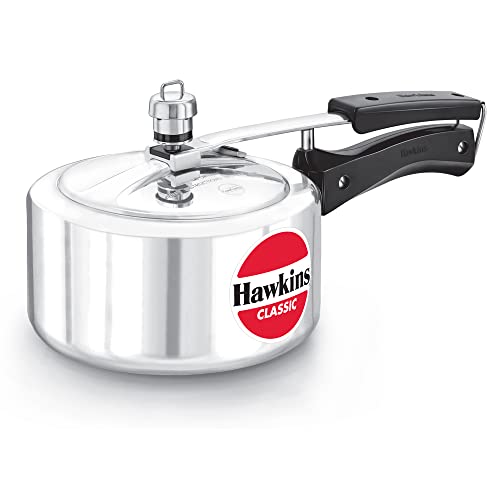
Hawkins Aluminium 5 Litre Classic (Cl50)
This is the default recommendation for anyone cooking on gas with a family of three to five. The five-liter capacity handles rice, dal, and whole-chicken dishes in one cycle without the bulk of larger pots. Owner feedback highlights the even heat distribution on gas burners and the satisfying weight of the lid-locking system that prevents the weight from sliding off.
- Pro: Generous capacity that covers most everyday cooking tasks without needing two pots
- Pro: The inner lid design locks the weight securely, earning trust from long-term owners
- Con: Standard aluminum base can warp over time on high-heat burners, especially if left empty on flame
Skip this if your stove is induction—this base simply will not work. Also skip it if you regularly cook for six or more.
Hawkins 2 Litre Classic (CL20)
Small capacity, small price, and a specific niche: single-portion cooking, steaming vegetables, or preparing baby food without wasting ingredients. Owners praise how quickly it reaches pressure due to the reduced volume, meaning less waiting on tasks that would be oversized in a larger pot.
- Pro: Reaches full pressure faster than larger models, ideal for quick side dishes
- Pro: Lightest weight in the range, easy to lift and store in tight cabinet space
- Con: Too small for any meal involving grains in bulk; rice expands and fills the pot past safe limits
Not suitable as your only cooker. It’s a supplemental pot for specific tasks, not a workhorse.
Hawkins 4 Litre Classic (CL40)
The middle child of the Classic line and arguably the best value for couples or singles who cook in batches. Four liters is enough for a meaningful meal-prep session without the awkward handling of the five-liter model when full. It shares the same inner lid safety as every other Classic, so you lose nothing on that front.
- Pro: Sweet-spot capacity that avoids the bulk of the 5L while still handling two servings comfortably
- Pro: At under forty dollars, it undercuts most competitors while matching Hawkins build quality
- Con: Still not induction-compatible, and the aluminum base shows discoloration sooner than the Contura line
Skip this if you cook for more than two people or need induction compatibility.
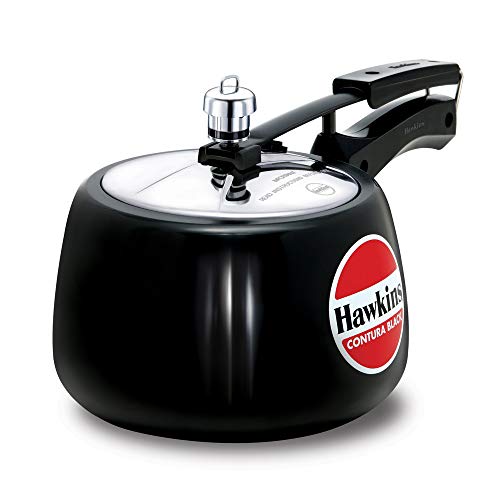
Hawkins 6.5 Litre Contura Black (Cb65)
The largest pot in this roundup, and the one built for households of six or for anyone who regularly makes stock, lentil soup, or whole-meat dishes in bulk. The hard anodized body resists the acidic wear that stains plain aluminum, and the thick base spreads heat more evenly than any Classic model. Owner feedback notes it heats faster than expected for its size, which is a practical plus when you’re feeding a crowd.
- Pro: Massive capacity without the unwieldy proportions of larger commercial pots
- Pro: Hard anodized finish resists scratching and acid discoloration far better than bare aluminum
- Con: The black exterior shows water spots and fingerprints, demanding more careful cleaning than silver models
Consider skipping if your kitchen has only one small burner or if you rarely cook for more than four.
Hawkins 5 Litre Contura Stainless Steel (SSC50)
This is the model that solves the induction problem without sacrificing capacity or the Hawkins safety design. The stainless steel construction over a thick base gives you induction compatibility, magnetic response, and a surface that shrugs off acidic foods without any special care. The five-liter volume matches the most popular Classic size, so nothing changes except compatibility and finish.
- Pro: Fully induction-compatible, solving the main limitation of the Classic line
- Pro: Stainless steel exterior stays visually clean without the staining issues of hard anodized or bare aluminum
- Con: Highest price in this lineup at sixty-six dollars, a premium driven almost entirely by the steel body
If you cook on gas only, the Classic Cl50 at nearly twenty dollars less delivers identical performance.
Hawkins 3 Litre Contura Black (CB30)
For induction kitchens that don’t need a large pot, this fills the gap. The hard anodized build gives you thick-base induction compatibility in a compact footprint. Owners report it handles the rice-and-dal routine of a single cook or a couple in one cycle without expanding to the size where leftover management becomes a problem.
- Pro: Induction-compatible at a price well below most stainless steel competitors
- Pro: Compact enough for small kitchens and apartment cooking with limited storage
- Con: The black anodized finish requires mild soap and no abrasive scrubbing, adding a maintenance step that stainless avoids
Skip if your household regularly cooks for three or more in a single pot.
Hawkins Contura Hard Anodized Induction Compatible 5L
Another 5-liter induction option, but this one takes the hard anodized route instead of stainless. That means the base and body are chemically hardened for durability against scratching and corrosion, while maintaining the dark matte finish Hawkins has made a signature. At sixty-two dollars, it sits between the 6.5-liter black and the stainless model in price.
- Pro: Hard anodized surface is significantly more scratch-resistant than plain or even stainless finishes
- Pro: Induction compatibility at a lower price than the stainless steel equivalent in the same capacity
- Con: The dark finish, while durable underneath, shows white mineral deposits from hard water more visibly than silver options
If water spots and fingerprint management bother you, pay the extra four dollars for the stainless SSC50 instead.
Hawkins B60 3 Litre Silver
The B60 line is an older design that Hawkins still sells, and this 3-liter silver model is a curious entry in 2026. It offers induction compatibility with a thick base in a smaller format, but at fifty-five dollars it costs more than the newer Contura CB30 while delivering a smaller capacity in a less modern design. The appeal is narrow: someone who specifically prefers the B60 body shape or finds it discounted.
- Pro: Thick induction-compatible base in a compact format that handles single-person meals well
- Pro: Silver finish avoids the maintenance concerns of black anodized models
- Con: Priced above the newer Contura CB30 for a smaller, older-design body with no clear functional advantage
Unless the B60 is significantly cheaper at your retailer, the Contura CB30 is the better value in the same capacity class.
Buying Guide
Capacity: Match the Pot to the People
Hawkins pressure cookers should never be filled more than two-thirds for standard foods or one-half for items that expand (rice, beans, lentils). That means a 2-liter pot realistically cooks only about one liter of expanded grains, enough for one or two servings. The 3- and 4-liter models suit single cooks and couples. The 5-liter Classic is the family default for three to five. The 6.5-liter is for six or more, stock-making, or serious batch cooking.
Base Construction: Induction Compatibility and Warp Resistance
Classic models use a standard aluminum base with no magnetic layer, meaning they will not work on induction cooktops at all. Contura and B60 models use a thick sandwich base with a magnetic steel layer bonded to the aluminum, enabling induction response and dramatically improving heat distribution on any stove. If your kitchen has induction, the decision is already made for you—Contura or B60 only. If you use gas, the thick base still resists warping over years of high-heat cooking.
Finish: Hard Anodized vs. Stainless Steel vs. Bare Aluminum
Bare aluminum (Classic line) is inexpensive and effective but oxidizes over time, develops dark patches from acidic foods, and cannot go in the dishwasher without dulling. Hard anodized finishes (Contura Black, Contura Anodized) resist that oxidation and look new longer but show water spots and require gentle cleaning. Stainless steel (SSC50) is the most forgiving visually—no staining, no mineral marks, dishwasher-safe—but costs the most. Choose based on how much you value the pot’s appearance over its decade-plus functional life.
Our Verdict
For most buyers cooking on gas, the Hawkins Aluminium 5 Litre Classic (Cl50) for under $50 remains the best balance of capacity, safety, and price. For induction kitchens, the Hawkins 5 Litre Contura Stainless Steel (SSC50) at $66 is the top choice, combining full compatibility with a low-maintenance finish. Budget pick: the 4 Litre Classic (CL40) for under $40 delivers nearly the same daily utility as the 5-liter for anyone cooking for two. The one situation where another product wins outright is large-batch cooking on induction, where the 6.5 Liter Contura Black at $60 is the only option in this list that handles serious volume.
FAQ
Can I use a Hawkins Classic pressure cooker on an induction stove?
No. The Classic line has a bare aluminum base with no magnetic layer, so an induction cooktop will not detect it. You need a Contura or B60 model for induction compatibility.
What is the inner lid design and why does it matter?
The weight that regulates pressure locks onto the inside of the lid rather than sitting loosely on top, preventing it from sliding or falling off during cooking. This is Hawkins’s signature safety feature and is present across all models in this roundup.
How long does a Hawkins pressure cooker last?
Owner feedback and the company’s own guidance suggest the body and base last many years of regular use, while the rubber gasket needs replacement roughly every one to two years depending on cooking frequency. The base warping concern applies primarily to thin-based Classic models on aggressive high-heat gas burners.
Is the hard anodized finish safe for cooking?
Yes. Hard anodizing is an electrochemical process that transforms the aluminum surface into a stable, non-reactive layer that cannot leach into food. It is the same process used on high-quality cookware and is considered safe by food-contact material standards.