Key takeaways
- Find the best rc batteries for sale for cars, trucks, and boats, with 3S LiPo packs in 5200mAh, connector choices, care tips, and timing advice for your rig.
A 3S LiPo battery is the standard power pack for 1/8 and 1/10 scale RC cars, trucks, and boats, and the three packs below share the same 5200mAh capacity at 11.1 volts. The differences that matter are the discharge rating, the connector, and whether the pack comes singly or in a pair, because those choices decide punch, compatibility, and session length. A battery with the wrong connector will not plug in at all, and a pack with too low a discharge rating will sag under a powerful motor, so match the numbers first.
This guide is for RC drivers running 1/8 and 1/10 scale cars, trucks, and boats on 3S power, and for anyone buying spares for longer sessions. It also suits newcomers moving up from 2S who need to understand voltage, capacity, and connectors. Each battery below was chosen from the names and specifications on its Amazon page, with attention to cell count, capacity, discharge rating, and connector. Timing matters: seasonal shopping windows are when pack prices usually move.
Quick Picks
As an Amazon Associate we earn from qualifying purchases
| Product | Best for | Key spec from title |
|---|---|---|
| Zeee 3S 5200mAh 80C Hard Case | A tough single pack with XT60 | 5200mAh, 80C, XT60 connector |
| OVONIC 3S 5200mAh 120C EC5 2-Pack | Maximum punch with a voltage checker | 5200mAh, 120C, EC5, 2-pack |
| OVONIC 3S 50C 5200mAh Dean T | A steady pack with a Dean connector | 5200mAh, 50C, Dean-style T plug |
How to Choose
Cell Count and Voltage
Cell count decides the voltage, and voltage decides the speed, so start there before anything else. A 3S pack holds three cells in series at 11.1 volts, which suits 1/8 and 1/10 scale cars, trucks, and boats built for that voltage. Never fit a 3S pack into a vehicle rated for 2S only, since the extra voltage can damage the speed controller and the motor. Check the vehicle manual for the highest cell count it accepts, and match the pack to that figure rather than guessing. A 3S pack also weighs more than a 2S pack. A pack with the right voltage runs the vehicle as designed, while the wrong one risks the electronics.
Capacity and Discharge Rating
Capacity and discharge rating decide runtime and punch, so read both figures together rather than either one alone. Capacity in milliamp-hours sets how long the pack runs, and 5200mAh is a generous figure for a 3S pack that suits long sessions. The C rating sets how fast the pack can deliver its charge, and a higher figure means stronger acceleration and steadier power under load. Multiply capacity by the C rating for the maximum current. A pack with a higher rating also runs cooler under load. Match the rating to the motor, since a powerful brushless setup needs a higher C rating than a mild brushed one.
Connector Match
Connector type decides whether the pack plugs in at all, so confirm it against the vehicle before ordering. The three packs here use three different connectors: XT60, EC5, and a Dean-style T plug, and none of them fits the others without an adapter. Adapters add resistance and a failure point, so a pack with the native connector is always the better choice. Keep a spare connector in the toolbox, since a damaged plug can end a session early. Check the connector on the speed controller, not just the vehicle manual, since owners sometimes change the connector when upgrading. Buy the pack that matches the plug already on the car.
Care, Storage, and Safety
LiPo care decides how long a pack lasts and whether it stays safe, so treat it as part of the purchase rather than an afterthought. Always balance-charge a LiPo pack with a proper charger, never leave a charging pack unattended, and store packs at storage voltage rather than full or empty. A hard case protects the cells from knocks and crashes, which matters on a truck that rolls often. Inspect the pack after every run for puffing or damage, and retire any pack that swells, since a damaged LiPo is a fire risk that should never be charged again. A swollen pack should be retired at once, not kept for one more run.
The 3 Best Options
Zeee 3S 5200mAh 80C Hard Case
The Zeee 3S 5200mAh pack suits drivers who want a tough single battery with a strong discharge rating and the widely used XT60 connector. Its hard case protects the cells from knocks on rough tracks, and the 80C rating gives strong punch for acceleration and climbs without sagging under load. At 11.1 volts and 5200mAh, it covers long sessions in 1/8 and 1/10 scale cars and trucks, and the XT60 plug fits many popular models without an adapter. The hard case also protects the cells during transport to the track. It is the pick for a single reliable pack that covers most 3S driving.
Specs
- 3S LiPo, 11.1 volts
- 5200mAh capacity
- 80C discharge rate
- XT60 connector
- Hard case
Best for: A tough single pack with XT60 for 1/8 and 1/10 scale cars and trucks.
Watch out for: Confirm the vehicle uses an XT60 connector, since other plugs need an adapter.
ASIN: B0925W1CHX
OVONIC 3S 5200mAh 120C EC5 2-Pack
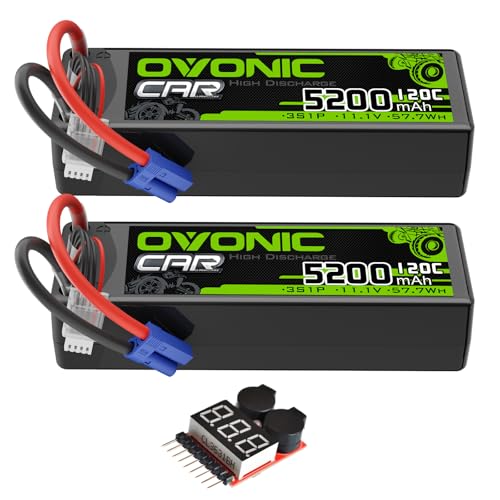
The OVONIC 3S 5200mAh 120C pack suits drivers who want maximum punch and a spare ready to go, because the 2-pack covers two full sessions and the 120C rating delivers the strongest current here. The EC5 connector suits larger 1/8 scale trucks and Arrma models that draw heavy current, and the included voltage checker helps track each pack before and after a run. Two packs in the box mean less waiting between sessions, and the 5200mAh capacity keeps runtimes long. The 120C rating also keeps the power strong across the whole run. It is the pick for powerful trucks where punch matters most.
Specs
- 3S LiPo, 11.1 volts
- 5200mAh capacity
- 120C discharge rate
- EC5 connector
- 2-pack with LiPo voltage checker included
Best for: Maximum punch with a voltage checker for powerful 1/8 scale trucks.
Watch out for: The 120C rating suits powerful brushless setups best, so check the motor before choosing this pack.
ASIN: B0D8SVQRHK
OVONIC 3S 50C 5200mAh Dean T
The OVONIC 3S 50C pack suits drivers whose vehicles use a Dean-style T connector and whose motors do not need a very high discharge rating. Its 50C rating still delivers steady power for 1/8 and 1/10 scale cars, trucks, and boats, and the hard case protects the cells during crashes and transport. At 138 by 46 by 38 millimetres and 368 grams, it fits the standard battery tray on most models in its class. The 368-gram weight also keeps the vehicle balanced on the track. It is the pick for a steady, well-priced pack that matches a Dean connector without adapters.
Specs
- 3S LiPo, 11.1 volts
- 5200mAh capacity
- 50C discharge rate
- Dean-style T connector
- Hard case
- 138 by 46 by 38 mm; 368 grams
Best for: A steady pack with a Dean connector for cars, trucks, and boats.
Watch out for: The 50C rating suits milder motors best, so a very powerful brushless setup may need a higher rating.
ASIN: B07L6221YZ
Which One Fits Your Situation
You Run 1/10 Scale Cars With XT60
Choose the Zeee 3S 5200mAh 80C pack when the car uses an XT60 connector and the motor needs strong punch. The hard case survives rough tracks, and the 80C rating keeps acceleration sharp. It is the simplest choice for a single reliable pack. The XT60 plug fits many popular models without an adapter. It covers long sessions well. A single pack also keeps the setup simple for a driver who runs one car.
You Run a Powerful 1/8 Scale Truck
Choose the OVONIC 3S 120C 2-pack when the truck draws heavy current and the sessions run long. The 120C rating delivers maximum punch, the EC5 connector suits larger models, and the second pack covers the next session. The voltage checker helps track both packs. The 2-pack suits a long day with several runs. It covers two full sessions without a recharge. Two packs also mean less waiting between runs at the track.
Your Vehicle Uses a Dean Connector
Choose the OVONIC 3S 50C Dean T pack when the speed controller carries a Dean-style plug, since a native connector beats any adapter. The 50C rating suits milder motors, and the hard case protects the cells. It is the right pack for a straightforward replacement. A native Dean plug also avoids adapters, so the setup stays simple. The standard size fits most battery trays in its class. A mild setup runs well on 50C.
You Want Spares for Long Sessions
Choose the OVONIC 3S 120C 2-pack when the day involves several runs, since two packs double the driving time without a recharge stop. Charge one pack while running the other, and keep both at storage voltage between sessions. A spare pack turns a short outing into a full afternoon. A second pack also covers a failure, so the day is not cut short. Two packs cover a full afternoon of driving without recharging.
Common Mistakes
- Buying a 3S pack for a vehicle rated for 2S only, then damaging the speed controller and motor beyond all repair.
- Ignoring the connector and ordering a pack that needs an adapter to fit at all on the car itself.
- Choosing too low a C rating for a powerful brushless motor, so the pack sags under load and wears out much faster.
- Storing packs full or empty instead of at storage voltage between sessions, which shortens pack life considerably over time.
- Continuing to use a swollen pack instead of retiring it at once, which risks a fire.
Frequently Asked Questions
What does 3S mean on an RC battery?
3S means the pack holds three lithium-polymer cells in series, giving a nominal voltage of 11.1 volts. The S number counts the cells, so a 2S pack is 7.4 volts and a 4S pack is 14.8 volts. Check the vehicle manual for the highest cell count it accepts, since a higher voltage than rated can damage the speed controller and motor.
How do I know which connector my RC car needs?
Look at the connector on the speed controller, since that is the plug the battery must match. Common types include XT60, EC5, and Dean-style T plugs, and none fits the others without an adapter. Adapters add resistance and a failure point, so buy the pack with the native connector already fitted.
What C rating do I need for my RC car?
The C rating sets how fast the pack can deliver its charge, and a higher figure suits more powerful motors. A mild brushed setup runs well on 50C, while a powerful brushless truck benefits from 80C or 120C. Multiply capacity by the C rating for the maximum current, and match it to what the motor draws under load.
How should I store LiPo batteries?
Store LiPo packs at storage voltage, roughly half charge, in a cool dry place away from flammable materials. A LiPo-safe bag adds protection, and the packs should be checked every few months and brought back to storage voltage if they drift. Never store a pack full or empty for months, and never charge a swollen or damaged pack.
FAQ
What does 3S mean on an RC battery?
How do I know which connector my RC car needs?
What C rating do I need for my RC car?
How should I store LiPo batteries?
More from Amazon
Programs that pair well with the guide above. Offers and eligibility are set by Amazon and may change.
Free shipping on eligible items, Prime Video and more. Eligible new members can start with a free trial.
Start a Prime free trialAudiobooks and podcasts to listen to on the go. Eligible new members can start with a free trial.
Try Audible freeAd-free music streaming. Eligible new subscribers can start with a free trial.
Try Music Unlimited freeA free business account with business pricing and bulk-buying tools for work, shop or home office.
Create a business accountAs an Amazon Associate we earn from qualifying purchases.