Key takeaways
- Compare five budget dehumidifiers by tank size, coverage and noise, from a 16 oz closet mini to a 95 oz unit with sleep mode and auto shut off.
A budget dehumidifier purchase usually comes down to one honest question: is your damp problem a single steamy bathroom, a musty closet or a whole room that never quite dries out? The small machines in this price band collect ounces per day, not pints, so matching the unit to the size of the problem matters far more than any feature list. Buy too small and the tank fills while the walls stay damp; buy with realistic expectations and a compact unit quietly does its job.
This guide is for renters, small-space households, RV owners and anyone fighting condensation or closet mildew without stepping up to a full-size compressor machine. The five picks below were chosen from their Amazon listing titles and stated specifications, spanning 16 oz closet minis, a mid-size 52 oz room unit and a 95 oz model with a sleep mode.
Quick Picks
As an Amazon Associate we earn from qualifying purchases
| Product | Best for | Key spec from title |
|---|---|---|
| TABYIK 35 OZ Dehumidifier (DH-CS01) | Quiet overnight use in small bedrooms | 35 oz tank, 28 dB, auto shut off |
| ToLife Dehumidifier for Home, 95 OZ Tank (TZ-C2) | Bigger single rooms, fewer tank trips | 95 oz tank, up to 1000 sq ft, sleep mode |
| Pro Breeze Premium Electric Mini Dehumidifier, 52 oz | Small rooms that outgrow a mini | 52 oz tank, up to 18 oz collected per day |
| Pro Breeze Electric Mini Dehumidifier, 16 oz (PB-02) | Closets, RVs and tiny bathrooms | 16 oz tank, 1200 cubic feet coverage |
| Eva-Dry EDV-1100 Petite Dehumidifier | Unattended RVs and cabins | 16 oz reservoir, auto shut off and restart |
How to Choose
Match the daily collection rate to your room
Every budget unit states two different numbers, and only one describes how fast it works. Tank size tells you how much water it can hold; the daily collection rate tells you how much it actually pulls from the air. A 16 oz mini that collects a few ounces a day suits a closet, while a damp bedroom needs a model collecting closer to a liter daily. Compare the collection rate first, then check that the tank is big enough to hold at least a day or two of that water.
Know what thermoelectric technology can and cannot do
Nearly every dehumidifier at this price uses a thermoelectric Peltier module instead of a compressor. That keeps the machine small, light and quiet, and it uses very little power, but the trade-off is modest output that falls further as the room gets cooler or drier. These units earn their keep in small, warm, enclosed spaces. A chronically wet basement with standing damp is compressor territory, and no budget mini in this guide pretends otherwise.
Decide how the water leaves the machine
Most budget models rely on a removable tank you carry to a sink, with an auto shut off that stops the fan when the tank fills. A few larger rooms justify hunting for a continuous drain hose connection, which none of the five picks here offer. If the unit will run in a vacation cabin or an RV storage bay, auto shut off matters more than capacity, because nobody is there to empty it. Count how often you are willing to make the sink trip before choosing a tank size.
Weigh noise and placement for sleeping spaces
Manufacturers quote noise figures measured in quiet test rooms, and the numbers still separate the picks usefully. Models rated under 30 dB, or with a dedicated sleep mode, can run in a bedroom without becoming the loudest thing in it. Placement matters as much as the rating: every unit here needs open air around its intake, so a machine shoved against a wall or buried in laundry collects less and sounds louder than its listing suggests.
The 5 Best Options
TABYIK 35 OZ Dehumidifier (DH-CS01)

The TABYIK is the pick for a small bedroom or bathroom where the machine has to run overnight without being heard. Its listing quotes a 28 dB noise level, a seven-color light on its own button so the glow can stay off, and a transparent 35 oz tank with a groove at the base that makes it easy to pull out and empty. The auto shut off stops the unit when the tank reaches roughly 700 to 800 ml and flashes the light red, so a full tank never becomes a puddle.
Specs
- Tank capacity: 35 oz (1000 ml), transparent with a bottom groove for removal
- Collection rate: up to 16 oz per day at 86 degrees Fahrenheit and 80 percent relative humidity
- Coverage: up to 280 sq ft
- Noise: 28 dB
- Size: 5.9 x 5.9 x 10.1 inches, with a built-in rear handle
- Power: about 40 watts, under 1 kWh per day per the listing
Best for: Small bedrooms and bathrooms that need quiet, set-and-forget moisture control.
Watch out for: The collection rate is quoted at 86 degrees Fahrenheit and high humidity, so expect noticeably slower results in a cool room or mild damp.
ToLife Dehumidifier for Home, 95 OZ Tank (TZ-C2)

The ToLife is the step up for a larger single room, built around a 95 oz tank that stretches the time between sink trips well beyond the minis. It uses semiconductor condensation like the rest of this list, but pairs it with two fan speeds and a sleep mode rated under 30 dB, so it can work harder during the day and quiet down at night. A seven-color LED light and auto shut off round out a listing aimed at bedrooms, bathrooms and basement corners.
Specs
- Tank capacity: 95 oz
- Collection rate: up to 1 liter per day
- Coverage: up to 1000 sq ft per the listing
- Noise: sleep mode under 30 dB, two speeds
- Size: 8.27 x 5.55 x 13.78 inches
- Power: 93 watts
Best for: Larger single rooms where a big tank matters more than a tiny footprint.
Watch out for: The 1000 sq ft figure is the maker’s ceiling for a semiconductor unit, so treat this as a strong one-room helper rather than a whole-basement solution.
Pro Breeze Premium Electric Mini Dehumidifier, 52 oz
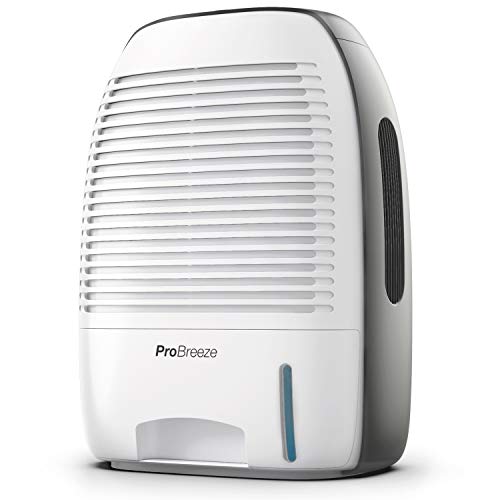
Pro Breeze’s Premium mini is the middle path between the tiny closet units and the ToLife: a 52 oz tank with a stated collection rate of up to 18 oz per day, aimed at small rooms up to 2200 cubic feet. It keeps the thermoelectric design’s usual virtues, quiet running and low power draw, while roughly tripling the tank of its smaller sibling. For a spare bedroom or home office with persistent stuffiness, that extra capacity is the difference between daily and twice-weekly emptying.
Specs
- Tank capacity: 52 oz
- Collection rate: up to 18 oz per day
- Coverage: 2200 cubic feet (250 sq ft)
- Technology: thermoelectric Peltier, no compressor
- Model: PB-13
Best for: Small rooms that have outgrown a 16 oz mini but still need a compact machine.
Watch out for: There is no continuous drain option, so in sticky weather the 52 oz tank is the only path and will need regular emptying.
Pro Breeze Electric Mini Dehumidifier, 16 oz (PB-02)

The original Pro Breeze mini is the closet-and-RV staple of this category: a 16 oz tank, coverage rated at 1200 cubic feet, and a footprint small enough for a wardrobe shelf or a caravan corner. It is the simplest machine here, with thermoelectric cooling, an auto shut off when the tank fills, and nothing in the way of lights or modes to configure. Buy it for a defined small space with light, persistent damp rather than a room with an active moisture problem.
Specs
- Tank capacity: 16 oz
- Coverage: 1200 cubic feet (215 sq ft)
- Technology: thermoelectric Peltier, energy efficient and low noise per the listing
- Auto shut off when the tank is full
- Model: PB-02
Best for: Closets, RVs, garages and tiny bathrooms with light ongoing damp.
Watch out for: The 16 oz tank fills quickly in a steamy bathroom, so place it where emptying it is a small habit, not a chore.
Eva-Dry EDV-1100 Petite Dehumidifier

The EDV-1100 has been the budget category’s quiet constant for years, and its listing still leads on the two numbers that matter for a small room: roughly 33 dB of noise and about 22 watts of power draw. Its signature feature is auto restart, which brings the unit back after a power interruption without anyone pressing a button. That makes it the natural fit for places that sit empty between visits, from RVs to lake cabins to a spare room across the house.
Specs
- Reservoir: 16 oz, removable
- Coverage: up to 122 sq ft (1100 cubic feet)
- Collection: up to 16 oz per week run continuously in warm, humid air
- Noise: about 33 dB
- Power: about 22 watts
- Size: 6.5 x 5 x 11 inches
- Auto shut off when full, with auto restart after power returns
Best for: Unattended spaces like RVs and cabins where the machine must look after itself.
Watch out for: Eva-Dry advises against using it below 50 degrees Fahrenheit or in low humidity, and there is no drain hose, so unheated winter spaces are a poor match.
Which One Fits Your Situation
Your bathroom mirror fogs and stays fogged
A small bathroom is the easiest win in this category, because the space is tiny and the moisture arrives in predictable bursts. The TABYIK fits best here: its 35 oz tank swallows a few days of shower steam, the auto shut off covers a forgotten week, and the transparent tank shows at a glance when it needs emptying.
Your bedroom feels clammy at night
Bedroom damp calls for the quietest machine you can find, running a few feet from the bed. The ToLife’s sleep mode, rated under 30 dB, plus its 95 oz tank make it the pick for overnight duty, while the TABYIK is the alternative if your room is small and you want the lowest quoted noise figure of the group.
Your closet smells musty and clothes feel damp
Closets need the smallest tool, not the strongest. The Pro Breeze 16 oz mini or the Eva-Dry EDV-1100 both tuck onto a shelf and sip moisture steadily; choose the Eva-Dry if the closet is in a space that loses power or sits unchecked, thanks to its auto restart.
Your spare room or basement corner never dries out
Scale your expectations first: a budget semiconductor unit dries a corner, not a floor. The ToLife, with the largest tank and highest daily collection here, is the realistic pick for a basement corner or laundry room, and the Pro Breeze Premium 52 oz is the fallback for a smaller spare room.
Common Mistakes
- Judging a unit by tank size alone, when the daily collection rate decides whether it can keep up with the room at all.
- Expecting a thermoelectric mini to fix a wet basement, a job that calls for a compressor dehumidifier with a drain.
- Placing the unit flush against a wall or inside a closed cabinet, which blocks the intake the listing warns you to keep clear.
- Running a mini in a cold garage or unheated room, where Peltier output collapses and some makers advise against use entirely.
- Ignoring the full tank: a machine that has auto-stopped is collecting nothing, so an oversized tank or a regular emptying routine matters.
Frequently Asked Questions
How long does a budget dehumidifier take to make a difference?
In a small enclosed room, most owners notice less condensation and a fresher smell within several days of continuous running. These machines collect ounces per day, so the change is gradual rather than overnight. A room that still feels damp after two weeks of steady use is telling you the unit is undersized for the space.
Can I leave a small dehumidifier running all the time?
Yes, that is how they are designed to work, and every pick here has an auto shut off that stops the unit when the tank fills. Continuous running is also when the quoted collection rates apply. Just build emptying the tank into a routine, because a stopped machine collects nothing until the tank is emptied.
Why does my dehumidifier collect less water in winter?
Thermoelectric units depend on warm, moist air condensing on a cold plate, so cool or dry rooms give them little to work with. Collection can drop sharply below about 60 degrees Fahrenheit, and Eva-Dry advises against using the EDV-1100 below 50 degrees. Winter damp in an unheated space usually needs a different technology, not a bigger mini.
Is a bigger tank always better?
Only up to the point where it matches the collection rate. A large tank on a slow unit just means heavier lifts to the sink, while a small tank on a fast unit means constant emptying. The balanced buys here pair roughly two to four days of collection with the tank, which is the rhythm most households can keep.
FAQ
How long does a budget dehumidifier take to make a difference?
Can I leave a small dehumidifier running all the time?
Why does my dehumidifier collect less water in winter?
Is a bigger tank always better?
More from Amazon
Programs that pair well with the guide above. Offers and eligibility are set by Amazon and may change.
Free shipping on eligible items, Prime Video and more. Eligible new members can start with a free trial.
Start a Prime free trialAudiobooks and podcasts to listen to on the go. Eligible new members can start with a free trial.
Try Audible freeAd-free music streaming. Eligible new subscribers can start with a free trial.
Try Music Unlimited freeA free business account with business pricing and bulk-buying tools for work, shop or home office.
Create a business accountAs an Amazon Associate we earn from qualifying purchases.