Our Short List of 3

- Best for: Homeowners mounting TVs, cabinets and heavy shelves who want the stud’s edges and center in one pass.
- Brand: Franklin Sensors
- Sensors: 13, with LED display of full stud width and center
- Scan depth: up to 1.7 inches, deep scan always on
- Detects: wood and metal studs, plus live wire detection

- Best for: Renters and apartment dwellers who want multi-sensor accuracy in a compact, drawer-friendly body.
- Brand: Franklin Sensors
- Model: ProSensor M150, also sold as X990
- Sensors: 9, with LED full-width display and green center LED
- Scan depth: up to 1.5 inches, deep scan always on

- Best for: DIYers who want distinct stud, metal and wire modes and a pointer that marks the spot for them.
- Brand: Zircon
- Model: HD55
- Modes: Stud Scan, DeepScan, Metal Scan and AC Scan
- Scan depth: studs to 0.75 inch in Stud Scan, 1.5 inches in DeepScan
All 5 Picks at a Glance
| Product | Specs | Action |
|---|---|---|
| Franklin Sensors ProSensor M210 |
| Check price on Amazon |
| Franklin Sensors ProSensor M150 |
| Check price on Amazon |
| Zircon StudSensor HD55 |
| Check price on Amazon |
 C.H. Hanson 03040 Magnetic Stud Finder |
| Check price on Amazon |
 Tavool Stud Finder Wall Scanner TH250 |
| Check price on Amazon |
Key takeaways
- Compare the best stud finders for budget home projects, from multi-sensor scanners to a battery-free magnet, with scan depths, modes and wire warnings.
A stud finder earns its keep the first time a TV bracket, a loaded shelf or a bathroom cabinet has to hang on something stronger than drywall. The real decision is not which finder costs the least, but which detection style matches your walls: a wide multi-sensor head that maps the whole stud at once, a single-sensor scanner you calibrate and sweep, or a simple magnet that finds the screws already sitting in the framing.
This guide serves renters hanging their first shelves, homeowners mounting TVs and cabinets, and DIYers who want a backup finder in the kitchen drawer. Every pick below is a stud finder sold on Amazon, chosen from its listing title and stated specs: sensor count, scan depth, detection modes and power source.
Quick Picks
As an Amazon Associate we earn from qualifying purchases
| Product | Best for | Key spec from title |
|---|---|---|
| Franklin Sensors ProSensor M210 | Seeing the full stud width before drilling | 13 sensors, scan depth up to 1.7 inches |
| Franklin Sensors ProSensor M150 | A compact multi-sensor finder for smaller jobs | 9 sensors, scan depth up to 1.5 inches |
| Zircon StudSensor HD55 | Separate modes for studs, metal and live wire | 4-mode multiscanner, metal scan to 3 inches |
| C.H. Hanson 03040 Magnetic Stud Finder | A battery-free backup that lives in a drawer | Rare-earth magnets, no batteries needed |
| Tavool Stud Finder Wall Scanner TH250 | A low-cost LCD scanner with four modes | 4-in-1 detection, deep scan to 1.5 inches |
How to Choose
Multi-Sensor Heads Versus Single-Sensor Scanners
A multi-sensor finder carries a row of sensors across a wide pad, so one pass lights up the stud’s edges and center together and there is no calibration step. A single-sensor scanner reads one point at a time: you calibrate it on a blank patch of wall, then sweep slowly and mark each edge as the signal peaks. The wide heads cost more but remove most of the guesswork, while the single-sensor tools reward a slow, careful sweep and punish a rushed one.
Scan Depth and Wall Build-Up
Standard mode on most electronic finders reads through about three quarters of an inch, enough for a single layer of drywall. Double drywall, wood paneling over plaster, or tile backer board calls for a deep scan mode rated to 1.5 inches or beyond. Check the stated depth for the mode you will actually use, because the headline number on a box is usually the deepest mode, not the everyday one. Thick plaster and lath still defeat most capacitive sensors at any depth.
Wire and Metal Warnings
A live-wire warning tells you a powered cable is near before the drill goes in, and it is the feature worth prioritizing if you hang things near outlets, switches or ceiling lights. Metal scan modes go further and locate pipes, conduit and metal studs at greater depths than stud modes reach. Magnetic finders offer neither warning: they only pull toward steel fasteners. Whatever you choose, treat every reading near plumbing as a prompt to scan again from the opposite direction.
Power Source and Everyday Practicality
Finders run on AA, AAA or 9-volt batteries, and the battery is rarely in the box, so check the listing before the tool arrives mid-project. One Franklin model in this guide states plainly that it rejects rechargeable cells, which matters if your drawer only holds rechargeables. A magnetic finder sidesteps the question entirely with no power at all. Size matters too: a wide 13-sensor head maps walls fast but will not fit between closely spaced shelves or inside a cabinet carcass.
The 5 Best Options
Franklin Sensors ProSensor M210
- Best for: Homeowners mounting TVs, cabinets and heavy shelves who want the stud’s edges and center in one pass.
- Brand: Franklin Sensors
- Sensors: 13, with LED display of full stud width and center
- Scan depth: up to 1.7 inches, deep scan always on
- Detects: wood and metal studs, plus live wire detection
Homeowners mounting TVs, cabinets and heavy shelves who want the stud’s edges and center in one pass.
The wide head can read a dense copper pipe as framing, so cross-check any reading near plumbing, and note the AA batteries are not in the box.
The M210 is the pick for anyone who has ever marked a stud edge wrong and drilled into a void. Its 13 sensors read a wide patch of wall in a single pass and light up the stud’s full width, with a green LED at the center, so the mark you make is the mark you drill. There is no calibration routine, deep scan is always on, and a live-wire meter warns over powered cables. A built-in bubble level and pencil caddy keep the follow-up work in the same hand.
Franklin Sensors ProSensor M150
- Best for: Renters and apartment dwellers who want multi-sensor accuracy in a compact, drawer-friendly body.
- Brand: Franklin Sensors
- Model: ProSensor M150, also sold as X990
- Sensors: 9, with LED full-width display and green center LED
- Scan depth: up to 1.5 inches, deep scan always on
Renters and apartment dwellers who want multi-sensor accuracy in a compact, drawer-friendly body.
The listing states this model is not compatible with rechargeable batteries, so keep a pack of standard AAA cells with it.
The M150 keeps the same full-width idea in a smaller body, with 9 sensors instead of 13 and a scan depth of 1.5 inches. It still shows both edges and the center on its LED bar, still needs no calibration, and still includes live-wire detection, which makes it the natural step down for apartments and smaller hanging jobs where the M210 feels oversized. At just over five ounces it rides in a tool belt or drawer without complaint, and it is also sold under the X990 name on the same listing family.
Zircon StudSensor HD55
- Best for: DIYers who want distinct stud, metal and wire modes and a pointer that marks the spot for them.
- Brand: Zircon
- Model: HD55
- Modes: Stud Scan, DeepScan, Metal Scan and AC Scan
- Scan depth: studs to 0.75 inch in Stud Scan, 1.5 inches in DeepScan
DIYers who want distinct stud, metal and wire modes and a pointer that marks the spot for them.
It needs a 9-volt battery that is not included, and it must be calibrated on a blank section of wall before each scan or readings drift.
The HD55 is a four-mode multiscanner for buyers who want one tool that separates its jobs instead of blending them. Stud Scan reads to three quarters of an inch, DeepScan reaches 1.5 inches for thicker walls, Metal Scan reaches 3 inches, and AC Scan flags live, unshielded wire to 2 inches. A backlit display and the SpotLite pointer, which throws an illuminated arrow onto the wall at the stud edge, make the readings easy to mark in dim rooms and closets.
C.H. Hanson 03040 Magnetic Stud Finder
- Best for: A battery-free backup for the kitchen drawer, and for plaster or textured walls that confuse electronic finders.
- Brand: C.H. Hanson
- Model: 03040, model number 03040A on the listing
- Type: magnetic stud finder, rare-earth magnets
- Detects: metal fasteners in wood and metal studs
A battery-free backup for the kitchen drawer, and for plaster or textured walls that confuse electronic finders.
It finds fasteners, not the stud itself, so walls built with adhesive or few screws give it little to grab, and it offers no wire or pipe warning.
The 03040 is the oldest idea in this guide and still one of the most reliable: a pocket block of rare-earth magnets that pulls toward the screws and nails fastening drywall to the studs. When it finds a fastener it sticks to the wall on its own, leaving both hands free to mark or check level with the built-in two-way bubble level. There are no batteries, no calibration and no electronics to fail, which is why so many people keep one as the finder that verifies what an electronic scanner claims.
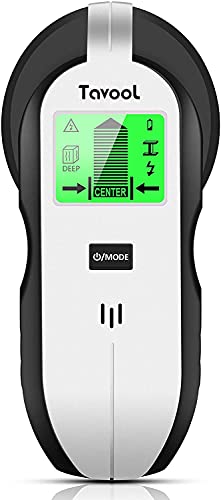
Tavool Stud Finder Wall Scanner TH250
- Best for: First-time buyers and occasional DIYers who want an LCD scanner with wire detection on a tight budget.
- Brand: Tavool
- Model: TH250
- Modes: stud scan, deep scan, metal scan and AC scan
- Scan depth: deep scan up to 1.5 inches
First-time buyers and occasional DIYers who want an LCD scanner with wire detection on a tight budget.
Deep-scan readings on budget scanners can be inconsistent, so sweep slowly, scan from both directions, and confirm the center before drilling.
The TH250 is the budget electronic option: a 4-in-1 scanner with an LCD screen at the lowest cost of entry in this guide. Its four modes cover stud scan, a deep scan rated to 1.5 inches, metal scan, and AC wire detection to 2 inches, with auto calibration and an audio alarm when it locks onto a target. For occasional picture hanging, a first apartment toolkit or a spare scanner for the garage, that feature list covers the jobs most households actually face without paying for a pro-grade head.
Which One Fits Your Situation
Mounting a TV or Heavy Shelves
Reach for the ProSensor M210. A bracket needs two solid studs and fasteners near the center of each, and the M210 shows the full width of every stud it crosses, so you can space the bracket holes with confidence. Its live-wire meter is the safety net you want on the wall where the TV’s outlet and cables already live.
Working in a Small Apartment
The ProSensor M150 fits this life better. It delivers the same full-width readout and wire warning in a body that stores in a drawer and runs on AAA cells. For picture ledges, mirrors and a single shelf run, its 1.5-inch depth covers standard apartment drywall without paying for the bigger head.
Older Walls and Mixed Materials
Start with the Zircon HD55, whose separate metal and AC modes help sort out what an older wall is hiding. Where plaster and lath blunt its readings entirely, switch to the C.H. Hanson magnet: it ignores the wall material and reads the fasteners themselves, which is often the only honest signal an old wall gives.
Building a First Toolkit on a Budget
Take the Tavool TH250 as the scanner and add the C.H. Hanson 03040 when you can. The Tavool covers everyday stud, metal and wire checks with a clear screen, and the magnet gives you a battery-free way to confirm its readings. Together they cost less than most single pro finders and cover each other’s blind spots.
Common Mistakes
- Drilling on the first beep instead of marking both stud edges and confirming the center.
- Calibrating an electronic finder while it sits over a stud, which throws off every reading that follows.
- Trusting a magnetic finder’s pull as proof of a stud without checking for a second fastener on the same line.
- Skipping the wire scan because the stud reading looked clean, especially near outlets and switches.
- Buying on the deepest headline depth while your everyday mode reads far shallower.
Frequently Asked Questions
Do I need to calibrate a stud finder before every use?
Single-sensor scanners like the Zircon HD55 and the Tavool TH250 do need calibration on a blank patch of wall before each session, and skipping it is the most common cause of false readings. Multi-sensor finders such as the Franklin M210 and M150 skip calibration entirely, because their sensor rows compare readings across the pad instead of relying on one baseline point.
Can a stud finder detect wires and pipes as well as studs?
Most electronic models here include a live AC wire warning, and scanners with a dedicated metal mode, like the HD55 and the TH250, also locate metal pipes and conduit. No stud finder detects plastic pipe, and a magnetic finder detects none of these hazards at all, which is why a wire scan belongs in every drilling routine regardless of the tool.
Why does my finder give different readings on plaster walls?
Plaster and lath vary in density from inch to inch, and capacitive sensors read those changes as possible studs, so readings wander. Deep scan modes help on some plaster walls, but the dependable fallback is a magnetic finder like the C.H. Hanson 03040, which reads the screws and nails in the framing rather than the wall material itself.
How deep does a stud finder need to scan?
A single layer of drywall over studs needs only about three quarters of an inch of scan depth. Double drywall, paneling or tile backer pushes the requirement to 1.5 inches, which is why deep scan modes exist. Anything thicker, such as plaster over masonry, sits beyond what the finders in this guide promise, and a small probe hole becomes the honest check.
FAQ
Do I need to calibrate a stud finder before every use?
Can a stud finder detect wires and pipes as well as studs?
Why does my finder give different readings on plaster walls?
How deep does a stud finder need to scan?
More from Amazon
Programs that pair well with the guide above. Offers and eligibility are set by Amazon and may change.
Free shipping on eligible items, Prime Video and more. Eligible new members can start with a free trial.
Start a Prime free trialAudiobooks and podcasts to listen to on the go. Eligible new members can start with a free trial.
Try Audible freeAd-free music streaming. Eligible new subscribers can start with a free trial.
Try Music Unlimited freeA free business account with business pricing and bulk-buying tools for work, shop or home office.
Create a business accountAs an Amazon Associate we earn from qualifying purchases.