Our Short List of 3

- Best for: Replacing every hardwired alarm in a house at once without paying single-unit prices five times over.
- Sensor type: ionization
- Power source: 120V AC hardwired with 9V battery backup, battery included
- Alarm loudness: 85 decibels
- Interconnect: up to 12 compatible alarms plus 6 compatible devices
- Best for: Apartments, rentals, and single rooms where a set-and-forget alarm matters more than interconnect features.
- Model number: i9010
- Sensor type: ionization
- Power source: sealed 10-year lithium battery, no wiring required
- Indicators: LED status lights with end-of-life replacement alert

- Best for: Households that want a modern sealed-battery alarm whose status can be checked from across the room.
- Model number: 20SD10
- Power source: built-in 10-year battery
- Alarm loudness: 85 decibels
- Indicators: LED status lights for power, fault, and alarm states
All 4 Picks at a Glance
| Product | Specs | Action |
|---|---|---|
| First Alert 9120B Smoke Detector, Hardwired Alarm with Battery Backup, 5 Pack |
| Check price on Amazon |
| Kidde Smoke Detector, 10-Year Battery, LED Indicators, Replacement Alert, Test-Reset Button |
| Check price on Amazon |
| Kidde Smoke Detector, 10-Year Battery Powered, with LED Status Lights, 85 dB Alarm, 20SD10 |
| Check price on Amazon |
 Kidde Smoke & Carbon Monoxide Detector, 10-Year Battery, Voice Alerts, P3010CU |
| Check price on Amazon |
Key takeaways
- Compare five budget smoke detectors with sealed 10-year batteries, hardwired interconnect options and smoke and CO combo models from First Alert and Kidde.
Replacing a house full of aging smoke alarms can look expensive until you separate what actually drives the cost: the power source, the sensor type, and whether one unit also watches for carbon monoxide. A basic battery alarm for a hallway and an interconnected hardwired unit for a three-story home solve different problems, and paying for the wrong one wastes money in both directions.
This guide is for renters adding a first alarm, landlords covering several units at once, and homeowners replacing expired detectors without overspending on features they will never use. Each pick comes from current Amazon listings by First Alert and Kidde, chosen for stated sensor type, battery arrangement, pack size, and listed safety standards rather than brand extras or app add-ons.
Quick Picks
As an Amazon Associate we earn from qualifying purchases
| Product | Best for | Key spec from title |
|---|---|---|
| First Alert 9120B Hardwired Smoke Alarm, 5 Pack | Whole-house hardwired replacement on a budget | 120V hardwired with 9V battery backup |
| Kidde i9010 Smoke Detector | Renters who want zero battery changes | Sealed 10-year lithium battery |
| Kidde 20SD10 Smoke Detector | Bedrooms that need clear status lights | 10-year battery with LED status lights |
| Kidde P3010CU Smoke and CO Detector | One unit covering two hazards | Smoke and carbon monoxide with voice alerts |
| First Alert SC9120B Smoke and CO Detector | Hardwired combo protection | 120V hardwired combo with battery backup |
How to Choose
Pick the Power Source That Matches Your Wiring
Battery-powered alarms mount anywhere with two screws and suit renters, older homes without alarm wiring, and quick single-room additions. Hardwired models draw 120V power from the ceiling circuit and keep a backup battery for outages, which fits homes that already have wired alarm boxes. Choosing wrong here is the most common budget mistake: a hardwired alarm is useless in a rental where you cannot open the ceiling circuit, while a battery unit in a wired home leaves the interconnect feature you already paid for unused.
Decide Between Ionization and Photoelectric Sensors
Ionization sensors react quickly to fast-flaming fires with small particles, while photoelectric sensors respond sooner to slow, smoldering fires and tend to trigger fewer nuisance alarms near kitchens and bathrooms. Many building codes and fire departments suggest covering both fire types across a home, so a mixed layout is a sensible budget strategy. Read each listing for its stated sensor type before ordering, because two alarms that look identical on the shelf can use different sensing technology inside the same housing.
Count the Real Cost Over the Alarm’s Life
A sealed 10-year battery alarm costs more upfront than a basic 9V model, yet it removes a decade of replacement batteries and the low-battery chirps that come with them. Multipacks lower the per-unit cost when several rooms need alarms at once, which matters for landlords and anyone replacing a full set after the 10-year replacement date printed on old units. Compare pack size and battery type together rather than judging a single sticker figure, since the cheapest single alarm can become the priciest option once spare batteries enter the math.
Check Interconnect and Standards Before You Buy
Interconnected alarms all sound when one unit detects smoke, so an alarm in the basement can wake sleepers two floors up. Hardwired First Alert and Kidde models state how many units they can link, and that number decides whether the set covers your floor plan. Also confirm the listing names a recognized standard such as UL 217 and check the manufacture date policy where the listing states one, because an alarm’s service life runs from installation and local codes often set placement rules by room.
The 5 Best Options
First Alert 9120B Smoke Detector, Hardwired Alarm with Battery Backup, 5 Pack
- Best for: Replacing every hardwired alarm in a house at once without paying single-unit prices five times over.
- Sensor type: ionization
- Power source: 120V AC hardwired with 9V battery backup, battery included
- Alarm loudness: 85 decibels
- Interconnect: up to 12 compatible alarms plus 6 compatible devices
Replacing every hardwired alarm in a house at once without paying single-unit prices five times over.
Confirm your ceiling boxes carry a three-wire interconnect circuit before ordering, and note the listing crawl showed conflicting featured-offer signals, so check the current seller and offer on the page.
This five-pack suits homeowners replacing a full set of wired alarms in one weekend, since each unit connects to the same 120V circuit style used by older BRK and First Alert boxes. The ionization sensor targets fast-flaming fires, the 9V backup keeps watch during outages, and units can interconnect so one trigger sounds the rest. Buying the detectors as a matched set also keeps mounting brackets and connectors consistent across every ceiling in the house.
Watch out for: Confirm your ceiling boxes carry a three-wire interconnect circuit before ordering, and note the listing crawl showed conflicting featured-offer signals, so check the current seller and offer on the page.
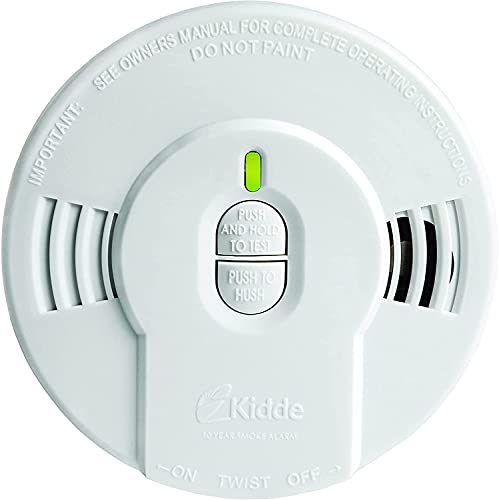
Kidde Smoke Detector, 10-Year Battery, LED Indicators, Replacement Alert, Test-Reset Button
- Best for: Apartments, rentals, and single rooms where a set-and-forget alarm matters more than interconnect features.
- Model number: i9010
- Sensor type: ionization
- Power source: sealed 10-year lithium battery, no wiring required
- Indicators: LED status lights with end-of-life replacement alert
Apartments, rentals, and single rooms where a set-and-forget alarm matters more than interconnect features.
Because the battery is sealed, the whole unit is replaced at end of life; write the install date on the alarm so the replacement year is never a guess.
The i9010 is the low-effort pick for renters and anyone tired of the 2 a.m. low-battery chirp. Its sealed lithium battery is built to power the alarm for its full 10-year service life, so there is nothing to swap and no wiring to run. An ionization sensor watches for flaming fires, LED indicators show status at a glance, and the unit signals when it reaches end of life and needs replacing rather than going silent unnoticed on the ceiling.
Watch out for: Because the battery is sealed, the whole unit is replaced at end of life; write the install date on the alarm so the replacement year is never a guess.
Kidde Smoke Detector, 10-Year Battery Powered, with LED Status Lights, 85 dB Alarm, 20SD10
- Best for: Households that want a modern sealed-battery alarm whose status can be checked from across the room.
- Model number: 20SD10
- Power source: built-in 10-year battery
- Alarm loudness: 85 decibels
- Indicators: LED status lights for power, fault, and alarm states
Households that want a modern sealed-battery alarm whose status can be checked from across the room.
This is a standalone battery unit with no interconnect, so a multi-story home needs one per level and will not get whole-house sounding from a single trigger.
Kidde’s 20SD10 keeps the sealed 10-year battery format and adds a clearer status display, which helps in bedrooms and hallways where a quick glance should confirm the alarm is working. Colored LED lights distinguish normal operation from a fault or an alarm event, and the 85 dB sounder matches the output expected of residential units. At five inches across it covers the footprint of most older round alarms, making it a tidy one-for-one swap when dated detectors come down.
Watch out for: This is a standalone battery unit with no interconnect, so a multi-story home needs one per level and will not get whole-house sounding from a single trigger.
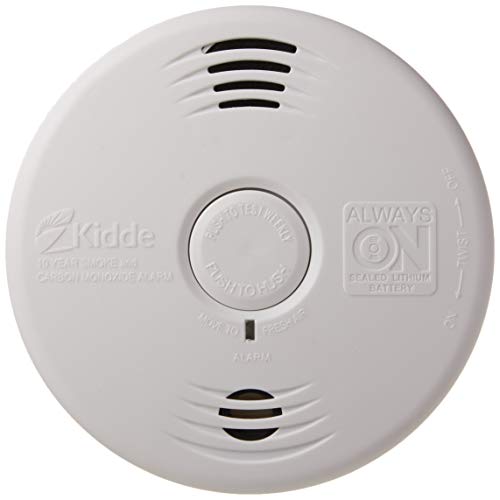
Kidde Smoke & Carbon Monoxide Detector, 10-Year Battery, Voice Alerts, P3010CU
- Best for: Homes with gas furnaces, water heaters, or attached garages that need smoke and CO detection in one unit.
- Model number: P3010CU
- Sensor types: photoelectric for smoke, electrochemical for carbon monoxide
- Power source: sealed 10-year lithium battery
- Alerts: voice announcements plus 85 decibel alarm and flashing red LED
Homes with gas furnaces, water heaters, or attached garages that need smoke and CO detection in one unit.
Place it following the listing guidance for CO placement, since carbon monoxide coverage depends on room choice and mounting height, not just on owning a combo unit.
One ceiling spot can cover two hazards with this combination unit, which pairs a photoelectric smoke sensor with an electrochemical carbon monoxide sensor. Instead of a tone alone, voice alerts announce whether the event is smoke, fire, or carbon monoxide, which shortens the guesswork when an alarm sounds at night. The sealed 10-year lithium battery powers both sensors, and a flashing red LED backs up the voice warning. It fits homes with fuel-burning appliances that need CO coverage without new wiring.
Watch out for: Place it following the listing guidance for CO placement, since carbon monoxide coverage depends on room choice and mounting height, not just on owning a combo unit.
First Alert BRK SC9120B Hardwired Smoke and Carbon Monoxide Detector with Battery Backup
For wired homes that also need carbon monoxide detection, the SC9120B combines an ionization smoke sensor and an electrochemical CO sensor in a hardwired unit with a 9V battery backup. A single button handles test and silence functions, the latching indicator shows which unit in an interconnected chain started the alarm, and an end-of-life signal tells you when the detector itself is due for replacement. The mounting bracket design allows battery changes while the unit stays on the ceiling.
Specs
- Model number: SC9120B
- Sensor types: ionization for smoke, electrochemical for carbon monoxide
- Power source: 120V AC hardwired with 9V battery backup, battery included
- Controls: single-button test and silence
- Indicators: latching alarm indicator and end-of-life signal
- Interconnect: links with compatible BRK and First Alert hardwired alarms
Best for: Wired homes adding carbon monoxide coverage to bedrooms and hallways without separate CO alarms.
Watch out for: The listing information dates from an older crawl, so confirm the current offer, pack configuration, and warranty terms on the product page before ordering.
Which One Fits Your Situation
You Rent and Cannot Touch the Wiring
Choose a sealed-battery model and mount it with the included bracket. The Kidde i9010 covers a single room with no battery changes for its service life, while the 20SD10 adds clearer LED status lights for bedrooms. Both install in minutes, leave no wiring behind when you move, and avoid the chirping that comes with replaceable 9V cells near the end of their charge.
You Own a Home With Wired Alarm Boxes
Match the hardwired format already in your ceilings. The First Alert 9120B five-pack refreshes a whole house with interconnect intact, and the SC9120B adds carbon monoxide sensing on the same circuit. Keeping one brand family across the chain preserves the interconnect count stated in the listings and simplifies future replacements, since brackets and harnesses stay consistent from room to room.
Your Home Burns Gas, Oil, or Wood
Fuel-burning appliances and attached garages make carbon monoxide coverage as relevant as smoke coverage. The Kidde P3010CU handles both in a battery unit that needs no wiring, while the hardwired SC9120B suits homes with existing alarm circuits. Voice alerts on the Kidde help occupants identify the hazard type quickly, which matters when the correct response differs between smoke and carbon monoxide events.
You Manage Several Rental Units
Standardizing on one sealed-battery model across units cuts maintenance visits, because there are no tenant battery swaps to track. The Kidde i9010’s end-of-life alert flags replacements during routine inspections, and multipack hardwired options like the 9120B set lower per-unit costs in wired buildings. Keep a simple log of install dates per unit so the 10-year replacement cycle stays predictable across the whole property.
Common Mistakes
- Buying hardwired alarms for a home with no alarm wiring, then leaving them in the box when installation stalls.
- Mixing sensor types by accident instead of on purpose, ending up with five identical alarms and a coverage gap for smoldering fires.
- Judging cost by the single-unit figure while ignoring a decade of replacement batteries for 9V models.
- Installing every alarm near the kitchen, where cooking fumes trigger nuisance alarms that tempt people to remove the battery.
- Forgetting that alarms expire; a detector past its service life can look fine while its sensor no longer meets its stated standard.
Frequently Asked Questions
How many smoke detectors does a home actually need?
Most guidance calls for alarms inside every bedroom, outside each sleeping area, and on every level of the home, including the basement. Exact requirements come from your local code, so count rooms and levels first, then size the pack or combination of models to that count rather than buying a single alarm for the whole house.
Is a sealed 10-year battery worth it on a budget?
For many households, yes. The sealed battery removes replacement cells for the alarm’s whole service life and ends low-battery chirps, which are a common reason alarms get disabled. Listings for models like the Kidde i9010 note the savings versus repeated battery purchases, and the convenience suits rentals where access for battery changes is limited.
Can I mix hardwired and battery alarms in one house?
Yes, and many homes do. Hardwired units cover the wired locations and keep their interconnect, while battery models fill rooms the circuit never reached. Just remember the two groups will not sound together unless the listing states a shared interconnect feature, so treat battery additions as independent coverage for their own rooms.
When should a smoke detector be replaced?
Replace the whole alarm at the end of its stated service life, typically 10 years from manufacture or installation depending on the model, or sooner if it fails its test button check. Sealed-battery models signal end of life with an alert. Check the date printed on each existing unit before assuming a working test tone means the sensor is still within spec.
FAQ
How many smoke detectors does a home actually need?
Is a sealed 10-year battery worth it on a budget?
Can I mix hardwired and battery alarms in one house?
When should a smoke detector be replaced?
More from Amazon
Programs that pair well with the guide above. Offers and eligibility are set by Amazon and may change.
Free shipping on eligible items, Prime Video and more. Eligible new members can start with a free trial.
Start a Prime free trialAudiobooks and podcasts to listen to on the go. Eligible new members can start with a free trial.
Try Audible freeAd-free music streaming. Eligible new subscribers can start with a free trial.
Try Music Unlimited freeA free business account with business pricing and bulk-buying tools for work, shop or home office.
Create a business accountAs an Amazon Associate we earn from qualifying purchases.