Key takeaways
- Material: Silver-plated nickel silver is normal for student flutes. Solid silver is substantially more expensive and is not necessary for a first instrument.
- Headjoint response: A beginner-friendly headjoint should produce notes without excessive force. If the player must blow hard to make a sound, adjustment or fit may be the problem.
- C foot: A C-foot flute has a practical student range and is usually lighter, less expensive, and easier to maintain than a B-foot model.
- Key alignment: Keys should move smoothly, return promptly, and sit evenly when closed. Bent rods or sluggish keys are warning signs on a used instrument.
- Case protection: Look for a shaped interior, secure latches, and enough room for the flute without forcing the joints together.
- Service access: Confirm who will adjust the flute, whether parts are available locally, and what the warranty excludes.
The best flutes for beginners are usually closed-hole, silver-plated student models with an offset G key, a C foot, reliable adjustment, and a practical warranty; the Yamaha YFL-222, Jupiter JFL700RE, Pearl PF-505, Gemeinhardt 2SP, and Trevor James 10X are strong choices for different budgets and hand positions.
Our top picks


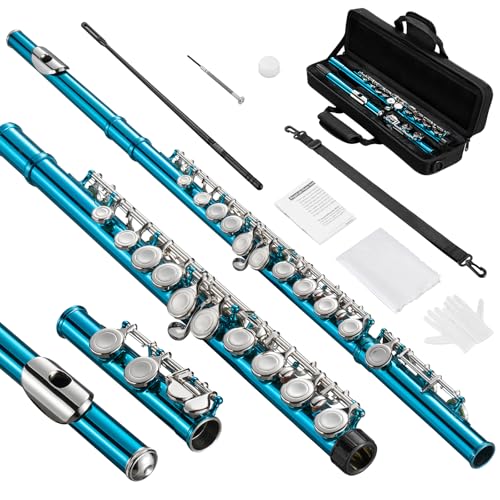
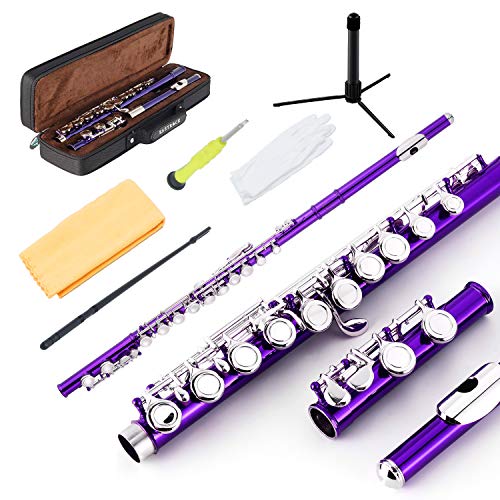
As an Amazon Associate we earn from qualifying purchases at no extra cost to you. Ratings are shown as listed on Amazon.
Best flutes for beginners at a glance
| Model or type | Beginner-friendly features | Typical new-price range in 2026 | Best for |
|---|---|---|---|
| Yamaha YFL-222 | Closed holes, offset G, C foot, silver-plated body and keys | $650–$850 | A dependable long-term student instrument |
| Jupiter JFL700RE | Closed holes, offset G, C foot, silver-plated construction | $550–$750 | Players wanting comfortable ergonomics and good value |
| Pearl PF-505 | Closed holes, offset G, C foot, student-focused headjoint design | $600–$850 | A beginner who may continue into school ensembles |
| Gemeinhardt 2SP | Closed holes, offset G, C foot, established student layout | $500–$750 | Traditional band-program requirements |
| Trevor James 10X | Closed holes, offset G, C foot, lightweight student design | $550–$800 | A first-time player prioritizing easy handling |
| Open-hole intermediate flute | Five open keys, often inline G, sometimes B foot | $900–$2,000+ | A learner with teacher guidance and a clear upgrade plan |
Prices vary with country, finish, case, tax, and whether the flute is sold new or reconditioned. A properly serviced used flute from a reputable repair shop can be a better purchase than a new instrument with poor key adjustment.
Our top picks by beginner situation
Best all-round choice: Yamaha YFL-222
The Yamaha YFL-222 is a sensible default when reliability matters more than finding the lowest price. Its closed-hole plateau keys remove the need to seal five open tone holes with the fingertips, while the offset G key places the left-hand G mechanism slightly nearer the natural reach of many beginners. The C foot keeps the instrument simpler and lighter than a B-foot model.
Yamaha’s student flutes are widely recognized by school music programs and repair technicians, which can make replacement parts and servicing easier to arrange. Choose it when the player expects to practice several times a week and you want an instrument that will not need replacing immediately after the first year.
Best value-focused alternative: Jupiter JFL700RE
The Jupiter JFL700RE offers the conventional beginner specification without adding features that increase cost or complexity: closed holes, offset G, a C foot, and silver-plated construction. It is a good fit for a student whose hand position benefits from an offset G but whose budget does not stretch to the highest-priced major-brand option.
Before buying, confirm that the seller includes an initial adjustment or return period. A flute’s playability depends heavily on pad seating and key regulation, so two nominally identical instruments can feel different if one has been stored or transported poorly.
Best for a school-band pathway: Pearl PF-505
The Pearl PF-505 is aimed at students who want a conventional beginner flute but may continue into more serious ensemble playing. Its closed-hole design is forgiving during the first months, and Pearl’s student instruments are known for using construction features intended to support consistent alignment and response.
It is worth comparing the included case and cleaning accessories rather than judging only the instrument price. A sturdy case, cleaning rod, and correctly sized swab reduce the chance of damage and may save an immediate accessory purchase.
Best traditional classroom option: Gemeinhardt 2SP
The Gemeinhardt 2SP has long been associated with entry-level school and community-band use. Its familiar closed-hole, offset-G layout is easy for teachers and repairers to work with. It is especially worth considering when a local music teacher or repair shop already supports Gemeinhardt instruments.
Availability can vary by region, so local service should be part of the decision. A nearby technician who can perform seasonal adjustments may be more valuable than a modest difference in advertised price.
Best lightweight-feeling option: Trevor James 10X
The Trevor James 10X is designed around the needs of new players, including a closed-hole layout and offset G. It can suit younger learners who find a standard flute tiring to hold, although physical fit still matters more than the brand name. An adult should check that the student can reach the keys without collapsing the wrists or squeezing the instrument.
Closed holes versus open holes
Closed-hole, also called plateau-key, flutes have solid key cups. The player presses each key and does not need to cover a hole directly with a fingertip. This makes them the safest starting point for most beginners because small gaps in finger placement are less likely to produce weak or unstable notes.
Open-hole, or French-style, flutes have five keys with holes in their centers. They can support techniques such as certain alternate fingerings and quarter-tone effects, but they demand more precise finger placement. Many open-hole flutes include removable plugs, allowing a learner to begin with the holes closed and remove the plugs later.
Open holes are not automatically better for a beginner. They are more useful when a teacher specifically requires them, when the player has a clear intermediate-level plan, or when the learner already has strong finger control. For a first flute, closed holes generally deliver a shorter learning curve and fewer avoidable leaks.
Why offset G matters
An offset G key is positioned slightly toward the player instead of lining up perfectly with the other left-hand keys. This can reduce stretching for smaller hands and may allow a more relaxed wrist. Inline G is not wrong, but it can feel less comfortable for some beginners, particularly younger players.
Hand size is individual, so treat offset G as a fitting preference rather than a quality ranking. The player should be able to press the G and adjacent keys with curved fingers, relaxed shoulders, and no need to rotate the wrist sharply. A teacher can identify poor fit before it becomes a habit.
What to look for beyond the brand
- Material: Silver-plated nickel silver is normal for student flutes. Solid silver is substantially more expensive and is not necessary for a first instrument.
- Headjoint response: A beginner-friendly headjoint should produce notes without excessive force. If the player must blow hard to make a sound, adjustment or fit may be the problem.
- C foot: A C-foot flute has a practical student range and is usually lighter, less expensive, and easier to maintain than a B-foot model.
- Key alignment: Keys should move smoothly, return promptly, and sit evenly when closed. Bent rods or sluggish keys are warning signs on a used instrument.
- Case protection: Look for a shaped interior, secure latches, and enough room for the flute without forcing the joints together.
- Service access: Confirm who will adjust the flute, whether parts are available locally, and what the warranty excludes.
Decision matrix for choosing a first flute
| Your situation | Recommended direction | Reason |
|---|---|---|
| Lowest sensible cost | Serviced used closed-hole student flute | Condition and adjustment matter more than cosmetic age |
| Practicing 4–7 days per week | Yamaha, Jupiter, Pearl, Gemeinhardt, or Trevor James student model | Better support for regular use and future repairs |
| Small hands or uncomfortable reach | Offset G, closed holes, teacher-assisted fitting | Reduces unnecessary stretching and finger leaks |
| Teacher requires open holes | Open-hole flute with plugs, if budget allows | Provides a gradual transition to open-key technique |
| Occasional playing only | Reliable used student flute or rental | Avoids paying for advanced features that will remain unused |
Setup and maintenance that protect the purchase
Assemble the flute by holding the joints by their solid metal sections, not by pressing on the keys. Twist the headjoint and footjoint gently into position; forcing them can misalign the mechanism. The headjoint should usually line up approximately with the center of the main-body keys, but a teacher may make small adjustments for posture.
- Wash and dry your hands before playing to reduce residue on the pads and finish.
- After every session, pull a correctly sized lint-free swab through each joint to remove internal moisture.
- Do not leave the swab or cloth inside the case with the flute unless the case design specifically provides a ventilated compartment.
- Wipe fingerprints from the exterior with a soft cloth; do not use metal polish or household cleaners.
- Never oil or bend keys yourself. Take the flute to a qualified technician when a pad leaks, a key sticks, or a rod becomes loose.
The pads and corks are the parts most likely to need attention first. Frequent players may need periodic regulation, while a rarely played flute can still develop sticky pads or corrosion if stored damp. A general repair allowance of roughly $80–$200 per year is sensible for regular use, though a new instrument may need little beyond routine adjustments during its first year.
Frequently asked questions
Should a beginner buy a silver flute?
Usually no. Silver-plated student construction is durable, widely available, and less costly to repair. Solid silver changes the price far more than it changes the learning experience for most first-time players.
Is a used flute safe to buy?
Yes, if it comes from a repair shop or includes inspection and return protection. Ask whether all notes speak, whether the pads seal, and when the last regulation occurred. A very cheap flute with bent keys or missing pads can cost more after repair than a properly serviced model.
Do beginners need a B-foot flute?
No. A C-foot is sufficient for normal beginner repertoire and is lighter and simpler. Consider a B foot only when a teacher or future repertoire specifically calls for it.
For most new players, start with a closed-hole C-foot flute and an offset G, then choose between the Yamaha YFL-222, Jupiter JFL700RE, Pearl PF-505, Gemeinhardt 2SP, and Trevor James 10X based on local service, hand comfort, included accessories, and the total ownership cost—not just the sticker price.