Key takeaways
- Pro: Walking foot feeds top and bottom layers equally, eliminating fabric shifting on thick stacks
- Pro: Servo motor provides speed control from very low RPM to full working speed
- Con: Large footprint and heavy weight make it impractical for shared or multi-use spaces
A sewing machine marketed as “industrial” can mean anything from a $180 domestic heavy-duty model with a metal frame to a $1,700 walking-foot workstation that handles saddle leather. The confusion is real, and the price spread reflects genuinely different machines rather than brand markup. A buyer comparing a Singer 4411 against a Consew 206RB-5 is not choosing between tiers of the same product — they are solving different problems. The right answer depends entirely on what you stitch, how often, and whether the machine needs to survive eight-hour shifts.
What separates a worthwhile industrial sewing machine from a disappointing one in 2026 comes down to three things: feed mechanism quality (does it move top and bottom layers at the same rate under load), motor type (servo versus clutch versus universal), and total system cost once you add the table, lighting, and any feet you will actually use. Owner feedback across these eight models consistently points to feed consistency and setup friction as the two recurring pain points. Everything else is negotiable.
Our top picks





As an Amazon Associate we earn from qualifying purchases at no extra cost to you.
Quick Picks
| Product | Best for | Price |
|---|---|---|
| Consew 206RB-5 | Production leather and canvas work | $1,669 |
| Juki 2010q | Production quilting at speed | $1,199 |
| Singer 4411 | Budget heavy-duty home use | under $200 |
| Juki DDL8700 | Small garment shop straight stitching | $1,189 |
| JUKI DDL8700H (Head Only) | Upgrading an existing table setup | $629 |
| Singer 4452 Holiday Bundle | All-in-one starter with accessories | under $300 |
| Singer 4432 Sterling | Decorative and stretch stitch variety | under $250 |
| 550W Industrial Set | Long-run upholstery and drapery | $254 |
How We Picked
We compared these eight machines on published stitch-rate specifications, feed mechanism type, frame construction material, included or excluded hardware (tables, motors, lamps), and recurring themes from verified owner reviews. The three criteria that carried the most weight were: feed quality under multi-layer load (the single most common complaint category in negative reviews), true out-the-door cost after adding necessary components, and motor control — specifically whether the machine offers variable speed or runs at fixed RPM. Weight and throat space were secondary factors because they are easier to assess from spec sheets.
The 8 Best Industrial Sewing Machine in 2026
Consew 206RB-5 Walking Foot Industrial Sewing Machine
The Consew 206RB-5 is the closest thing to a turnkey production workstation on this list. It ships with a heavy-duty walking foot mechanism, a full table, and a servo motor, meaning you can sew leather, canvas, or multiple layers of denim without fuss. Owners consistently praise the feeding system’s ability to handle mismatched plies without shifting. The servo motor runs quiet and offers stitch-per-minute control that belt-driven alternatives cannot match. The obvious trade-off is the footprint and price; this is a dedicated shop machine, not something you tuck away between projects. Skip it if you sew lightweight fabrics exclusively or need portability.
- Pro: Walking foot feeds top and bottom layers equally, eliminating fabric shifting on thick stacks
- Pro: Servo motor provides speed control from very low RPM to full working speed
- Con: Large footprint and heavy weight make it impractical for shared or multi-use spaces
Juki 2010q Sewing and Quilting Machine
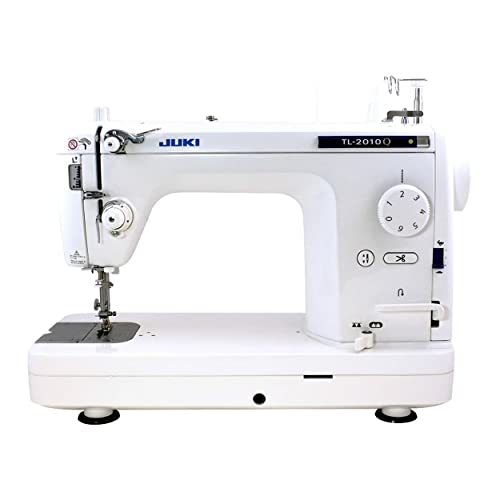
The Juki 2010q occupies a specific niche: high-speed lockstitch work that also handles quilt sandwich feeding through an extended flatbed. It is not a true industrial machine — Juki markets it as semi-industrial — but the 1,500 SPM rating and large workspace make it viable for production quilters who do not want the bulk of a dedicated longarm. Owners highlight the drop-feed dog system as a genuine advantage for free-motion patterns without a separate darning plate. The con is thread tension behavior on very dense fabric stacks; some users report needing frequent adjustment. Skip this if your primary work is upholstery or multi-layer canvas.
- Pro: 1,500 SPM speed with an extended flatbed suits production quilting workflows
- Pro: Drop feed dogs enable free-motion work without accessory plates
- Con: Tension stability drops on dense multi-layer stacks like denim-on-canvas combinations
SINGER 4411 High Speed Heavy Duty Sewing Machine
For anyone whose definition of “industrial” is “my home machine keeps breaking,” the Singer 4411 is a credible step up. It is not a lockstitch workhorse in the commercial sense, but the 1,100 SPM rating and all-metal frame mean it handles denim layers, canvas tote bags, and light upholstery that would stall a standard domestic machine. The price makes it essentially a no-brainer for hobbyists scaling into small-scale resale. Owners praise the included accessory kit and the straightforward threading path. The main limitation is stitch quality at speed on curved seams — it lacks the feed control of true industrial machines. Skip if you need consistent stitch-per-inch across full-length straight runs.
- Pro: All-metal internal frame for under $180 is structurally rare at this price
- Pro: Straightforward threading reduces setup friction for new heavy-duty users
- Con: No walking foot or compound feed means fabric layers can shift on curves
Juki DDL8700 Lockstitch Industrial Sewing Machine
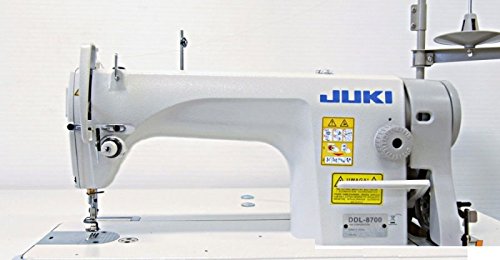
The Juki DDL8700 is the most common single-needle lockstitch you will find in a small garment shop, and the full package — table, servo motor, and built-in lamp — removes the usual assembly headaches that plague head-only purchases. Owner feedback centers on reliability and the consistency of the feed dog geometry, which produces clean stitch lines even when pushing through eight to ten layers of woven cotton. The “not assembled” note is real: you still need to mount the head to the table and wire the motor, which adds a couple of hours. Skip if you lack basic mechanical confidence or need a walking foot.
- Pro: Feed dog geometry produces unusually clean stitch lines on dense woven stacks
- Pro: Package includes table, servo motor, and lamp — fewer compatibility headaches
- Con: Ships not fully assembled; budget time for mechanical setup and wiring
JUKI DDL8700H Head Only for Heavy Material
Buying the DDL8700H head alone makes sense only if you already own a compatible table and clutch motor and want to upgrade your feed mechanism for heavier materials. At this price, the head’s value proposition is strong — you get the same H-style hook assembly and needle bar travel rated for thicker substrates without paying for components you already have. The H variant specifically offers a longer presser foot lift, which matters for topstitching over seam bulk. The obvious downside is that without a table, motor, and belt, total cost rises once you add what you still need. Skip if you are starting from zero.
- Pro: Higher presser foot lift accommodates seam bulk and topstitching over joins
- Pro: At $629 for the head, it undercuts most comparable H-style units
- Con: Requires a separate table, motor, and belt to function — total cost climbs quickly
SINGER 4452 Holiday Bundle Heavy Duty Sewing Machine
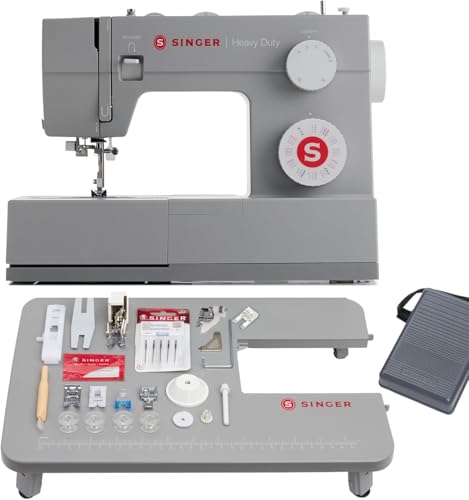
The 4452 Holiday Bundle positions itself as the most accessorized entry point in Singer’s heavy-duty line. Alongside the machine, you get a broader presser foot set and a carrying case, which reduces the hidden accessory cost that often surprises first-time buyers. The machine shares the same 1,100 SPM core as the 4411, so performance expectations should be identical. Owners report the added feet genuinely expand the range of projects — zippers, buttonholes, and cording become manageable. The bundle’s value is real but modest; the extra accessories add roughly $25 to $30 of standalone cost. Skip if you already own a compatible foot set or have dedicated storage.
- Pro: Included feet and case reduce near-term accessory spending
- Pro: Same proven heavy-duty core as the 4411 at a competitive bundle price
- Con: Bundle value is thin; the machine itself is identical to lower-priced variants
SINGER 4432 Sterling High Speed Heavy Duty Sewing Machine
The Singer 4432 sits just below the 4411 in capability and price, distinguished primarily by its integrated needle threader and a larger stitch selection — 32 stitches versus 11 on the 4411. For sewists who need decorative and stretch stitches alongside basic straight and zigzag, the extra stitch library justifies the small premium. Owners note the build quality matches the 4411’s metal frame, so it is not a downgrade in structural terms. The trade-off is that more stitches mean more potential tension complications on dense fabric. Skip if you only sew straight lines and want the absolute lowest entry price in this group.
- Pro: 32 stitch options including decorative and stretch patterns the 4411 lacks
- Pro: Integrated needle threader saves time on repeated setup
- Con: Additional stitch patterns add tension adjustment complexity on thick fabrics
550W Industrial Sewing Machine Set (Excluding Motor)
This 550W set targets a specific workflow: long-run upholstery and drapery stitching where a standard bed length simply runs out of workspace. The listing explicitly excludes the motor, so budget accordingly if you do not already have a compatible clutch unit. The machine head’s extended arm geometry allows you to pass bulky assembled items — finished cushions, drapery panels, mattress ticking — without folding them back under the needle repeatedly. Owner reviews are thinner than the Juki and Singer options, which is a reasonable risk factor to weigh. Skip if your projects are garment-scale or if you cannot source a matching motor.
- Pro: Extended arm and long bed handle assembled items that standard machines cannot accommodate
- Pro: 550W rating suggests capacity for sustained heavy-material stitching
- Con: No motor included, and sparse owner feedback makes reliability harder to assess
Buying Guide
Feed Mechanism: Walking Foot vs. Drop Feed
Standard lockstitch machines rely on drop feed dogs to advance the bottom layer while the presser foot holds the top — this works well until you hit materials that grip or shift differently, like leather on cotton or multiple layers of canvas. Walking-foot mechanisms advance top and bottom simultaneously using an independent arm, eliminating the slippage that causes wavy stitch lines. If your work involves materials with different surface friction coefficients, the feed mechanism is the single most important spec after stitch type. Compound feed (walking foot plus needle feed) adds further control but increases cost and complexity.
Motor Type and Speed Control
Clutch motors are cheaper and robust but run at full speed the moment you press the pedal — there is no low-speed creep for precision work like buttonholes or starting seams on curved panels. Servo motors allow variable speed from near-zero to full working RPM, consume less electricity, and run noticeably quieter. The trade-off is cost and, in some head-only packages, compatibility questions with existing table wiring. For home use, the speed control advantage of a servo outweighs the price premium; for a production shop already running clutch motors, the upgrade may not justify the rewiring effort.
Total Out-the-Door Cost
The listed price of a head-only machine is never the real cost. A $629 Juki DDL8700H head still needs a table ($150-$300), a motor ($100-$200), a belt and pulley set, and a lighting unit if you work in dim spaces. Similarly, the 550W set excludes the motor entirely. Before comparing prices, identify what is included and what you must supply. A “complete package” at $1,189 that includes table, servo, and lamp is often a better value than a $629 head plus $400 in add-ons — but only if the included components match your workspace and electrical requirements.
Our Verdict
The Consew 206RB-5 is our top pick for anyone whose work involves multi-layer, mixed-friction materials like leather, canvas, or vinyl on a regular basis. Its walking foot and included servo motor make it the most capable complete system here without requiring additional purchases. For budget-conscious buyers who need heavy-duty capability without full commercial features, the Singer 4411 for under $200 delivers unmatched value. However, if you already own a compatible table and motor and primarily sew woven garments in volume, the Juki DDL8700H head at $629 becomes the most cost-effective path to a reliable production lockstitch.
FAQ
What is the difference between a heavy-duty home machine and an industrial sewing machine?
Industrial machines are rated for eight-plus hours of continuous operation, use replaceable parts designed for serviceability, and typically run at 4,000 to 5,500 SPM versus 1,100 SPM on heavy-duty home models. Home machines with metal frames can handle occasional thick projects but are not built for sustained production loads.
Do I need a walking foot or is a standard lockstitch sufficient?
If you sew single or double layers of similar-friction fabrics like cotton on cotton, a standard drop-feed lockstitch is adequate. The moment you work with leather, vinyl, coated canvas, or mismatched plies where top and bottom layers resist movement differently, a walking foot prevents the shifting that ruins stitch consistency.
Can a servo motor be retrofitted onto an existing clutch-motor table?
Yes, in most cases. Servo motors mount to the same pulley position and require a control box wired to a standard outlet. You may need to swap the belt if the servo’s pulley diameter differs, and the table’s existing clutch pedal becomes unnecessary — the servo control box handles speed.
Is a head-only purchase ever the better financial decision?
It is worthwhile only if you already own a compatible table, motor, belt, and lighting unit in good condition. If you are starting from zero, head-only prices create a misleading sense of savings; once you add the missing components, total cost frequently exceeds a bundled package that includes them from the factory.