Key takeaways
- Finding reliable Wi-Fi coverage across a large home can be a real challenge. Thick walls, multiple floors, and sprawling floor plans often leave
What's inside
Finding reliable Wi-Fi coverage across a large home can be a real challenge. Thick walls, multiple floors, and sprawling floor plans often leave distant rooms with frustratingly slow speeds or dead zones entirely. Standard routers simply lack the range and capacity to handle dozens of connected devices spread across 3,000 square feet or more, which means streaming in the family room, gaming in a basement office, and video calls in an upstairs bedroom can all suffer simultaneously.
This guide covers the best Wi-Fi routers and mesh systems engineered specifically for large homes. We have selected models that combine the latest wireless standards, expansive coverage, multi-gigabit ports, and robust device capacity. Whether you need a powerful standalone router or a multi-unit mesh system, these picks deliver the range and performance required to keep every corner of your home connected.
As an Amazon Associate we earn from qualifying purchases.


🛒 Best Price Today on Amazon
Prime members get fast, free shipping on everything above, plus member-only deals. New members get a 30-day free trial — cancel anytime.
How to Choose a Wi-Fi Router for Large Homes
- Coverage Area: Match the router or mesh system rated square footage to your home size, adding a buffer of 20 percent to account for walls, ceilings, and interference.
- Mesh vs. Standalone: Opt for a mesh system for multi-floor homes over 3,000 square feet, while a high-power standalone router may suffice for smaller or more open layouts.
- Device Capacity: Look for support for at least 50 to 100 connected devices, especially in smart homes with numerous cameras, sensors, and streaming devices running simultaneously.
- Wi-Fi Standard: Prioritize Wi-Fi 6 or Wi-Fi 7 models for faster speeds, lower latency, and better handling of crowded networks compared to older Wi-Fi 5 hardware.
- Wired Ports: Choose a router with multi-gigabit ports if you have internet speeds above 1 Gbps or plan to add wired backhaul and high-bandwidth devices like NAS drives.
The Best Wi-Fi Routers for Large Homes Reviewed
NETGEAR Orbi 770 Tri-Band Mesh System
This tri-band WiFi 7 mesh system blankets homes up to 8,000 square feet with speeds up to 11 Gbps, making it the ideal choice for the largest properties with heavy bandwidth demands. With support for 100 devices and a dedicated 2.5 Gbps internet port, it easily handles everything from 4K streaming to competitive online gaming across multiple floors.
NETGEAR Orbi 370 Mesh System (3-Pack)
Offering coverage up to 6,000 square feet across a router and two satellite extenders, this dual-band WiFi 7 mesh system delivers up to 5 Gbps speeds for 70 devices. It is an excellent middle-ground option for large homes that want next-generation wireless performance without the premium tri-band price tag.
TP-Link Deco X55 AX3000 Mesh (3-Pack)
This WiFi 6 mesh system covers up to 6,500 square feet and includes three gigabit ports per unit with support for Ethernet backhaul, giving you wired flexibility where you need it most. It is a value-focused pick that still delivers strong AX3000 speeds for families with moderate to heavy streaming and smart home needs.
TP-Link BE6500 WiFi 7 Router
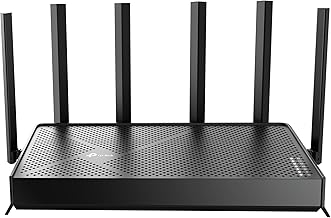
As a dual-band WiFi 7 router with dual 2.5 Gbps ports and coverage up to 2,400 square feet, this model brings next-gen speeds to mid-sized large homes at a competitive price. Its quad-core CPU, HomeShield security, and support for 90 devices make it a future-proof standalone option for users who do not need a full mesh setup.
NETGEAR Nighthawk WiFi 7 Router (RS140)
Delivering BE5000 wireless speeds up to 5.0 Gbps and covering up to 2,250 square feet, this Nighthawk router pairs WiFi 7 performance with a 2.5 Gbps internet port and free expert support. It is a strong choice for users with faster internet plans who want a single powerful router rather than a multi-unit mesh network.
Frequently Asked Questions
Is a mesh system better than a single router for a large home?
In most cases, yes. Mesh systems use multiple nodes placed throughout your home to eliminate dead zones, which is far more effective than relying on one router to push a signal through multiple walls and floors.
Do I need Wi-Fi 7 for a large home?
Wi-Fi 7 is not strictly necessary, but it offers faster speeds, lower latency, and better handling of multiple devices. If you plan to keep your router for several years, investing in Wi-Fi 7 now can future-proof your network.
How many square feet can a mesh system cover?
Coverage varies by model, but many three-pack mesh systems cover between 5,000 and 8,000 square feet. Adding extra satellite nodes can extend coverage further if needed.
What internet speed do I need for a large home network?
For a household streaming 4K content, gaming, and running smart home devices across multiple rooms, a plan of at least 500 Mbps is recommended. If you have over a gigabit connection, look for routers with a 2.5 Gbps port to take full advantage.
Final Thoughts
For homeowners who need maximum coverage and top-tier performance, the NETGEAR Orbi 770 and Orbi 370 stand out as the most capable mesh systems on this list. If you prefer a standalone router with WiFi 7 speeds, the TP-Link BE6500 delivers excellent value and future-ready features for mid-sized large homes.