Key takeaways
- Spring-driven rewind: A pre-wound steel spring pulls the hose in after a short tug releases the lock. Fast and reliable, but the spring is the wear item — budget units are often rated around 2,000–5,000 cycles, while better mechanisms exceed 10,000. At 20 rewinds a week in season, that’s roughly 2–5 years vs. 10+ years.
- Slow-return / controlled rewind: A braking mechanism (like the “Slow Return” system on Hoselink reels) feeds the hose in at walking pace. It costs more but removes the violent snap-back that fatigues springs and whips fittings.
The best hose reels retractable buyers can choose in 2026 depend on three measurable factors: hose length that actually reaches your furthest bed, a spring or slow-rewind mechanism rated for thousands of cycles, and a wall bracket with at least 180° of swivel so the hose pulls straight instead of binding. For most suburban yards, a 65–82 ft reel with a metal swivel bracket is the sweet spot; small patios can step down to 50 ft, and large lots need 100 ft or a pivot-mounted reel.
Our top picks

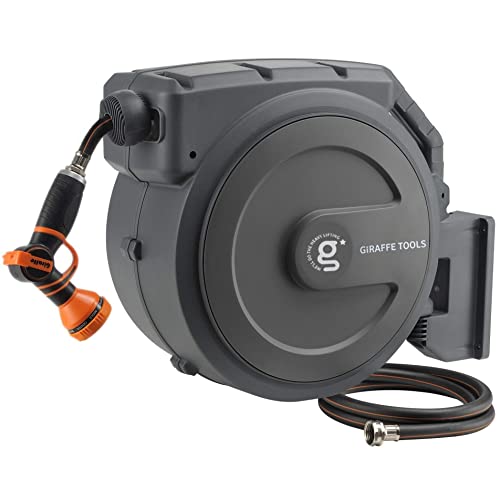

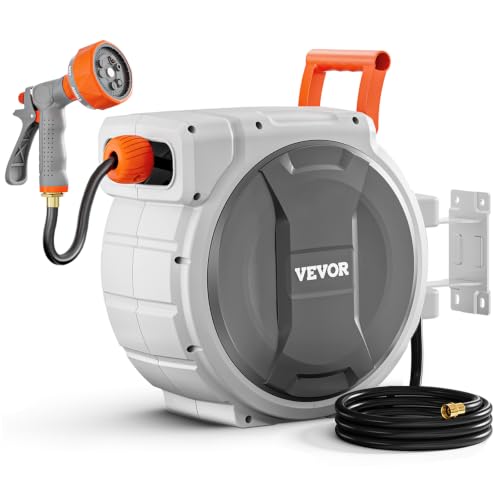
As an Amazon Associate we earn from qualifying purchases at no extra cost to you. Ratings are shown as listed on Amazon.
What “Retractable” Actually Means (and What Wears Out First)
Retractable reels come in two rewind styles, and the difference matters for longevity:
- Spring-driven rewind: A pre-wound steel spring pulls the hose in after a short tug releases the lock. Fast and reliable, but the spring is the wear item — budget units are often rated around 2,000–5,000 cycles, while better mechanisms exceed 10,000. At 20 rewinds a week in season, that’s roughly 2–5 years vs. 10+ years.
- Slow-return / controlled rewind: A braking mechanism (like the “Slow Return” system on Hoselink reels) feeds the hose in at walking pace. It costs more but removes the violent snap-back that fatigues springs and whips fittings.
Regardless of mechanism, the first failures are almost always the same: the internal swivel seal where water enters the drum (leaks after 2–4 seasons if left pressurized in freezing weather), and the hose end stopper. Both are cheap parts on quality reels — check that the brand sells spares before buying.
How to Match Hose Length to Your Yard
Don’t measure your yard’s longest dimension — measure the actual path the hose takes around corners, over beds, and to the furthest tap-to-target point. Then apply this rule: buy 15–20 ft more than your measured path, because a hose pulled at an angle to a fixed wall bracket loses effective length to friction and the swivel arc.
Worked example: a house with the spigot on the back wall, 55 ft to the far corner of the lawn along the hose path, plus a side gate detour. Add 20 ft of slack margin → a 65 ft reel is the minimum; an 82 ft reel gives comfortable pull without full extension, which matters because springs work hardest at maximum extension.
Comparison: Specs That Actually Differ Between Reels
| Reel | Hose Length | Hose Diameter | Rewind Type | Swivel Range | Bracket | Typical Price Range |
|---|---|---|---|---|---|---|
| Hoselink Retractable Hose Reel | 82 ft | 9/16 in | Slow return, spring | 180° | Metal wall mount, removable | $180–$220 |
| Giraffe Tools Retractable Reel | 90 ft / 130 ft options | 5/8 in | Spring, any-length lock | 180° | Metal wall mount | $130–$200 |
| Suncast Powerwind / auto-rewind (motorized) | 100 ft | 5/8 in | Battery motor rewind | Fixed / limited pivot | Resin enclosure, ground or wall | $150–$230 |
| Suncast / generic budget spring reels | 50–65 ft | 1/2–5/8 in | Spring | 170–180° | Resin or thin steel | $60–$120 |
| European-style drum reels (e.g., Gardena wall reels) | 66–115 ft | 1/2 in | Manual crank or spring depending on model | 180°+ swivel | Steel wall bracket | $120–$260 |
Note the hose diameter column — it’s quietly the most consequential spec. A 1/2 in hose at 80 ft loses noticeably more pressure than 5/8 in, which matters if you run sprinklers or pressure-dependent tools at full extension.
Decision Matrix: Which Reel Fits Your Situation
| Your Situation | Recommended Pick | Why |
|---|---|---|
| Patio, balcony, or yard under ~1,500 sq ft | 50–65 ft budget spring reel | Short hose keeps the unit compact and cheap; spring wear is low at partial extension |
| Typical suburban lot, daily watering | Hoselink 82 ft or equivalent slow-rewind reel | Controlled rewind protects the mechanism under frequent use; best long-term value |
| Large lot, 80–120 ft pull needed | Giraffe Tools 130 ft or pivot-mount 100 ft+ reel | Long hose plus any-length lock; confirm bracket is rated for the drum’s full weight (~25–35 lbs) |
| Weak grip strength or mobility limits | Motorized rewind (Suncast Powerwind type) | No tug to unlock; trade-off is batteries/charging and a bulkier housing |
| Freeze-prone climate | Any reel with a lift-off metal bracket | You need to store the unit indoors over winter — permanent brackets defeat the point |
Swivel Range and Mounting: The Overlooked Dealbreakers
A 180° swivel sounds like enough until you mount the reel near a corner — the hose then fights the stop in one direction every pull. If your spigot sits on a wall where you water on both sides, prioritize a full 180°+ bracket. If the reel can only go on a short wall or fence post, look for pivot/pole-mount options that rotate farther.
Mounting realities most listings skip:
- A loaded 80 ft reel weighs 25–40 lbs, and each rewind snap sends a shock load through the bracket. Mount into studs or masonry, never just siding or fence pickets.
- Mount at waist-to-chest height. Too low and the hose drags on the threshold, wearing the outer jacket; too high and retracting is awkward.
- Leave 6–8 inches of clearance behind the reel for the leader hose connection — kinked leader hoses are the second most common leak point.
Ownership: Maintenance and Common Mistakes
- Don’t leave it pressurized year-round. Turn off the tap after use; constant pressure on the internal swivel seal shortens its life dramatically.
- Drain before hard freezes. Water trapped in the drum or swivel can crack housings that otherwise last a decade.
- Guide the last few feet by hand. Letting spring-driven reels snap the nozzle against the stopper eventually breaks the stopper or the end fitting.
- Expect the nozzle, washers, and end stopper to be consumables — normal replacement every 1–3 seasons, and cheap on brands with parts support.
- Cycle the spring occasionally off-season. A spring held at partial tension all winter performs better than one locked fully wound for six months.
FAQ
Is a 5/8 in or 1/2 in hose better in a retractable reel?
5/8 in delivers meaningfully better flow at lengths over 65 ft — choose it for sprinklers or long pulls. 1/2 in is fine for short reels and keeps the drum smaller.
How long do retractable hose reels last?
The housing typically outlasts everything else. Expect 3–7 years from budget spring mechanisms and 8–10+ years from quality slow-rewind units, assuming winter storage or draining in cold climates.
Can I mount a retractable reel on a fence instead of a wall?
Only if the fence has solid posts — rails and pickets won’t survive rewind shock loads. A dedicated post mount or the house wall is safer.
Are motorized reels worth it?
For users who can’t manage the tug-and-guide action of a spring reel, yes. Otherwise they add cost, weight, and a battery to maintain for little gain.