Key takeaways
- Compare five budget paper shredders with cross-cut and micro-cut options, credit card slots, and compact bins, plus simple tips to pick the right one.
A home office shredder does not need to be a big purchase to be useful. The budget end of the category covers the jobs most households actually have: old bank statements, tax paperwork, junk mail with personal details, expired cards, and the occasional stack of school or work printouts that should not go into the recycling bin whole. What changes from model to model is how much paper each pass takes, how small the pieces come out, and how long the motor can run before it needs a rest.
This guide compares five budget paper shredders that cover those differences in a practical order. There is a simple cross-cut starter model, a compact six-sheet unit for small desks, two micro-cut options that cut paper into smaller pieces, and one step-up model with a much longer run time for people clearing out filing cabinets. Specs below come from the product listings, and anything a listing does not state is marked so you can confirm it on the listing before ordering.
As an Amazon Associate, we earn from qualifying purchases.
Quick Answer
For most home offices, the Aurora AS890C is the sensible starting point: an 8-sheet cross-cut shredder with a basket and a credit card slot. If you want smaller pieces, the Amazon Basics 8-Sheet Micro Cut steps up to micro-cut output with a pull-out bin. The Bonsaii C237-B suits small desks, and the Aurora AU1210MA handles long cleanout sessions.
Aurora AS890C 8-Sheet Cross-Cut Paper and Credit Card Shredder

The AS890C is the classic entry point in this category and a reasonable default for a first home shredder. It takes up to eight sheets at a time and cuts them cross-cut style, so pages come out as small confetti-style pieces rather than long strips. A separate feed handles credit cards, which covers the expired card and old loyalty card jobs that a plain paper-only slot cannot.
The unit sits on its own basket, so there is no need to balance a shredder head over a separate waste bin. For a household working through a drawer of statements a few times a year, this size and capacity are usually enough, and the design keeps the footprint modest beside a desk or inside a cabinet between uses.
Specs
- Sheet capacity: 8 sheets per pass
- Cut type: cross-cut
- Also shreds: credit cards
- Bin: basket included
- Model: AS890C
- Run time and bin capacity in gallons: confirm on the listing
Bonsaii Paper Shredder for Home Use, 6 Sheet Crosscut (C237-B)

The Bonsaii C237-B is built for small spaces and light, frequent use. Its six-sheet cross-cut head produces pieces the listing describes as 5 by 14 millimeters and rates the output at security level P-4, which is smaller than basic cross-cut output. It also takes staples and small paper clips without removal, plus one credit card at a time, which saves prep work on stapled statements and clipped paperwork.
The 3.4 gallon bin has a window so you can see the fill level, and a handle makes the head easier to lift off for emptying. The trade-off is run time: the listing describes short continuous runs of about three minutes followed by a longer cool-down, so this model fits a few minutes of shredding at a time rather than a full archive box in one session.
Specs
- Sheet capacity: 6 sheets per pass
- Cut type: cross-cut, listed at security level P-4
- Also shreds: credit cards, staples, and small paper clips
- Bin: 3.4 gallons with viewing window
- Run time: short runs with a cool-down period; confirm exact figures on the listing
- Size: 7 by 11.2 by 14 inches; 6.6 pounds
- Model: C237-B
Amazon Basics 8-Sheet Cross Cut Paper and Credit Card Shredder

This Amazon Basics model covers the middle of the budget range: eight sheets per pass, cross-cut output, and a 3.7 gallon bin. It is the kind of straightforward machine that suits a shared family desk, where the main jobs are statements, forms, and envelopes rather than high-volume cleanouts.
Cross-cut output is a step up from strip-cut because pages are cut in two directions, and the bin size means fewer trips to empty it than the smallest desktop units. The white finish is a small practical point for anyone whose shredder lives in view in a bedroom office or living room corner rather than under a desk. If your paperwork includes staples, check the listing for what the feed accepts before ordering, since acceptance varies across this line.
Specs
- Sheet capacity: 8 sheets per pass
- Cut type: cross-cut
- Also shreds: credit cards
- Bin capacity: 3.7 gallons
- Color: white
- Staple and clip acceptance and run time: confirm on the listing
Amazon Basics High Security Micro Cut Paper Shredder, 8 Sheet

This Amazon Basics model keeps the same eight-sheet capacity but switches to micro-cut, producing pieces the listing gives as approximately 0.5 by 1.3 centimeters and rates at security level P-4. Smaller pieces mean a bin fills more slowly in practical terms, because micro-cut output packs down instead of fluffing up the way strip and cross-cut pieces do.
The listing states it destroys CDs, DVDs, and credit cards one at a time, and that staples and small paper clips do not need to be removed first. A pull-out bin replaces the lift-off head design, which many people find tidier for emptying. At roughly 9 by 13 by 18 inches it is still a desk-side size, and it suits households whose shredding includes more sensitive records, such as tax documents and medical or financial paperwork, where smaller pieces are the priority.
Specs
- Sheet capacity: 8 sheets per pass
- Cut type: micro-cut, listed at security level P-4
- Also shreds: CDs, DVDs, and credit cards, one at a time
- Staples and small paper clips: no removal needed, per the listing
- Bin: pull-out bin, 4 gallons
- Size: 8.9 by 13.2 by 18.1 inches
- Run time: confirm on the listing
Aurora AU1210MA 12-Sheet Micro-Cut Shredder
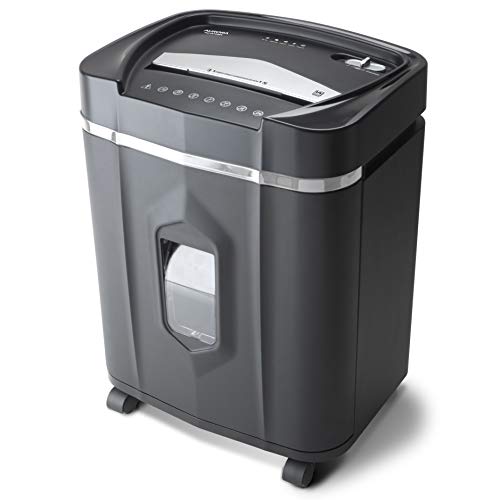
The AU1210MA is the step-up pick in this group, aimed at people whose shredding comes in big batches: an annual filing cabinet purge, a home business closing out a year of records, or a move that turns up boxes of old paperwork. It takes up to twelve sheets per pass, cuts micro-cut at a listed security level P-4, and shreds CDs and credit cards as well as paper.
Its headline feature is run time. The listing describes up to 60 minutes of continuous run time, which is far beyond the few minutes typical of budget models, and the 5.0 gallon pullout basket matches that capacity so you are not stopping to empty the bin mid-session. It costs more than the other picks here and takes up more room, so it earns its place only if long sessions are a real part of your routine.
Specs
- Sheet capacity: 12 sheets per pass
- Cut type: micro-cut, listed at security level P-4
- Also shreds: CDs and credit cards
- Run time: up to 60 minutes continuous, per the listing
- Bin: 5.0 gallon pullout basket
- Model: AU1210MA
How to Choose
Start with cut type. Strip-cut is the cheapest output but leaves long strips; cross-cut cuts in two directions and suits everyday household paperwork; micro-cut produces the smallest pieces and is the better match for sensitive records. Security levels such as P-4, where a listing states them, describe piece size rather than a guarantee, so treat them as a comparison tool between models.
Next, match sheet capacity and run time to your habits. Six to eight sheets per pass is fine for weekly mail and statements. If you regularly clear stacks of paper, run time matters more than sheet count, because a budget motor that rests after a few minutes turns a big job into a slow one. Bin size follows the same logic: a pull-out bin of four to five gallons suits batch work, while a compact three-gallon bin fits a small desk and occasional use.
Finally, check the extras against your actual paperwork. A credit card slot is worth having if you retire cards often. Staple and clip acceptance, where listed, saves prep time. Measure the space under or beside your desk, and confirm dimensions and run time on the listing, since those figures vary even within one brand’s range.
Who Should Skip
Skip this whole category if your shredding volume is a few pages a month; a locking drawer and tearing out account details may be enough, and a shredder will mostly gather dust. Skip the compact six-sheet models if you plan an annual archive purge, because short run times make big jobs frustrating; the long-run model or a shredding service fits better. Anyone handling regulated business records with formal destruction requirements should look at commercial services or business-grade machines rather than budget home models, and confirm any compliance needs before buying.
FAQ
Is cross-cut or micro-cut better for home use?
Micro-cut produces smaller pieces, which suits sensitive records like tax and financial documents. Cross-cut is fine for general household paperwork such as statements and junk mail. Choose based on what you actually shred, and compare the piece size and any security level stated on each listing.
How long can a budget shredder run before it overheats?
It varies widely. Compact budget models often run only a few minutes before needing a cool-down, while step-up models list run times up to an hour. Check the run time and cool-down figures on the listing for the model you are considering, and plan batch jobs around them.
Can these shredders handle staples and credit cards?
Many can, but it is model specific. Some listings state that staples and small paper clips can stay in the paper, and several picks here have a separate feed or stated capacity for credit cards, CDs, or DVDs. Confirm the accepted materials on the listing, and never put metal cards through a home shredder.
What size bin should I look for?
Around three to four gallons suits occasional household use and small spaces. If you shred in batches, a pull-out bin of four to five gallons means fewer stops to empty it. Micro-cut output also packs down more tightly than strip or cross-cut pieces, so the same bin lasts longer between empties.
Final Verdict
The Aurora AS890C is the balanced default for most homes: eight sheets, cross-cut output, and a credit card slot in a basket design. The Bonsaii C237-B fits small desks and short sessions, the two Amazon Basics models split the choice between simple cross-cut value and smaller micro-cut pieces, and the Aurora AU1210MA is the pick for long cleanout days. Match run time and bin size to how you actually shred, confirm the details on the listing, and any of these five will cover a home office well.
FAQ
Is cross-cut or micro-cut better for home use?
How long can a budget shredder run before it overheats?
Can these shredders handle staples and credit cards?
What size bin should I look for?
More from Amazon
Programs that pair well with the guide above. Offers and eligibility are set by Amazon and may change.
Free shipping on eligible items, Prime Video and more. Eligible new members can start with a free trial.
Start a Prime free trialAudiobooks and podcasts to listen to on the go. Eligible new members can start with a free trial.
Try Audible freeAd-free music streaming. Eligible new subscribers can start with a free trial.
Try Music Unlimited freeA free business account with business pricing and bulk-buying tools for work, shop or home office.
Create a business accountAs an Amazon Associate we earn from qualifying purchases.