Key takeaways
- Compare five self-emptying robot vacuums by base capacity, bagged or bagless upkeep, navigation and runtime, with tips for checking current offers.
A robot vacuum only saves real time if you are not bending over its dustbin after every run. Self-emptying models solve that last chore: when the robot docks, the base pulls the contents of the bin into a much larger bag or canister, so the machine can keep cleaning for weeks while you only deal with the base now and then. For value hunters, the trick is balancing that convenience against what the base costs you over time in bags, filters, and floor space.
This guide compares five self-emptying robot vacuums that keep ongoing upkeep simple. They differ in how the base stores dirt, how long it goes between changes, how the robot navigates, and how much daily runtime you get. Specs below come from the product listings, and because bundle contents and bag counts change, it is worth confirming the details on the listing before you order.
As an Amazon Associate, we earn from qualifying purchases.
Quick answer
For most homes, the Shark AV2501S AI Ultra is the easiest value pick because its bagless base skips replacement bags entirely. The iRobot Roomba j7+ suits pet owners who want obstacle avoidance, the roborock Q5+ offers the longest runtime, the Roomba i3+ EVO keeps the familiar Clean Base system, and the dreame D10 Plus adds basic mopping.
iRobot Roomba j7+ (7550) Self-Emptying Robot Vacuum

The Roomba j7+ pairs iRobot’s Clean Base Automatic Dirt Disposal with PrecisionVision navigation, which lets the robot spot and steer around everyday obstacles such as cords, socks, and pet waste instead of pushing through them. The sealed bags inside the base hold up to 60 days of debris, so bin duty becomes a rare task rather than a daily one.
Imprint Smart Mapping lets the j7+ learn your floor plan and clean specific rooms on command, and it works with Alexa for voice control. For pet homes, the obstacle avoidance is the headline feature, since it reduces the chances of the robot dragging a mess across the floor. The ongoing cost to plan for is the disposal bags, which are a recurring purchase, so check how many come in the box on the listing.
Specs
– Base type: Clean Base Automatic Dirt Disposal, bagged
– Base capacity: bags hold up to 60 days of debris
– Navigation: PrecisionVision camera navigation with obstacle avoidance
– Mapping: Imprint Smart Mapping, room-by-room cleaning
– Control: iRobot Home app and Alexa voice control
– Runtime: confirm on the listing
Shark AV2501S AI Ultra Robot Vacuum

The Shark AV2501S stands out in this group because its self-empty base is bagless. Dirt collects in a canister you empty into the trash, which removes the recurring bag purchase from the budget entirely. The base holds up to 30 days of dirt and debris and uses true HEPA filtration to trap dust and allergens as the robot empties.
Navigation is handled by LiDAR home mapping with Matrix Clean, which cleans in a precise grid pattern and can target specific rooms. Runtime is listed at up to 120 minutes, and the self-cleaning brushroll is designed to resist hair wrap, a plus for pet households. Control runs through the SharkClean app or voice assistants including Alexa and Google Home. The trade-off is the smaller 30-day capacity, so busier homes will empty the canister more often.
Specs
– Base type: bagless self-empty base with HEPA filtration
– Base capacity: up to 30 days of dirt and debris
– Navigation: LiDAR home mapping with Matrix Clean grid pattern
– Runtime: up to 120 minutes
– Brushroll: self-cleaning, designed for pet hair pickup
– Control: SharkClean app, Alexa, and Google Home
roborock Q5+ Robot Vacuum with Self-Empty Dock
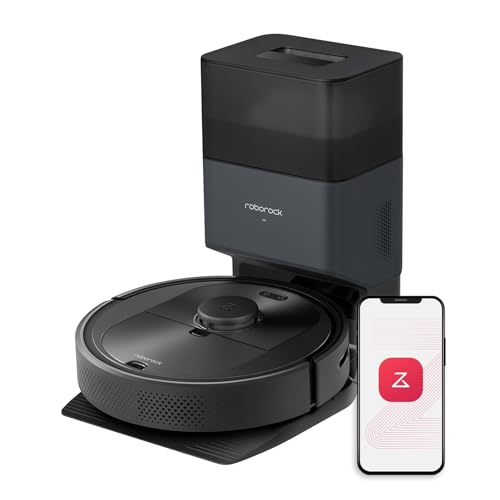
The roborock Q5+ uses the Auto-Empty Dock Pure, which pulls dust into a 2.5 liter bag rated for up to seven weeks of cleaning between changes. That is the longest hands-free stretch in this roundup alongside the longest runtime, listed at up to 180 minutes, which suits larger floor plans that need a full clean on one charge.
Suction is rated at 2700 Pa, and the robot navigates with LiDAR, supports multi-level mapping, no-go zones, and invisible walls through the Roborock app. The dock offers several emptying modes, including a smart mode that adjusts how often it empties based on recent cleaning habits. One practical note from the listing: the auto-empty dock only supports 100 to 120 volt outlets, so check compatibility if your home wiring differs.
Specs
– Base type: Auto-Empty Dock Pure, bagged
– Base capacity: 2.5 liter bag, up to 7 weeks of debris
– Navigation: LiDAR with multi-level mapping and no-go zones
– Suction: 2700 Pa maximum
– Runtime: up to 180 minutes
– Filter: washable filter; dock supports 100 to 120 volt outlets
iRobot Roomba i3+ EVO (3550) Self-Emptying Robot Vacuum

The Roomba i3+ EVO uses the same Clean Base approach as its j7+ sibling: the robot empties itself into an enclosed bag that holds up to 60 days of debris, then resumes cleaning if the job is not finished. It learns your home room by room with smart mapping, so you can send it to a specific room from the app or with a voice command.
The listing highlights a premium three-stage cleaning system with 10 times the power-lifting suction of the entry Roomba 600 series, and dual multi-surface rubber brushes that flex to adjust to carpet and hard floors. Battery life is listed at 75 minutes, the shortest here, though recharge and resume means larger homes still get finished, just with a pause in the middle. Like the j7+, plan on replacement Clean Base bags as the main running cost.
Specs
– Base type: Clean Base Automatic Dirt Disposal, bagged
– Base capacity: bags hold up to 60 days of debris
– Navigation: smart mapping with room-by-room cleaning
– Runtime: 75 minutes, with recharge and resume
– Dustbin capacity: 13.5 ounces
– Control: iRobot Home app, Alexa, Google Home, and Siri shortcuts
dreame D10 Plus Robot Vacuum and Mop

The dreame D10 Plus is the only pick here that also mops. Its auto-empty base holds a 2.5 liter dust bag rated for up to 45 days of hands-free cleaning, and DualBoost emptying uses two air paths to move dirt into the bag while limiting clogs and odors. Two dust bags are included in the box per the listing.
Suction is rated at 4000 Pa, the strongest figure in this group, and LiDAR navigation builds maps for planned routes with no-go zones. The 5,200 mAh battery is listed for up to 180 minutes of runtime, and the robot carries a separate water tank and mop pad for light wet cleaning on hard floors. It works with Alexa, and the Mi Home app handles scheduling and cleaning modes. Mopping here is maintenance level, not scrubbing, so think of it as a bonus rather than the main event.
Specs
– Base type: self-emptying base, bagged, DualBoost emptying
– Base capacity: 2.5 liter bag, up to 45 days of debris
– Navigation: LiDAR with mapping and no-go zones
– Suction: 4000 Pa maximum
– Runtime: up to 180 minutes; 5,200 mAh battery
– Extra: vacuum and mop combo with water tank; Alexa compatible
How to choose a self-emptying robot vacuum
Start with the base, because it decides your running costs. Bagged bases from iRobot and roborock seal dust away neatly, but the bags are a repeat purchase, so check the bag size and how many ship in the box. A bagless base like the Shark removes that cost, trading it for a smaller canister you empty more often and rinse out now and then.
Next, match capacity claims to your home. A 60-day rating assumes average debris; a shedding dog or a large family will fill any base faster, so treat the day counts as best-case guides. Navigation matters too: LiDAR models map quickly and clean in tidy rows, while the Roomba j7+ uses a camera to actively avoid obstacles, which pet owners may value more than raw mapping speed.
Finally, look at runtime against your floor area. Anything around 120 minutes covers most apartments and mid-size homes in one pass. Longer runtimes and recharge-and-resume features matter for big, single-level layouts. Before ordering, confirm on the listing which bags, filters, and brushes are included, since bundles change and those extras affect the real first-year cost.
Who should skip a self-emptying model
Skip the self-empty dock if your home is small and you already empty a standard robot bin without thinking about it; the base adds floor space and purchase cost that may never pay back. Multi-story homes are another weak fit, since the robot can only empty itself when it returns to the one floor where the base lives.
Also skip if replacement bags would be hard to source for your model, or if anyone in the home is sensitive to the brief burst of noise the base makes while it vacuums out the robot’s bin. A plain robot with a large onboard bin, or a bagless dock you can empty quietly by hand, may suit those households better.
FAQ
How long do self-emptying bases really go between changes?
Listings rate these bases from about 30 days for the Shark up to 60 days for the Roomba models, with the roborock rated in weeks. Treat those as best-case figures. Homes with pets, kids, or high-traffic entryways fill bags and canisters faster, so expect to change them sooner.
Are bagged or bagless bases cheaper to run?
Bagless bases avoid repeat bag purchases, so their day-to-day running cost is mainly filters and electricity. Bagged bases add a recurring bag cost, but the sealed bag keeps dust contained when you swap it. Check the listing for how many bags are included before deciding which pattern fits your budget.
Can these robots handle pet hair?
Yes, all five picks are marketed for pet hair pickup, and features like the Shark’s self-cleaning brushroll and the Roomba j7+ obstacle avoidance help in pet homes. Hair still wraps around brushes over time on any robot, so plan on quick brush checks every few weeks.
What should I check on the listing before buying?
Confirm the included bag count, the dock’s voltage support, whether the base needs bags or is bagless, and the stated runtime. Bundle contents change between sellers, and those details decide your real first-year upkeep cost more than the headline features do.
Final verdict
For the lowest running costs, the Shark AV2501S is the standout: a bagless HEPA base, LiDAR mapping, and a 120-minute runtime cover most homes without a single bag purchase. If obstacle avoidance around pets matters most, choose the Roomba j7+. The roborock Q5+ is the pick for long runtimes and multi-level maps, the Roomba i3+ EVO keeps things simple inside the iRobot app, and the dreame D10 Plus adds light mopping to the strongest listed suction here. Whichever you pick, confirm the current bundle and bag count on the listing before you check out.
Product and ASIN Reference
| Product | ASIN |
|---|---|
| iRobot Roomba j7+ (7550) Self-Emptying Robot Vacuum | B094NYHTMF |
| Shark AV2501S AI Ultra Robot Vacuum | B09H8CWFNK |
| roborock Q5+ Robot Vacuum with Self-Empty Dock | B09NM56KJM |
| iRobot Roomba i3+ EVO (3550) Self-Emptying Robot Vacuum | B08C4LC7TG |
| dreame D10 Plus Robot Vacuum and Mop | B09VKZT1FQ |
More from Amazon
Programs that pair well with the guide above. Offers and eligibility are set by Amazon and may change.
Free shipping on eligible items, Prime Video and more. Eligible new members can start with a free trial.
Start a Prime free trialAudiobooks and podcasts to listen to on the go. Eligible new members can start with a free trial.
Try Audible freeAd-free music streaming. Eligible new subscribers can start with a free trial.
Try Music Unlimited freeA free business account with business pricing and bulk-buying tools for work, shop or home office.
Create a business accountAs an Amazon Associate we earn from qualifying purchases.