Key takeaways
- Wi-Fi 5 AC1200–AC1750: suitable for basic browsing and older routers, often at lower prices.
- Wi-Fi 6 AX1800–AX3000: the best value range for most apartments and medium homes.
- Wi-Fi 6 AX5400–AX6000: useful for faster broadband, many clients, and wired devices near the extender.
- Wi-Fi 6E and Wi-Fi 7: potentially valuable in compatible ecosystems, but an extender using a newer band is not automatically better if the router and client devices cannot use it.
The best WiFi extenders for most homes are Wi-Fi 6 dual-band models with gigabit Ethernet, but the right choice depends on your home’s size, internet speed, router brand, and whether you want a true mesh system or simply a stronger signal in one problem room.
Our top picks


As an Amazon Associate we earn from qualifying purchases at no extra cost to you. Ratings are shown as listed on Amazon.
Best WiFi Extenders by Home Situation
| Situation | Recommended extender type | Useful minimum specification | Typical market range |
|---|---|---|---|
| Small apartment or one weak bedroom | Compact dual-band Wi-Fi 6 extender | AX1800, 1 gigabit Ethernet port | $35–$70 |
| Medium house with two floors | Dual-band Wi-Fi 6 extender with higher wireless capacity | AX3000, gigabit Ethernet, app setup | $60–$110 |
| Large home or several simultaneous 4K streams | High-capacity Wi-Fi 6 extender or mesh satellite | AX5400 or AX6000, gigabit or multi-gigabit port | $100–$180 |
| Gaming console, smart TV, or desktop in a weak-signal room | Extender with wired backhaul or Ethernet output | Wi-Fi 6, gigabit Ethernet, access-point mode | $50–$130 |
| Existing compatible mesh router | Manufacturer-matched mesh extender | Same mesh platform and compatible router firmware | $80–$200 |
Our Top Picks for the Best WiFi Extenders
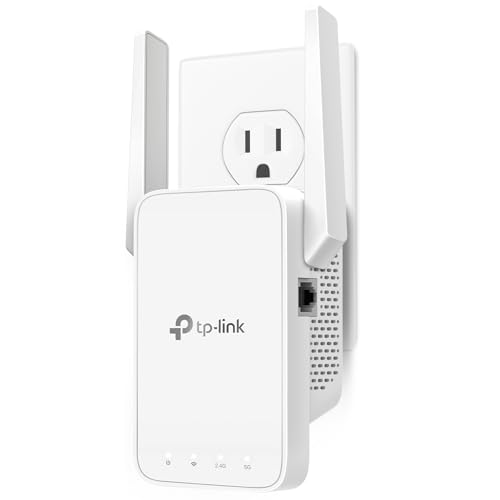
TP-Link RE715X: Best balanced Wi-Fi 6 choice
The TP-Link RE715X is a practical match for medium-sized homes that have a compatible TP-Link OneMesh router. It uses dual-band Wi-Fi 6 with an AX3000 class rating and includes a gigabit Ethernet port. Its rated wireless capacity is more than enough for ordinary broadband plans, multiple phones and laptops, streaming devices, and smart-home equipment.
Its strongest advantage is flexibility: it can work as a conventional range extender or as an access point when connected to the router by Ethernet. The latter arrangement is usually faster and more stable because the extender does not have to use wireless airtime to communicate with the main router.
Choose it when you want a relatively simple app-based setup and your router is already from TP-Link. Do not assume OneMesh compatibility means it will form a mesh with every TP-Link model; check the router’s current compatibility list and firmware requirements first.
ASUS RP-AX58: Best for ASUS AiMesh households
The ASUS RP-AX58 is an AX3000 dual-band Wi-Fi 6 extender designed to work as part of ASUS AiMesh with compatible ASUS routers. It has a gigabit Ethernet port and can also operate in a standard repeater mode with routers from other manufacturers.
It makes the most sense for an ASUS owner who wants one network name, centralized management, and the option to add more compatible ASUS nodes later. AiMesh compatibility is more useful than a larger theoretical speed rating when it allows devices to move between nodes without requiring separate network names.
For a non-ASUS router, it remains a capable extender, but you lose the main reason to pay for this model: integrated management within the ASUS system.
NETGEAR EAX80: Best high-capacity standalone extender
The NETGEAR EAX80 is an AX6000-class dual-band extender with multiple gigabit Ethernet ports. Its higher class rating provides more wireless capacity than entry-level models, although the actual speed reaching a phone or laptop depends on distance, interference, client hardware, and the main router.
The Ethernet ports make it useful for a home office, smart television, game console, or desktop computer located near the extender. It can also be used in access-point mode with a wired connection. That arrangement can deliver more consistent performance than wireless repeating, particularly when the home has thick walls or several neighboring networks.
It is a better fit for fast broadband and many active devices than for a small apartment with a basic internet plan. A high-capacity extender cannot create internet speed that the router or service connection does not provide.
D-Link Eagle Pro AI AX1500: Best for a modest budget
The D-Link Eagle Pro AI AX1500 extender is aimed at smaller homes and moderate internet use. Its Wi-Fi 6 capacity is lower than AX3000 and AX6000 models, but that is not necessarily a disadvantage for a 100–300 Mbps connection used by a few people.
Look for the exact hardware revision and compatibility details before buying. D-Link’s Eagle Pro AI range is intended to work with selected compatible D-Link routers and mesh products, but not every D-Link device shares the same platform.
Wi-Fi Standard: Match the Extender to the Router
Wi-Fi 6, also called 802.11ax, is the sensible starting point in 2026. It improves efficiency in busy homes and generally works with older Wi-Fi 5 and Wi-Fi 4 devices. A Wi-Fi 6 extender can repeat an older router’s signal, but the network will still be limited by the older router’s capabilities.
- Wi-Fi 5 AC1200–AC1750: suitable for basic browsing and older routers, often at lower prices.
- Wi-Fi 6 AX1800–AX3000: the best value range for most apartments and medium homes.
- Wi-Fi 6 AX5400–AX6000: useful for faster broadband, many clients, and wired devices near the extender.
- Wi-Fi 6E and Wi-Fi 7: potentially valuable in compatible ecosystems, but an extender using a newer band is not automatically better if the router and client devices cannot use it.
Model numbers such as AX3000 describe combined theoretical band capacity, not the speed of one device. A dual-band AX3000 product might advertise approximately 574 Mbps on 2.4 GHz and 2,402 Mbps on 5 GHz under ideal conditions. Real throughput is lower, and wireless repeating can reduce available capacity because traffic must travel between the router and extender over the air.
Coverage Claims Need a Reality Check
Manufacturers’ square-footage claims are useful only as rough comparisons. Walls, ceilings, brick, concrete, metal appliances, neighboring Wi-Fi networks, and the router’s location all matter. A two-story 1,800-square-foot wood-frame home can be easier to cover than a 1,200-square-foot apartment with dense concrete walls.
Place the extender roughly halfway between the router and the weak area, not inside the dead zone. The extender needs a healthy connection to the router before it can provide a healthy connection onward. Use the setup app’s signal indicator, or test the connection at the intended position before permanently mounting it.
For a long house, one extender at the far end may be less effective than a centrally placed unit. For multiple disconnected dead zones, a mesh system is usually more predictable than adding several unrelated repeaters.
Mesh Compatibility Versus Universal Repeating
A universal extender can usually repeat the signal from many brands, but it may create a separate network name or offer limited roaming. A compatible mesh extender is designed to share management and roaming features with a matching router family.
- Choose TP-Link OneMesh hardware for a compatible TP-Link OneMesh router.
- Choose ASUS AiMesh hardware for a compatible ASUS AiMesh router.
- Choose a manufacturer-matched mesh satellite when seamless roaming is more important than the lowest purchase price.
- Use a universal extender when the goal is simply to reach one room and separate network management is acceptable.
Do not mix up “mesh-ready” marketing with universal mesh compatibility. Mesh systems are platform-specific more often than the branding suggests.
Ethernet Ports and Backhaul: The Performance Difference
An Ethernet port is valuable in two different ways. In access-point mode, an Ethernet cable carries the connection from the router to the extender, avoiding wireless backhaul losses. In client mode, the port lets a nearby wired device connect through the extender.
For broadband up to roughly 500 Mbps, a gigabit port is normally adequate. A multi-gigabit port becomes relevant when the router, switch, wired backhaul, and internet plan all exceed 1 Gbps. A high wireless rating paired with only a 100 Mbps Ethernet port is a poor choice for a fast connection or wired office.
Setup: A Reliable Five-Step Method
- Update the main router. Firmware can improve compatibility and security.
- Start near the router. Pair the extender using its app, web interface, or WPS if both devices support it.
- Copy the network settings carefully. A shared network name is convenient, while a separate name makes troubleshooting easier.
- Move the extender to the planned location. Keep it within a strong-signal area rather than at the edge of coverage.
- Test the actual room. Check download speed, latency, and stability on the device you care about, not only the app’s signal bars.
If the extender becomes unstable, move it closer to the router, change the 5 GHz channel if the router permits it, and keep it away from cordless-phone bases, microwaves, large metal objects, and enclosed cabinets.
Ownership Costs and Common Mistakes
Most plug-in extenders cost approximately $35–$180 depending on wireless class, Ethernet features, and mesh integration. There are usually no mandatory consumables, but firmware support and replacement cost matter over several years. The power adapter is often the first physical component to fail, while heat buildup and blocked ventilation can shorten electronics life.
Avoid buying solely from the biggest coverage number. Buying an AX6000 extender for a 100 Mbps plan may add cost without a noticeable benefit. Conversely, using a low-end extender for a gigabit plan, several video calls, and multiple 4K streams can create a bottleneck.
The most dependable upgrade is often a wired access point or a properly matched mesh node. If wiring is impossible, select a Wi-Fi 6 extender with a strong connection indicator, a gigabit Ethernet port, and compatibility with your current router’s management platform.
Final Buying Recommendation
For most buyers, start with a Wi-Fi 6 AX1800 or AX3000 model. Select the TP-Link RE715X for a compatible TP-Link setup, the ASUS RP-AX58 for an ASUS AiMesh network, the NETGEAR EAX80 for higher device density and multiple wired connections, or a more affordable AX1500 model for a small home and moderate broadband. Prioritize correct placement and a wired backhaul when possible; those decisions usually affect real-world coverage more than the largest number printed on the box.