Key takeaways
- After every use: empty or dry the tank as instructed, wipe condensation, and remove food debris.
- After greasy cooking: use the approved degreasing programme or cleaner; do not rely on a steam-only cycle.
- Regularly: inspect the door gasket, drain area, and water inlet for residue or blockage.
- When prompted: run a descaling cycle with the specified product and quantity.
- For accessories: check whether perforated trays, racks, and probes are dishwasher-safe rather than assuming they are.
Best Steam Ovens for Healthier Home Cooking
The best steam oven depends on whether you mainly want gentle steaming or one appliance that can steam, roast, bake, grill, and reheat: choose a steam-only model for vegetables, fish, rice, and simple everyday cooking, or a combi steam oven for broader cooking versatility and better browning.
Steam cooking can help retain moisture and reduce the need for added oil, but it is not automatically “healthier” than every other method. Ingredients, portions, salt, sauces, and cooking time still matter. This guide compares the practical differences that affect ownership: capacity, temperature control, water-tank design, cleaning, and versatility.
Our top picks

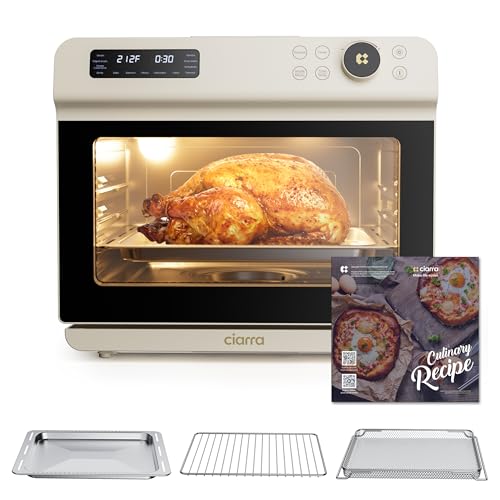


As an Amazon Associate we earn from qualifying purchases at no extra cost to you. Ratings are shown as listed on Amazon.
Steam-only vs. combi steam: the important distinction
A steam-only oven generates saturated steam, usually at approximately 40–100°C. It excels at poaching, steaming vegetables, cooking rice and grains, reheating without drying, and preparing delicate foods. It does not naturally brown food, so roast chicken, bread, and gratins may need a separate oven or a finishing step under a grill.
A combi steam oven combines steam with conventional dry heat. Depending on the model, you can select steam-only, hot air, or a controlled combination such as 30–80% humidity with dry heat. This makes it more useful as a primary oven: bread can develop a crisp crust, meat can stay moist while browning, and leftovers can be reheated more successfully than in a microwave alone.
The trade-off is complexity. Combi models generally cost more, require more cleaning, and demand a little practice because a high-humidity setting can leave pastry soft or prevent browning.
Key specifications compared
| Feature | Steam-only oven | Combi steam oven | What it means at home |
|---|---|---|---|
| Typical cavity capacity | 20–40 litres | 40–76 litres | Small steam-only cavities suit 1–3 people; larger combi cavities handle family portions and roasting trays. |
| Typical temperature range | 40–100°C in steam mode | 30–230°C, depending on mode | Combi models can bake and roast; check whether the quoted maximum applies to dry heat only. |
| Water capacity | About 0.8–1.5 litres | About 1.0–2.0 litres | A larger tank means fewer refills, but a full tank adds weight and still needs emptying after use. |
| Installation | Usually countertop or compact built-in | Countertop, built-in, or plumbed-in professional-style models | Built-in models need ventilation and cabinet measurements checked before purchase. |
| Steam adjustment | Often fixed levels or temperature selection | Fixed humidity levels or, on advanced models, precise humidity percentages | More control helps with bread, meat, fish, and reheating, but adds a learning curve. |
| Cleaning demand | Wipe-down and occasional descaling | Wipe-down, drying, descaling, and sometimes grease-removal programmes | Frequent roasting makes the cavity and accessories harder to maintain. |
Best steam oven choices by situation
| Your situation | Best fit | Why | Watch out for |
|---|---|---|---|
| You steam vegetables and fish several times a week | Compact steam-only oven | Lower purchase cost, simple controls, fast setup, and less cavity to clean | Limited browning and smaller trays |
| You want one oven for nearly everything | Built-in combi steam oven, 60–76 litres | Handles family meals, bread, roasting, reheating, and steam cooking | Higher cost and more demanding maintenance |
| You rent or have limited kitchen space | Countertop combi model, roughly 20–30 litres | No cabinet alteration and useful dry-heat functions in one appliance | Small cavity limits large dishes and may need clearance around the unit |
| You are new to steam cooking | Model with automatic programmes and visible water-level indication | Reduces guesswork for vegetables, rice, fish, and reheating | Preset programmes do not replace checking food size and doneness |
| You cook large meals or entertain often | Plumbed-in or large-tank combi model | More usable capacity and fewer interruptions for refilling | Installation cost, water-quality requirements, and more expensive repairs |
Strong product directions to consider
Anova Precision Oven 2.0: best for precise countertop control
The Anova Precision Oven 2.0 is a countertop combi steam oven aimed at cooks who want detailed control rather than a conventional built-in appearance. Its large countertop format, probe-based cooking, and adjustable steam make it particularly appealing for bread, sous-vide-style cooking, reheating, and recipes where internal temperature matters.
It is a better choice for an experienced home cook who has worktop space and wants a flexible second oven. It is less suitable if you need a compact appliance that can be put away after every use. Before buying, measure depth as well as width: countertop combi ovens can project farther forward than expected and need ventilation clearance.
Miele DGC and comparable premium built-in combi ovens: best for integrated kitchens
Miele’s DGC range represents the premium built-in approach, with models commonly offering large cavities, automatic programmes, temperature probes, and either refillable tanks or more advanced water-management systems depending on the exact model. Comparable premium lines from brands such as Bosch, Siemens, and AEG follow a similar concept.
This category suits frequent cooks who want the steam oven to replace or complement a full-size oven. A 60–76-litre cavity is practical for several shelves, a whole chicken, or a family-sized tray. Premium features can improve convenience, but they do not eliminate cleaning: grease from roasting and mineral deposits from water still need attention.
Compact built-in steam ovens: best for small households
Compact built-in models, often around 40–50 litres, occupy less vertical cabinet space and can be paired with a standard oven. They are a sensible middle ground for one or two people who want better steaming and reheating without paying for a full-size premium appliance.
Check the internal shelf spacing carefully. A quoted capacity does not tell you whether a tall casserole, wide roasting tray, or multiple steam containers will fit. A slightly smaller cavity with usable rack positions can be more practical than a larger cavity with awkward dimensions.
Water tanks: convenience versus reliability
A removable front-access tank is the easiest design for most kitchens. You can fill it at the sink, see the water level, and remove it after cooking. A tank behind the control panel may look neater but can be inconvenient if it must be emptied frequently or cannot be removed while the oven is hot.
Plumbed-in models avoid refilling and may drain condensation automatically, but they require suitable plumbing and sometimes a water-softening strategy. Hard water can accelerate scale in pumps, generators, pipes, and sensors. If your water is mineral-rich, confirm the manufacturer’s descaling procedure and whether a filter or softened water is recommended.
A useful sizing calculation is simple: if a cooking session consumes approximately 0.5 litres of water, a 1.2-litre tank gives roughly two full sessions with some reserve. Actual usage varies with temperature, cooking time, and the amount of steam released when opening the door, so do not treat tank capacity as an exact number of meals.
Cleaning and durability realities
Steam does not sterilise a dirty oven or dissolve all grease. After cooking, remove trays and racks, wipe pooled water from the floor and door seal, and leave the door ajar until the cavity is dry. This reduces lingering odours and helps protect seals and finishes.
- After every use: empty or dry the tank as instructed, wipe condensation, and remove food debris.
- After greasy cooking: use the approved degreasing programme or cleaner; do not rely on a steam-only cycle.
- Regularly: inspect the door gasket, drain area, and water inlet for residue or blockage.
- When prompted: run a descaling cycle with the specified product and quantity.
- For accessories: check whether perforated trays, racks, and probes are dishwasher-safe rather than assuming they are.
The parts most likely to create ownership problems are the door seal, water pump, tank valve, mineral-sensitive steam generator, and electronic controls. Leaving water in the tank for days, using unsuitable descaler, forcing a hot tank out of its housing, or blocking ventilation can shorten component life. A longer warranty and accessible local servicing may be worth more than an extra automatic recipe.
How to choose without overbuying
- Measure the space. Record width, height, depth, door swing, ventilation clearance, and the route from the delivery point to the kitchen.
- List your five most common dishes. If they are mainly vegetables, fish, rice, dumplings, and reheated meals, steam-only may be enough. If bread, roast meat, pastry, and casseroles appear regularly, choose combi.
- Set a usable capacity target. Allow roughly 10–15 litres per person for routine meals, then add capacity if you cook batches or use large cookware.
- Compare water handling. Prefer a removable, accessible tank unless your usage justifies professional plumbing.
- Read the cleaning instructions before the feature list. An appliance that is difficult to dry and descale is less likely to be used regularly.
- Check accessories and service. A temperature probe, solid and perforated trays, replacement seals, and local repair support can matter more than a large menu of presets.
For most households, a compact steam-only oven is the economical choice when steaming is the main goal. A countertop combi model offers the best flexibility for renters and cooks who want precision. A 60–76-litre built-in combi oven is the strongest all-round option for frequent family cooking, provided the household is willing to maintain the water system and clean the cavity after greasy meals.
This article provides general cooking and purchasing information, not medical advice. If you are changing food preparation for a diagnosed health condition, discuss suitable dietary choices with a qualified healthcare professional.