Key takeaways
- Nominal geometric volume: 13 x 4 x 4 = 208 cubic inches.
- Approximate working volume after allowing for wall thickness and lid clearance: about 175 cubic inches.
- At a dough density near 0.55 ounces per cubic inch, 175 cubic inches corresponds to roughly 96 ounces, or 6 pounds, which is clearly too much for bread because the dough expands substantially during proofing.
- A more useful baking rule is to fill the pan with about 1.5 to 2 pounds of dough, leaving room for proofing before the lid is closed.
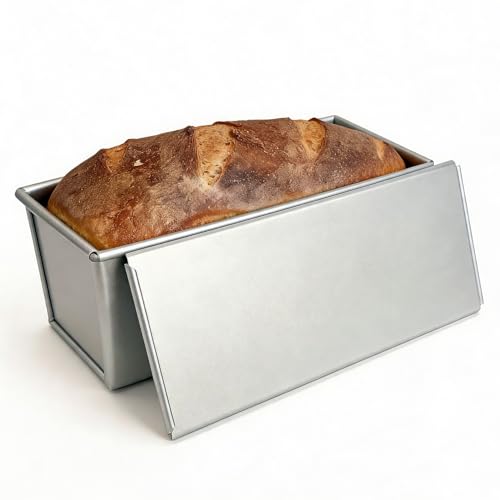
The best pullman loaf pan with lid for square sandwich bread is the USA Pan Pullman Loaf Pan if you want a durable aluminized-steel pan, reliable corners, and a coating that releases dough without requiring extensive seasoning; frequent bakers who prioritize commercial-style heat response should also compare the Chicago Metallic Commercial II Pullman pan.
Our top picks


As an Amazon Associate we earn from qualifying purchases at no extra cost to you. Ratings are shown as listed on Amazon.
Quick picks by baking situation
| Situation | Best choice | Why it fits | Main compromise |
|---|---|---|---|
| Most home kitchens | USA Pan Pullman Loaf Pan, 13 x 4 x 4 inches | Heavy aluminized steel, ridged sides, nonstick Americoat coating, and a sliding lid | Hand washing is preferable, and the ridges make scrubbing awkward |
| Frequent or high-volume baking | Chicago Metallic Commercial II Pullman pan, approximately 13 x 4 x 4 inches | Commercial-style construction and a removable sliding cover designed for repeated use | Coating and lid fit vary by model and require careful identification before purchase |
| Small square loaves | 7.5 x 4 x 4-inch Pullman-style pan | Produces a compact loaf for a small household while using less dough and oven space | Less forgiving if a recipe is written for a full 13-inch pan |
| Lowest initial cost | Uncoated aluminized-steel Pullman pan with lid | Usually costs less and tolerates regular baking temperatures | Needs parchment, greasing, or seasoning, and may develop stuck-on residue |
What matters when choosing a Pullman pan
Dimensions and usable loaf size
A Pullman pan is not simply a taller rectangular loaf tin. Its long, narrow body and sliding lid are designed to constrain dough into a square or nearly square cross-section. The common full-size pan measures about 13 x 4 x 4 inches externally, while smaller versions are often around 9 x 4 x 4 inches or 7.5 x 4 x 4 inches.
External measurements do not equal baking capacity. Rolled rims, wall thickness, and the lid track reduce the internal volume. A 13 x 4 x 4-inch geometric box has 208 cubic inches before those deductions, but its practical dough capacity is commonly around 1.5 to 2 pounds, depending on the recipe and the desired crumb density. Always use the manufacturer’s suggested dough weight when available.
For square sandwich bread, the internal width and height matter more than the outside length. A pan that is 4 inches wide but only 3.5 inches high will produce a flatter loaf, even if its advertised length is similar. Check the inside dimensions or baking instructions rather than comparing only nominal size.
Lid fit and venting
The lid should slide smoothly, remain level, and sit close enough to restrict upward expansion without crushing the dough. A loose cover can allow a domed top or uneven corners; an overly tight lid can scrape the coating and become difficult to remove after baking.
Some lids have a small gap or opening at the end of the track. This is useful because trapped steam needs somewhere to escape, but it also means the loaf may not have perfectly sharp edges. Before baking, move the lid several times while the pan is empty. If it catches, identify whether the problem is a bent rail, baked-on residue, or a lid installed from the wrong end. Do not force it across a damaged coating.
Material and heat performance
Aluminized steel is the most practical material for this style of pan. The steel provides rigidity and holds the long walls square, while the aluminum layer improves heat distribution and reduces the chance of severe hot spots. Dark nonstick coatings can brown crust slightly faster than bright bare metal, so the first bake may require checking five to ten minutes earlier than the recipe suggests.
Thin plain aluminum heats quickly but can flex when filled and may not keep the lid rails aligned. Heavy-gauge steel is more stable, particularly for enriched doughs that rise slowly and remain in contact with the walls for a long time. Cast iron Pullman pans exist as a category, but they are uncommon, heavy, and usually less convenient for a sliding-cover square loaf.
Coating durability
USA Pan’s Pullman pan uses an aluminized-steel body with its Americoat silicone-based nonstick coating and a fluted surface. The coating can release bread well when the pan is correctly filled, but it is not scratch-proof. Chicago Metallic Commercial II models are also commonly sold in aluminized steel with a nonstick finish, although the exact coating and dimensions should be confirmed on the particular product.
Coating damage usually comes from metal utensils, abrasive pads, dishwasher detergents, or sliding a lid over flour-and-sugar residue. A small cosmetic mark is not the same as immediate failure, but peeling, bubbling, or exposed corrosion is a reason to replace the pan. The lid track often wears before the main baking surface because repeated scraping removes finish from the rails.
Capacity: a practical dough calculation
A useful starting estimate for a 13 x 4 x 4-inch Pullman pan is 75 to 85 percent of its geometric volume in dough, adjusted for the bread formula. For example:
- Nominal geometric volume: 13 x 4 x 4 = 208 cubic inches.
- Approximate working volume after allowing for wall thickness and lid clearance: about 175 cubic inches.
- At a dough density near 0.55 ounces per cubic inch, 175 cubic inches corresponds to roughly 96 ounces, or 6 pounds, which is clearly too much for bread because the dough expands substantially during proofing.
- A more useful baking rule is to fill the pan with about 1.5 to 2 pounds of dough, leaving room for proofing before the lid is closed.
The calcul