Key takeaways
- Horizontal zip windows: useful for rifles and crossbows because they create a long, level opening.
- Vertical windows: better for standing archery shots and changing elevation.
- Drop-down mesh: fast to open and close, but it can flap in wind if not secured.
- Shoot-through mesh: convenient for some broadheads and firearms, but confirm the manufacturer’s instructions; not every mesh is intended for every projectile.
- Silent-magnet or quiet-close systems: reduce zipper noise, but magnets can collect debris and are not automatically windproof.
The best ground blinds depend on how you hunt: choose a 3-person hub blind for all-day firearm hunts, a compact 2-person model for bow hunting in tight cover, or a lightweight run-and-gun blind when packed size matters more than room.
Our top picks


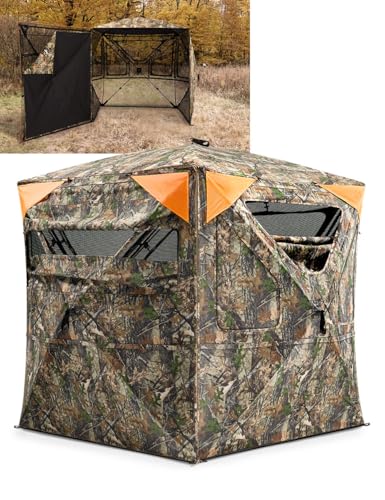
As an Amazon Associate we earn from qualifying purchases at no extra cost to you. Ratings are shown as listed on Amazon.
Best Ground Blinds at a Glance
| Blind type or example | Typical interior | Approx. packed weight | Shooting-window design | Best suited to |
|---|---|---|---|---|
| Barronett Blinds Big Cat 3500 | 80" W × 80" D × 72" H | About 24 lb | Large vertical and horizontal zip openings | Two hunters, firearm hunting, long sits |
| Ameristep Care Taker | 69" W × 69" D × 66" H | About 15 lb | Adjustable shoot-through mesh windows | One or two hunters on a budget |
| Muddy Matrix | 72" W × 72" D × 72" H | About 18 lb | Multiple silent-style zip window panels | Mixed bow and firearm use |
| Rhino Blinds R75 | 75" W × 75" D × 73" H | About 19 lb | Wide vertical and horizontal window openings | Archery hunters needing standing room |
| Compact 1-person hub blind | Approximately 50"–60" W × 50"–60" D | About 8–14 lb | Small zip or drop-down openings | Mobile hunters and tight setups |
Dimensions and weights can vary by generation, fabric pattern, and included accessories, so check the manufacturer’s current specification before ordering. The comparison is most useful as a sizing and portability guide rather than a substitute for the exact product label.
Our Picks by Hunting Situation
Best for maximum comfort: Barronett Blinds Big Cat 3500
The Big Cat 3500 is the stronger choice when concealment is only part of the problem and comfort determines whether you can remain still for several hours. Its roughly 80-inch square footprint gives two adults more usable elbow room than a compact 2-person blind, and the approximately 72-inch height is friendlier to taller hunters.
That extra space has practical value. A compound bow can be raised without immediately contacting a side wall, a firearm can be repositioned with less fabric movement, and a backpack or small heater can stay inside rather than blocking a window. The trade-off is a packed load of roughly 24 pounds and a larger case, which is less appealing for steep or long approaches.
Choose it for food plots, field edges, and semi-permanent locations where you can carry the blind in once and leave it for a season. It is excessive for a quick afternoon move between close-spaced setups.
Best budget-friendly all-rounder: Ameristep Care Taker
The Ameristep Care Taker provides a more compact footprint and generally lower market price than oversized hub blinds. At around 69 inches square and 66 inches high, it can accommodate one hunter comfortably or two hunters with disciplined gear management.
Its adjustable mesh shooting windows are useful for firearm hunters who need a broad field of view, while the smaller interior reduces the amount of fabric that can brush a bow limb or elbow. This blind is a sensible entry point for a hunter who uses a ground blind several times per season but does not need a premium oversized structure.
For two adults, consider the space carefully. Two chairs, packs, and a bow case can make a nominal 2-person blind feel crowded. If both hunters need to draw bows, a larger 3-person model is usually the safer choice.
Best mixed-use option: Muddy Matrix
The Muddy Matrix occupies the useful middle ground between compact portability and full-size comfort. Its approximately 72-inch square interior and 72-inch height are suitable for a seated firearm hunter and workable for archery when the window layout allows a clean draw cycle.
Look closely at the window configuration rather than counting the number of openings. Bow hunters need a low, quiet opening for drawing and a clear path for the upper limb. Firearm hunters generally value broad horizontal visibility and a stable rest position. A blind that offers many small windows may provide less useful visibility than one with fewer, larger openings.
The Matrix is a good fit for hunters who rotate between deer, turkey, and other game and do not want separate bow and firearm blinds.
Best for bow hunters needing standing room: Rhino Blinds R75
The Rhino Blinds R75 has a roughly 75-inch square footprint and approximately 73-inch height, giving an archery hunter more room to stand, turn, and draw than a low-profile 1-person blind. That extra height also makes it easier to sit on a taller chair without placing your head close to the roof.
For bow hunting, test the window position with your actual draw hand and bow orientation before committing to a setup. A right-handed archer and a left-handed archer may prefer opposite sides of the same blind. Keep the shooting opening large enough for the bow limb, but do not expose more mesh than necessary; a wide opening improves visibility while also making movement easier for game to detect.
Head-to-Head: What Matters More Than the Product Name?
Dimensions and usable space
Manufacturers usually publish the outside footprint, not the amount of unobstructed floor area. Hub corners, window hubs, seat height, and sloping walls reduce practical space. As a rough planning rule, allow about 30–36 inches of personal width for one seated hunter with a pack, and more than 40 inches of clear turning space for a standing bow draw.
A 3-person label does not mean three adults can comfortably draw bows inside. It usually means three seated firearm hunters can fit under controlled conditions.
Shooting-window design
- Horizontal zip windows: useful for rifles and crossbows because they create a long, level opening.
- Vertical windows: better for standing archery shots and changing elevation.
- Drop-down mesh: fast to open and close, but it can flap in wind if not secured.
- Shoot-through mesh: convenient for some broadheads and firearms, but confirm the manufacturer’s instructions; not every mesh is intended for every projectile.
- Silent-magnet or quiet-close systems: reduce zipper noise, but magnets can collect debris and are not automatically windproof.
Window placement is also a visibility decision. A low window may hide a seated hunter better, while a high window can improve a standing draw. For firearm hunting, look for a stable lower sill or enough interior height to use a shooting rest without pressing the barrel against fabric.
Weather protection
Most hub blinds use a coated polyester shell, but water resistance depends on fabric coating, seams, roof design, and condition. A larger roof overhang and tightly tensioned roof generally shed rain better than loose fabric. In snow or strong wind, the blind’s stakes and tie-downs matter as much as the shell.
Do not treat a blind as an enclosed shelter for severe weather. Ventilation is important when using a heater, and condensation can wet walls and equipment even when rain does not enter.
Visibility versus concealment
One-way or dark interior fabrics can make it harder for game to see movement inside, but they do not eliminate the need for slow motion. Open windows increase your view and your exposure. Brush the blind into its surroundings, avoid placing it where the entrance is silhouetted, and keep shiny equipment away from the window.
Decision Matrix
| Your situation | Recommended configuration | Why |
|---|---|---|
| First blind, occasional use, limited budget | 2-person hub, 65–70 inch footprint | Reasonable price and setup without carrying an oversized shell |
| Daily hunting from one field location | 3-person blind, 72–80 inch footprint, reinforced roof | More chair, pack, and movement room; comfort repays the extra weight |
| Bow hunting in thick cover | 1- or 2-person blind with vertical windows and quiet closures | Smaller outline and better control during the draw |
| Long walk or public-land rotation | Compact 1-person blind under about 14 lb | Lower carrying burden and faster relocation |
| Two hunters with firearms | 3-person blind with large horizontal windows | Allows separate shooting lanes and less accidental movement |
Setup Time and Packed Size
A typical hub blind can be erected in about 2–5 minutes once the location is prepared. The first setup takes longer because you must choose the entrance direction, stake the corners, tension the roof, and remove packaging creases. A pop-up hub design is faster than a framed or ladder-style blind, but its packed disc or bundle may be awkward on a narrow trail.
For a realistic carry estimate, add the blind’s listed weight to stakes, tie-downs, chair, weapon, clothing, and water. For example, a 19-pound blind plus 3 pounds of stakes and ropes, a 7-pound chair, and a 20-pound hunting pack creates a 49-pound approach before adding a firearm. A 10-pound lighter blind can make a larger difference than a small difference in fabric quality when the route is long.
Ownership Realities and Maintenance
- Hub joints and pole connections usually experience more stress than the fabric. Open and collapse the frame without forcing a bent hub.
- Zippers fail early when sand, leaves, or frozen moisture are dragged through the teeth. Brush them clean and avoid pulling against a snag.
- Let the blind dry completely before storage. Packing damp fabric encourages mildew and creates persistent odor.
- Inspect roof seams, stake loops, and bottom corners after windy hunts. These areas take concentrated loads.
- Store the blind loosely in a dry place rather than compressed under heavy gear.
- Replace missing stakes or frayed tie-downs before the next trip; a sound shell can still blow over if its anchors are inadequate.
When comparing prices, include likely accessories. A blind may require better stakes, additional tie-downs, a ground mat, or a carry strap for your terrain. A low-cost blind used 20 times costs less per outing than a premium blind used twice, but the premium model may be the better value if its larger interior keeps you hunting comfortably through long sits.
Final Buying Recommendation
For most hunters, the best ground blinds are medium-size hub blinds around 70–75 inches square with both horizontal and vertical window options. Choose a Barronett Big Cat 3500 when comfort and two-person firearm use come first, an Ameristep Care Taker for affordable occasional hunting, a Muddy Matrix for mixed bow-and-firearm use, or a Rhino R75 when an archery hunter needs standing room. Prioritize the actual draw cycle, window height, packed carry weight, and anchoring system over a simple person-capacity label.