Key takeaways
- Small ICU: suitable for a compact mirrorless body, one or two lenses, and spare batteries.
- Medium ICU: the sensible starting point for most mirrorless kits and smaller full-frame setups.
- Large ICU: better for a professional body, several lenses, or a moderate telephoto.
- Extra-large ICU: intended for extensive equipment; it consumes more of the pack’s general-purpose storage.
The best F-Stop camera bag for most photographers is the F-Stop Ajna 37L: it offers enough room for a camera, several lenses, a drone or jacket, and a tripod without becoming as cumbersome as the 50L-and-larger packs. Choose the Lotus 32L for shorter hikes and easier carry-on handling, the Tilopa 50L for multi-day camera trips, or the Kashmir 30L when fast urban access matters more than maximum outdoor capacity.
Our top picks


As an Amazon Associate we earn from qualifying purchases at no extra cost to you. Ratings are shown as listed on Amazon.
F-Stop camera bags compared
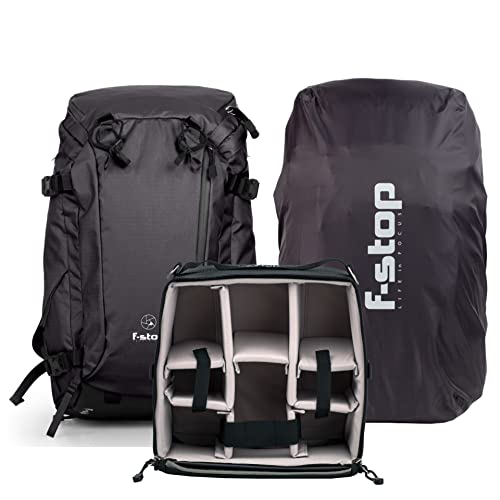
F-Stop’s system separates the outer pack from the padded Internal Camera Unit (ICU). That is the key distinction from a conventional camera backpack: you can change the camera compartment to suit the assignment, or remove it and use the pack as a general travel or hiking bag.
| Pack | Nominal capacity | Approx. weight | Best use | Access and carry-on practicality |
|---|---|---|---|---|
| Lotus | 32L | About 1.6 kg | Day hikes, city-to-trail shooting | Rear camera access; generally the easiest size for airline cabin travel |
| Kashmir | 30L | About 1.7 kg | Travel, street photography, light hiking | Side access plus top storage; compact profile, but side access is less convenient when the pack is fully loaded |
| Ajna | 37L | About 1.7–1.9 kg | All-day landscape and adventure photography | Rear camera access; usually practical as a carry-on when not overpacked |
| Tilopa | 50L | About 2.0 kg | Long trips, large lenses, overnight equipment | Excellent equipment capacity, but too deep or tall for some airline limits when expanded |
| Sukha | 70L | About 2.4 kg | Expeditions and heavy outdoor loads | Not a sensible everyday carry-on; intended for substantial equipment and clothing loads |
Capacity figures are nominal and can vary slightly by generation and configuration. The usable camera capacity depends more on the ICU selected than on the headline volume of the pack.
Best F-Stop camera bags by situation
Best overall: F-Stop Ajna 37L
The Ajna is the most balanced option in the range. Its 37-liter shell leaves space for a medium or large ICU, a rain layer, food, batteries, and a jacket, while remaining manageable for a full day outdoors. The rear opening keeps the camera compartment protected from the ground when the pack is placed face-down, and the top and front storage areas handle items that do not need padding.
Choose an ICU according to your kit rather than automatically buying the largest one. A medium ICU suits a mirrorless body and three or four compact lenses; a large ICU is more appropriate for a full-frame body, telephoto zoom, and several accessories. The Ajna is the strongest choice for photographers who shoot regularly but do not need expedition-sized storage.
Best for shorter hikes and carry-on simplicity: F-Stop Lotus 32L
The Lotus trades some packing room for a smaller, less intimidating shape. It is a good fit for a photographer carrying one body, two or three lenses, a compact tripod, and personal essentials. The rear camera access is secure and keeps the harness side clean, although you must remove the pack to reach the camera compartment.
Its smaller dimensions make it more practical for train travel, crowded streets, and airline cabins. Do not confuse “carry-on friendly” with a guarantee: airline limits differ, and an overfilled ICU or tripod attached externally can still cause problems.
Best for travel access: F-Stop Kashmir 30L
The Kashmir is the better choice when you frequently move between locations and need quicker access than a rear-opening hiking pack provides. Its side-access design can let you reach a camera without fully unpacking, while the main compartment carries clothing or everyday items.
That convenience has a trade-off. Side access works best when the camera body and most-used lens are positioned deliberately; a tightly packed ICU can make the opening awkward. The Kashmir is particularly suitable for urban photography, travel assignments, and photographers who alternate between carrying the pack and working from a shoulder strap.
Best for maximum working capacity: F-Stop Tilopa 50L
The Tilopa is the serious middle ground between a daypack and an expedition pack. It accommodates a larger ICU, longer lenses, warmer clothing, and more support equipment than the Ajna. The harness and hip belt are valuable once the load becomes heavy, but the bag feels unnecessarily large if your normal kit is one camera and two lenses.
It is a better investment for photographers who routinely carry a telephoto, drone, multiple batteries, a laptop, and outdoor layers. For occasional users, the extra volume often encourages overpacking and creates a heavier load than necessary.
Camera inserts: the decision that matters most
An F-Stop pack without an ICU is not a complete camera-protection solution. The insert provides padded dividers and a structured compartment; the pack shell supplies the harness, weather-resistant exterior, and general storage. Check whether an ICU is included in the particular bundle before comparing prices.
- Small ICU: suitable for a compact mirrorless body, one or two lenses, and spare batteries.
- Medium ICU: the sensible starting point for most mirrorless kits and smaller full-frame setups.
- Large ICU: better for a professional body, several lenses, or a moderate telephoto.
- Extra-large ICU: intended for extensive equipment; it consumes more of the pack’s general-purpose storage.
A useful sizing calculation is to count the lenses you actually carry on a normal day, not the lenses you own. If your regular load is a body plus a 24–70mm zoom, a 70–200mm zoom, and one small prime, reserve roughly two-thirds of the ICU for that kit and leave the rest for access and padding. A fully compressed insert is harder to organize and puts more pressure on zippers and dividers.
Harness comfort, protection, and access
F-Stop’s hiking-oriented packs generally distribute weight better than slim camera bags because they use a structured back panel, adjustable shoulder straps, and a hip belt. This matters once the complete load approaches 8–10 kg. Adjust the torso length first, place the hip belt over the hip bones, then tighten the shoulder straps; tightening shoulder straps alone makes a heavy camera pack feel worse.
The exterior fabrics and coated zippers provide useful weather resistance, but they are not a substitute for a waterproof cover or dry bag in sustained rain. Keep batteries, memory cards, and documents in an internal water-resistant pouch. The ICU protects against bumps, not prolonged water exposure.
Access is a practical compromise:
- Rear access protects the camera opening from dirt and makes theft more difficult, but requires removing the pack.
- Side access is faster for a frequently used body and lens, but gives a smaller opening and depends more on careful packing.
- Top access is useful for clothing and food, not as a replacement for a padded camera compartment.
Carry-on and everyday-use reality
The Lotus, Kashmir, and Ajna are the most defensible choices for cabin travel, but capacity is not the same as airline compliance. Measure the fully loaded bag, including the camera insert, tripod, and exterior pockets. A 37-liter pack can exceed a carrier’s depth limit if packed rigidly, while a nominally larger bag may fit when partially filled.
For flights, place dense items close to the back panel, avoid using every external compression strap, and leave enough empty space to compress the top compartment. The Tilopa can work as a cabin bag on some routes when lightly loaded, but it should be selected for its equipment capacity rather than assumed to be universally carry-on compliant.
Durability and ownership costs
The parts most likely to show wear are not the padded ICU walls. Inspect the zipper pulls, mesh side pockets, compression straps, hip-belt padding, and the bottom panel after repeated outdoor use. Sand and dried mud can abrade fabric and make zippers drag. Brush debris away before applying a small amount of manufacturer-approved zipper lubricant; do not force a stuck zipper while the bag is under tension.
Clean the pack with a soft brush and mild soapy water, then air-dry it fully before storage. Avoid machine washing, solvents, and high heat, which can damage coatings and foam. Store the ICU separately if the bag will not be used for months, and do not leave wet rain covers or damp clothing inside.
Replacement dividers and additional ICUs can extend the system’s useful life, but they also raise the total cost. A smaller pack with the right insert is usually better value than a large pack bought “for future gear” and carried half-empty every week.
Quick buying decision
| Your priority | Recommended choice | Why |
|---|---|---|
| Lowest practical size and frequent flights | Lotus 32L | Compact shape and enough room for a modest kit |
| One bag for hiking and photography | Ajna 37L | Best balance of camera, personal, and outdoor storage |
| Fast access while traveling | Kashmir 30L | Side-access design favors mobile shooting |
| Large lenses or multi-day equipment | Tilopa 50L | More ICU and non-camera capacity without expedition scale |
| Expedition-sized loads | Sukha 70L | Designed for substantial gear and clothing, not daily commuting |
For most buyers, start with the Ajna and choose the smallest ICU that safely fits the kit used most often. Move down to the Lotus or Kashmir when compactness or access is the priority, and move up to the Tilopa only when your equipment and clothing genuinely exceed a 30–37-liter daypack.