Key takeaways
- Edge sharpness: Normal cutting gradually dulls any knife. Use a wood or plastic board, and sharpen with a method appropriate for the blade’s hardness and edge angle. A honing rod can realign some edges, but it cannot replace sharpening once the edge is worn.
- Tips and thin edges: These are vulnerable to drops, bones, frozen food, and twisting. Use a cleaver or suitable heavy-duty knife for those tasks instead.
- Finish and handles: Dishwasher detergent, heat, and prolonged moisture can damage finishes and handles. Hand-wash, dry promptly, and store knives so edges do not knock against other utensils.
- Damascus pattern: The layered appearance is not a maintenance-free protective coating. Treat the blade as a quality stainless knife, but do not leave food or moisture on it for extended periods.
Best Damascus Knife Sets for Every Kitchen
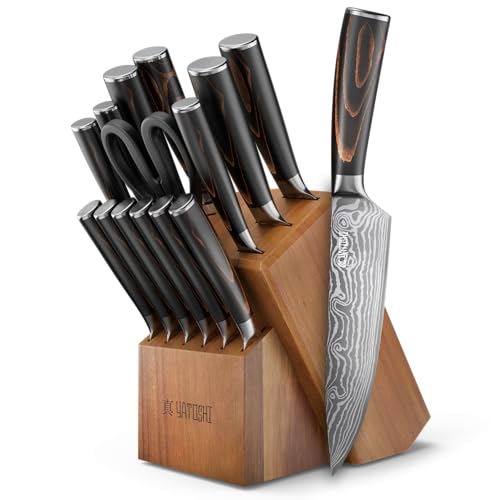
The best Damascus knife set for most kitchens is a compact set with a genuine Japanese-style VG-10 core, a comfortable handle, and the knives you will actually use—not the highest piece count. Choose a softer German-style steel if you prioritize toughness and easy upkeep, or a smaller set if counter and drawer space are limited.
“Damascus” describes the visible layered pattern on a blade; it does not, by itself, tell you how sharp, durable, or well-made the knife is. Look for the core steel, hardness rating, blade geometry, and care instructions. The options below are established product lines, but exact bundle contents and specifications can vary by model and retailer, so check the particular set before buying.
Our top picks



As an Amazon Associate we earn from qualifying purchases at no extra cost to you. Ratings are shown as listed on Amazon.
Quick comparison: what the specifications mean in use
| Knife or set type | Typical blade length | Typical hardness | Best fit | Ownership trade-off |
|---|---|---|---|---|
| Shun Classic 3-piece set | About 3.5–8 in. | About 60–61 HRC | Home cooks who want a small, precise set | Hard edge holds well, but needs careful handling |
| Shun Classic 6-piece set | About 3.5–8 in. | About 60–61 HRC | Frequent cooks wanting a broader core lineup | Higher cost; avoid bones and twisting cuts |
| Yaxell Gou 2-piece set | About 6.5–8 in. | About 63 HRC | Experienced cooks prioritizing edge retention | Very hard steel calls for careful use and sharpening |
| Dalstrong Shogun Series X 5-piece set | About 3.5–9.5 in. | About 60 HRC | Buyers wanting several knife styles in one set | More pieces mean more storage and maintenance |
| German-style Damascus set | Often about 3–8 in. | Often about 56–58 HRC | Busy kitchens and cooks who value toughness | Usually needs more frequent edge touch-ups |
Lengths and hardness figures are representative of named product lines or common steel categories, not a guarantee for every bundle. A set’s total weight is rarely listed consistently, so handle balance and grip are best checked in person when possible.
Choose by how you cook
| Your situation | Best starting point | Why |
|---|---|---|
| Small kitchen or first quality set | Three-piece set: chef’s knife, utility knife, paring knife | Covers most prep without paying for duplicate blades or a large block. |
| Frequent vegetable and meat prep | Five- or six-piece set with chef’s knife, paring knife, bread knife, and shears | Adds useful task coverage; confirm the exact contents before purchase. |
| Experienced cook who sharpens carefully | Hard Japanese-style core, such as VG-10 or a higher-hardness premium line | Can hold a fine edge longer, but is less forgiving of impact and poor technique. |
| Shared household or rougher daily use | More moderate-hardness, German-style blade | Typically favors toughness and easier upkeep over maximum edge retention. |
| Limited drawer space | Two- or three-knife set with a blade guard or compact storage | A large block takes valuable counter space and can encourage buying knives you do not need. |
Standout Damascus sets by use case
Best compact choice: Shun Classic 3-piece set
Shun Classic sets commonly pair VG-MAX core steel with layered Damascus cladding and a pakkawood handle. A compact bundle is a sensible pick when the priority is a capable chef’s knife plus smaller blades, rather than a full countertop block. The relatively high hardness supports edge retention, but the thin, hard edge is not intended for frozen food, bones, or forceful prying. Wash and dry each knife by hand.
Best expanded Japanese-style lineup: Shun Classic 6-piece set
A larger Classic bundle can suit someone who cooks often and wants more task-specific coverage from the same product family. Before paying for the additional knives, check whether the set includes a bread knife, honing rod, shears, or storage; bundles differ. The main advantage is consistency in grip and blade feel. The main drawback is that the extra pieces still need safe storage and occasional sharpening.
Best for edge retention: Yaxell Gou 2-piece set
Yaxell’s Gou line uses a very hard Japanese steel construction, with many models listed around 63 HRC and a layered Damascus finish. A two-knife pairing can make more sense than a large set for a confident cook who wants a fine edge for slicing and precise prep. Hardness is not a measure of overall quality on its own: at this level, careless contact with a hard board, twisting through dense food, or dropping a knife can chip the edge. Choose it for controlled cutting, not a rough-use kitchen.
Best variety in one purchase: Dalstrong Shogun Series X 5-piece set
The Shogun Series X is a broad product line with Damascus-patterned blades and multiple set configurations. Its larger bundles appeal to buyers who want a range of blade shapes at once. Compare the actual included pieces with your current kitchen: a second slicing or specialty knife may add less value than a bread knife or a useful paring knife. As with any multi-piece set, more blades also mean more cleaning, storage, and future sharpening.
Best for a busier, less delicate kitchen: a moderate-hardness German-style Damascus set
If several people use the knives or they are likely to encounter less-than-ideal technique, look for a reputable set with a tougher, moderate-hardness core rather than choosing by the Damascus pattern. German-style steels are often easier to touch up and more resistant to chipping, though they may lose their keen edge sooner than harder Japanese-style blades. Verify the exact steel and hardness: “German-style” is a broad category, not a precise specification.
Steel, hardness, and handle comfort: the practical differences
VG-10 is a common Japanese knife steel valued for a balance of sharpness, corrosion resistance, and edge retention. VG-MAX is Shun’s proprietary steel used in Classic knives. Higher-end lines may use harder steels such as SG2/R2. German-style stainless steels tend to prioritize toughness and straightforward maintenance. In every category, heat treatment and blade geometry matter as much as the steel name.
Hardness is commonly reported on the Rockwell C scale (HRC). Around 56–58 HRC generally leans toward toughness and easier maintenance; around 60–63 HRC can support longer edge life but increases the need for careful handling. These are tendencies, not guarantees. A thin, hard knife may feel exceptionally sharp but is less tolerant of lateral force. A softer knife can roll at the edge instead of chipping, and may need more frequent honing or sharpening.
Handle comfort is personal. Pakkawood is a resin-stabilized wood composite, while other sets may use wood or synthetic materials. Check whether the handle suits your grip, whether the balance feels comfortable, and whether the heel or bolster interferes with your pinch grip. A beautifully patterned blade is little consolation if the handle feels awkward during a long prep session.
What wears first—and how to make a set last
- Edge sharpness: Normal cutting gradually dulls any knife. Use a wood or plastic board, and sharpen with a method appropriate for the blade’s hardness and edge angle. A honing rod can realign some edges, but it cannot replace sharpening once the edge is worn.
- Tips and thin edges: These are vulnerable to drops, bones, frozen food, and twisting. Use a cleaver or suitable heavy-duty knife for those tasks instead.
- Finish and handles: Dishwasher detergent, heat, and prolonged moisture can damage finishes and handles. Hand-wash, dry promptly, and store knives so edges do not knock against other utensils.
- Damascus pattern: The layered appearance is not a maintenance-free protective coating. Treat the blade as a quality stainless knife, but do not leave food or moisture on it for extended periods.
For a simple routine, rinse and hand-wash after use, dry immediately, and put the knife in a sheath, drawer insert, or block that protects the edge. Sharpen when careful cutting starts to require noticeably more pressure. That keeps the edge usable without waiting until it is severely dull.
Bottom line
For most home cooks, a compact Shun Classic set is a strong choice when you want Japanese-style sharpness and are willing to care for a harder edge. Choose Yaxell Gou for edge retention and controlled technique, Dalstrong Shogun for a wider selection of knife types, or a verified moderate-hardness German-style set for a more forgiving shared kitchen. The best Damascus knife sets are the ones whose steel, hardness, handle, and included pieces match your actual cooking habits—not simply the ones with the most layers or the largest block.