Key takeaways
- Best for flat-pack furniture and household repairs: Bosch GO Professional, with a slim 3.6V format, electronic push activation, and approximately 5Nm of torque.
- Best for controlled workshop work: Makita DF012DSE, which combines a pistol or inline grip, a mechanical clutch, two speed ranges, and more torque than basic USB screwdrivers.
- Best for frequent fastening: Milwaukee M12 2401-20, a 12V screwdriver with substantially higher torque and a removable battery system.
- Best for users who prefer motion control: DeWalt DCF680, an 8V gyroscopic screwdriver whose speed responds to wrist rotation.
- Best for occasional light use on a tight budget: a 4V USB-rechargeable screwdriver with a built-in battery and a basic clutch.
Best Cordless Screwdrivers
The best cordless screwdriver for most homes is a compact 3.6V–4V model with adjustable torque, a two-position handle, USB or dock charging, and a weight below 600g; choose a 12V drill-driver instead when you regularly drive long screws, drill holes, or work with hard timber.
Quick picks by situation
- Best for flat-pack furniture and household repairs: Bosch GO Professional, with a slim 3.6V format, electronic push activation, and approximately 5Nm of torque.
- Best for controlled workshop work: Makita DF012DSE, which combines a pistol or inline grip, a mechanical clutch, two speed ranges, and more torque than basic USB screwdrivers.
- Best for frequent fastening: Milwaukee M12 2401-20, a 12V screwdriver with substantially higher torque and a removable battery system.
- Best for users who prefer motion control: DeWalt DCF680, an 8V gyroscopic screwdriver whose speed responds to wrist rotation.
- Best for occasional light use on a tight budget: a 4V USB-rechargeable screwdriver with a built-in battery and a basic clutch.
These are different tools rather than direct substitutes. A small screwdriver is easier to control inside cabinets and less tiring overhead, while a 12V model is better equipped for structural screws, repeated work, and drilling with the right chuck.
Our top picks

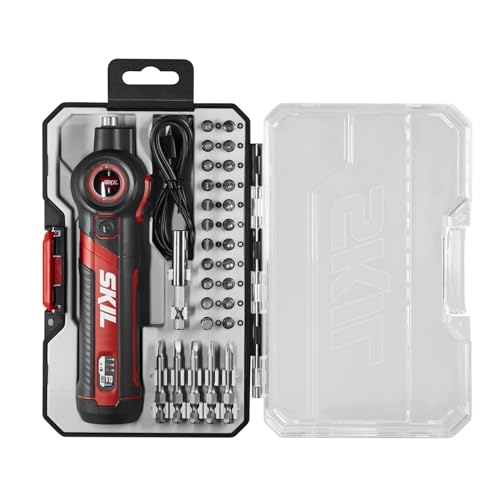


As an Amazon Associate we earn from qualifying purchases at no extra cost to you. Ratings are shown as listed on Amazon.
Head-to-head comparison
| Model or type | Published voltage | Maximum torque | Top speed | Approximate weight | Best use |
|---|---|---|---|---|---|
| Bosch GO Professional | 3.6V | 5Nm | 360rpm | 0.32kg | Furniture, cabinets, electronics enclosures |
| DeWalt DCF680 | 8V MAX | 4.5Nm | 430rpm | About 0.5kg | Fast household fastening and electrical work |
| Makita DF012DSE | 7.2V | 5.6Nm hard / 3.6Nm soft | 650rpm | About 0.53kg | Controlled workshop assembly |
| Milwaukee M12 2401-20 | 12V | 19Nm | 500rpm | About 0.9kg with compact battery | Frequent fastening and tougher materials |
| Typical 4V USB screwdriver | 3.6V–4V | 2–5Nm | 180–300rpm | 0.35–0.65kg | Light-duty home tasks |
Weights vary according to whether a battery, charger, belt clip, or case is included. Manufacturers also measure torque under different conditions, so the figures are useful for broad comparison rather than a guarantee of identical real-world performance.
Torque: how much is enough?
Torque determines how strongly the driver can turn a fastener before stalling. For assembling furniture, replacing cabinet handles, tightening switch plates, and installing small hinges, around 2–5Nm is normally sufficient. More torque can be a disadvantage if the tool has poor control: it can strip a screw head, crush soft wood, or snap a small fastener.
A 7.2V or 8V model with a clutch is a useful middle ground. It offers more authority than a basic 4V screwdriver while remaining light enough for overhead work. Choose a 12V screwdriver when you routinely drive 50mm or longer wood screws, install many fasteners in one session, or work with dense timber and sheet materials.
Do not confuse a screwdriver’s maximum torque with the setting you should use. Begin on a low clutch setting, drive the screw until its head is nearly flush, and increase the setting only if the tool stops too early. The correct setting is the lowest one that seats the fastener securely.
Speed control and handling
Variable speed is more valuable than a high top-speed number. Slow startup helps the bit stay engaged with a Phillips or Pozidriv recess. Faster rotation then reduces time on long screws. The Bosch GO uses pressure-based electronic activation, while the DeWalt DCF680 uses gyroscopic control. Traditional triggers, as found on many 12V tools, offer the most familiar control.
A two-position handle matters in cramped spaces. Inline mode is useful inside a drawer or along a narrow shelf; pistol mode gives better wrist leverage for ordinary wall and furniture work. Look for a lock-off or manual mode if you often begin screws by hand. It prevents the motor from starting unexpectedly and allows the tool to function as a manual screwdriver when the battery is empty.
Battery runtime and charging
Runtime depends more on screw length, material, clutch setting, and pauses than on voltage alone. A compact 3.6V tool may drive roughly 150–300 short screws per charge in light furniture work, while a small 12V battery can handle several hundred similar fasteners. Those figures are practical planning ranges, not standardized laboratory ratings.
Consider this simple workload calculation: if a project requires 120 short screws and your chosen tool averages 200 screws per charge, one full battery should be enough, but a partly discharged battery or dense material removes the margin. For a 300-screw job, a removable-battery system is preferable because a spare battery lets you continue immediately instead of waiting 60–180 minutes for charging.
Built-in USB batteries keep the tool compact and inexpensive, but the battery is usually not user-replaceable. That can be acceptable for occasional use. For a workshop, a replaceable battery platform has better ownership value, especially if you already own compatible batteries for other tools.
Bit compatibility: the detail that prevents frustration
Most cordless screwdrivers use a 6.35mm (1/4-inch) hex bit holder. This accepts standard driver bits, magnetic bit holders, countersinks, and many short sockets. Check whether the holder is magnetic, quick-release, or a locking collet. A magnetic holder is convenient for rapid bit changes, while a locking collet retains bits more securely when working overhead.
Common household jobs call for Phillips PH1 and PH2, Pozidriv PZ2, slotted, Torx T10–T25, and hex bits. Pozidriv screws require Pozidriv bits rather than Phillips bits; using the wrong profile is a frequent cause of cam-out and damaged heads. For long screws, use impact-rated bits only when the tool and accessory manufacturer permit them. A normal screwdriver does not become an impact driver simply because an impact-rated bit is fitted.
Decision matrix
| Your situation | Recommended format | Why | What to avoid |
|---|---|---|---|
| Under 20 uses per year, small living space | 3.6V–4V USB model | Light, compact, and inexpensive to store | Large 12V kits with unused accessories |
| Flat-pack furniture and cabinet hardware | 3.6V–8V model with clutch | Better control and less wrist fatigue | High-torque drill-drivers without a fine clutch |
| Several projects each month | 7.2V–12V removable-battery tool | Faster work and replaceable batteries | Built-in batteries with no charge indicator |
| Workshop, dense timber, or long screws | 12V screwdriver or drill-driver | Higher torque and better sustained performance | Low-power models rated only for light fastening |
| Overhead or confined-space work | Tool under 600g with inline mode | Improves balance and reduces fatigue | Bulky batteries and extended chucks |
Durability and ownership realities
The first parts to show wear are usually the bit holder, clutch mechanism, trigger or electronic switch, and battery. A worn bit holder may develop side-to-side movement; a clutch that slips unpredictably can make consistent fastening difficult. Keep bits clean and replace them when their tips become rounded. Damaged bits require more pressure, which increases the chance of stripping the screw.
Brush dust and wood particles can enter ventilation openings. After use, remove the battery if it is removable and brush or blow debris away with low-pressure air. Do not spray lubricant into the electronics or leave the tool in a damp shed. Store lithium-ion batteries partly charged rather than completely empty, and avoid charging them in extreme heat or cold.
The most common mistake is using maximum speed and maximum clutch torque for every job. Start slowly, keep the bit aligned with the fastener, and let the clutch stop the motor instead of forcing the tool through a stalled screw. Pre-drill a pilot hole in hard or splitting-prone timber; this reduces required torque and improves the final result.
Price expectations
Basic 4V cordless screwdrivers generally occupy the lower-cost range, while branded 3.6V–8V models with better clutches and cases sit in the mid-range. A 12V tool with a battery and charger usually costs more initially, but the price can be better value for frequent users because batteries may be shared across drills, lights, and other tools. Compare the complete kit price, battery capacity, charger speed, and replacement-battery cost rather than comparing bare-tool prices alone.
Final recommendation
Choose the Bosch GO Professional or a comparable 3.6V–4V clutch-equipped tool for ordinary household fastening. Select the Makita DF012DSE or DeWalt DCF680 when speed control, balance, and repeated assembly matter more. Move to the Milwaukee M12 2401-20 or another reputable 12V platform for workshop use and higher torque. In every case, prioritize a usable clutch, comfortable grip, suitable bit holder, and a battery plan that matches how often you work.