Key takeaways
- Intake filters: Protect the finish from shop dust and protect fans and heating equipment. Replace them before they visibly collapse or discolor severely.
- Exhaust filters: Capture overspray before it enters ductwork or the exhaust stack. Their loading directly affects airflow.
- Ceiling filter media: Especially important in downdraft booths because a partially blocked ceiling can create uneven air movement over the vehicle.
- Make-up air: Heated replacement air prevents negative pressure, door problems, backdrafting, and inconsistent booth temperature.
The best commercial spray booth for auto painting is usually a full-size downdraft booth from Global Finishing Solutions, Blowtherm, or Accudraft when finish quality and daily production matter; a crossdraft or semi-downdraft booth is the better value when space and budget are limited.
Our top picks

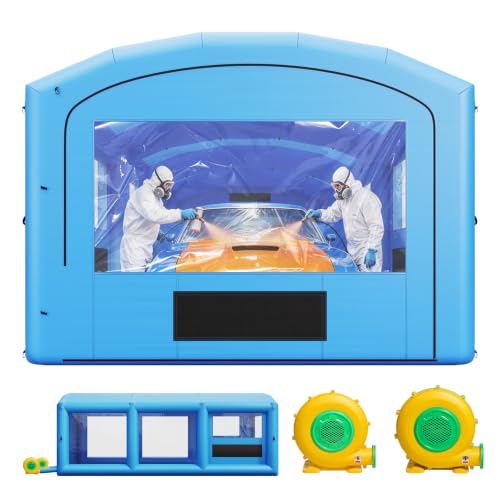

As an Amazon Associate we earn from qualifying purchases at no extra cost to you. Ratings are shown as listed on Amazon.
Best commercial spray booths by operating situation
| Situation | Best booth type | Typical inside dimensions | Why it fits |
|---|---|---|---|
| High-volume collision or custom shop | Full downdraft | 14 ft W × 27–30 ft L × 9–10 ft H | Cleanest airflow pattern and room for full-size vehicles |
| Regular work with limited construction budget | Semi-downdraft | 12–14 ft W × 24–27 ft L × 8–9 ft H | Good finish quality without the excavation or raised floor of a pit-style booth |
| Small repair, restoration, or occasional commercial use | Crossdraft | 12 ft W × 24 ft L × 8 ft H | Lower installation complexity and lower initial cost |
| Large vans, box trucks, or multiple vehicles | Truck-height downdraft or crossdraft | 16 ft W × 30–40 ft L × 12–14 ft H | Provides clearance for tall roofs, mirrors, doors, and access equipment |
The dimensions above are planning ranges, not substitutes for a manufacturer’s engineered layout. Global Finishing Solutions, Blowtherm, and Accudraft all offer automotive booth configurations that can be specified around vehicle size, paint process, and local code requirements.
Head-to-head: which booth design is best?
Full downdraft booths: best finish and highest installation burden
A downdraft booth draws filtered air from the ceiling and moves overspray downward through a grated floor or exhaust pit. This carries dust and paint particles away from the vehicle rather than across its surfaces. For shops spraying several vehicles per week, especially shops applying clearcoat or high-gloss custom finishes, this is normally the strongest choice.
The trade-off is infrastructure. A pit-style downdraft booth may require excavation, reinforced flooring, a raised floor assembly, substantial exhaust ducting, and a larger make-up-air system. The building also needs enough ceiling height for the booth shell, lighting, ductwork, and service access.
Semi-downdraft booths: the practical middle ground
Semi-downdraft designs introduce air near the front ceiling and exhaust it toward the rear or lower wall. They improve overspray control compared with a basic crossdraft booth while avoiding some of the structural work associated with a full downdraft floor.
This design is often the sensible choice for a growing collision shop that needs repeatable results but cannot justify a major building modification. It still requires correct exhaust discharge, filtered intake air, fire protection, and sufficient make-up air.
Crossdraft booths: lowest entry cost, more demanding technique
In a crossdraft booth, filtered air enters at one end and travels horizontally across the vehicle to exhaust filters at the opposite end. Crossdraft booths are generally simpler to install and may work well for primer, industrial refinishing, restoration, or lower-volume automotive work.
Because the airflow crosses the vehicle, the side closest to the intake can affect the side closest to the exhaust. Careful gun technique, correct flash times, clean filters, and controlled vehicle positioning become more important. A crossdraft booth is not automatically unsuitable for quality work, but it offers less airflow advantage than a well-designed downdraft system.
Airflow, filtration, and operating costs
Many automotive booths are designed around approximately 80–100 feet per minute of average face velocity, although the required figure depends on the booth design, opening size, spray process, and applicable regulations. A 14 ft × 28 ft booth has 392 square feet of floor area. At an illustrative 90 feet per minute across that area, the airflow calculation is:
392 sq. ft. × 90 fpm = 35,280 cubic feet per minute.
This is only a sizing illustration. Actual fan selection must account for filter loading, pressure loss, duct length, burner or heater resistance, and the manufacturer’s tested airflow. Oversizing or undersizing the fan can create poor capture, excessive energy use, or unstable spray conditions.
- Intake filters: Protect the finish from shop dust and protect fans and heating equipment. Replace them before they visibly collapse or discolor severely.
- Exhaust filters: Capture overspray before it enters ductwork or the exhaust stack. Their loading directly affects airflow.
- Ceiling filter media: Especially important in downdraft booths because a partially blocked ceiling can create uneven air movement over the vehicle.
- Make-up air: Heated replacement air prevents negative pressure, door problems, backdrafting, and inconsistent booth temperature.
Filter life varies with paint volume, product type, cleaning discipline, and transfer efficiency. Budget for filter replacement as a routine operating cost rather than treating it as an occasional repair.
Vehicle-size fit: measure the working envelope, not just the car
A booth must fit the vehicle, painter, spray gun, hose, lights, and door swing. For a typical passenger car, a 12 ft-wide booth can work, but 14 ft provides more comfortable side clearance. For full-size pickups, a 14 ft width is safer. Vans and box trucks often need 16 ft or more, greater door height, and additional length.
Use this planning method before requesting quotes:
- Measure the vehicle’s maximum length, width including mirrors, and height including roof accessories.
- Add at least 3–4 ft of working clearance on each side where painters must move around the vehicle.
- Add clearance behind the vehicle for hose movement and in front for doors, ramps, or vehicle positioning.
- Check the booth’s clear opening, not merely its outside dimensions.
- Confirm that lifts, masking stands, exhaust ducts, heaters, and light fixtures do not reduce usable clearance.
For example, a 6.5 ft-wide pickup with mirrors may need roughly 9.5–10.5 ft of practical interior width before allowing comfortable painter movement. A nominal 12 ft booth may fit it physically, while a 14 ft booth will be less restrictive during doors-open and bedside work.
Installation requirements that change the purchase decision
Obtain an engineered site review before choosing a booth. The installer should evaluate slab thickness and levelness, ceiling height, electrical service, gas capacity if heated, exhaust routing, roof penetrations, fire suppression, hazardous-material storage, and make-up-air discharge.
Commercial spray booths commonly require explosion-resistant or suitably rated electrical components in designated areas, interlocked fans and burners, emergency controls, approved lighting, grounding, and fire protection. Requirements vary by jurisdiction, but NFPA 33 and local building, fire, mechanical, and environmental authorities are key references in the United States. A booth that fits the floor plan may still fail permitting if exhaust termination, separation distances, or ventilation calculations are inadequate.
Ask each supplier for:
- A stamped or otherwise code-appropriate layout where required
- Specified airflow and static-pressure data
- Filter sizes and replacement costs
- Heater output and fuel or electrical requirements
- Installation scope, including ductwork, roof work, wiring, and commissioning
- Warranty coverage for fans, controls, burners, lights, and booth panels
Durability and ownership realities
Paint booth panels and floors usually last far longer than filters, door seals, light lenses, belts, fan bearings, and booth coatings. Overspray gradually builds on walls and fixtures, reducing light output and creating contamination risk. Schedule cleaning rather than waiting until the booth looks heavily coated.
Common ownership mistakes include running with loaded filters, using household fans or unapproved heaters, storing paint and solvent inside the booth, allowing hoses to drag across filters, and opening booth doors during flash or cure cycles. These practices can reduce finish quality and create serious safety and compliance problems.
For a busy shop, a more expensive downdraft booth can be economical if it reduces rework. Suppose a shop completes 12 vehicles per month and a superior airflow layout prevents one $450 repaint. That is $450 of avoided rework monthly, before counting labor and scheduling disruption. The calculation is not a guarantee—the result depends on process control—but it shows why booth design should be compared against total operating cost rather than purchase price alone.
Final recommendation
Choose a full downdraft booth from an established manufacturer such as Global Finishing Solutions, Blowtherm, or Accudraft when the shop paints vehicles frequently and premium finish consistency justifies the installation work. Choose semi-downdraft when you need a balanced solution for regular production. Choose crossdraft when budget, building constraints, or low usage outweigh maximum airflow performance.
The best commercial spray booth for auto painting is the one that matches the largest vehicle you will actually paint, provides documented airflow and filtration performance, can be permitted at your site, and has replacement parts and service available. Compare complete installed proposals—not just the booth shell—before making the decision.