Key takeaways
- Particle size: Small bonsai generally suit particles around 2–5 mm; medium trees commonly use 4–8 mm; large trees may use 6–12 mm. Very fine dust fills air gaps and slows drainage.
- Drainage: Water should pass through the pot quickly, but the particles should still hold a thin film of moisture.
- Water retention: Akadama and some organic ingredients retain more water than lava or pumice. More retention is useful in dry conditions, but not automatically better.
- Structure: The ingredients should resist collapsing into mud. Decomposed particles reduce drainage and can make watering inconsistent.
- pH and salts: Most bonsai mixes are mildly acidic to neutral and contain little nutrition. Fertilizer is normally supplied separately, which makes feeding easier to control.
The best bonsai soil mix is a free-draining, particle-based blend matched to your tree’s watering routine: use roughly 1/3 akadama, 1/3 pumice, and 1/3 lava rock for a versatile starting point, then adjust it for species, climate, and pot size.
Our top picks
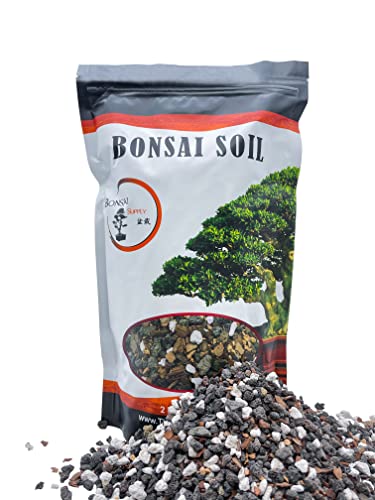
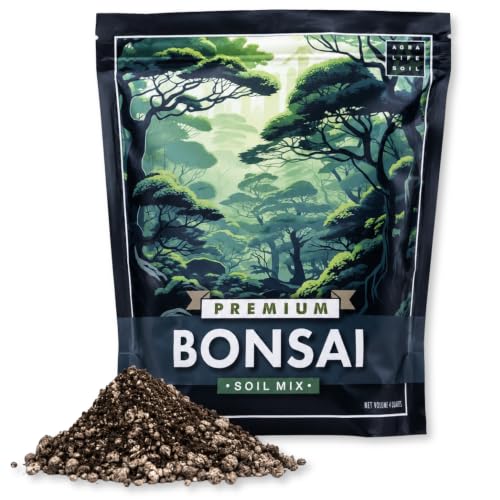


As an Amazon Associate we earn from qualifying purchases at no extra cost to you. Ratings are shown as listed on Amazon.
Best bonsai soil mixes by situation
| Situation | Best choice | Recommended blend | Why it fits |
|---|---|---|---|
| First bonsai or irregular watering | Ready-to-use organic-mineral mix | About 50% porous aggregate, 30% akadama or fired clay, 20% bark or coco-based material | More forgiving moisture retention without becoming garden-soil heavy |
| Indoor tropical bonsai | Fine-to-medium mineral mix | 40% pumice, 30% akadama, 20% lava, 10% bark or coco coir | Retains moderate moisture while preserving air around the roots |
| Outdoor juniper, pine, or spruce | Fast-draining mineral mix | 40% pumice, 30% lava rock, 30% akadama | Reduces the risk of persistently wet roots and supports strong drainage |
| Hot, dry climate or frequent travel | Moisture-retentive blend | 40% akadama, 30% pumice, 20% bark, 10% lava | Holds more usable water while remaining more open than ordinary potting soil |
| Advanced grower or large collection | Custom mineral blend | Adjust each ingredient and particle size by species and watering frequency | Offers the most control over drainage, root development, and fertilizing |
What makes a bonsai soil mix effective?
Bonsai roots need both water and oxygen. A mix that stays saturated can exclude air and encourage root problems, while an excessively coarse mix may dry before the tree can use enough water. The useful compromise is a blend of stable particles with air spaces between them.
- Particle size: Small bonsai generally suit particles around 2–5 mm; medium trees commonly use 4–8 mm; large trees may use 6–12 mm. Very fine dust fills air gaps and slows drainage.
- Drainage: Water should pass through the pot quickly, but the particles should still hold a thin film of moisture.
- Water retention: Akadama and some organic ingredients retain more water than lava or pumice. More retention is useful in dry conditions, but not automatically better.
- Structure: The ingredients should resist collapsing into mud. Decomposed particles reduce drainage and can make watering inconsistent.
- pH and salts: Most bonsai mixes are mildly acidic to neutral and contain little nutrition. Fertilizer is normally supplied separately, which makes feeding easier to control.
Head-to-head: the main bonsai soil ingredients
| Ingredient | Typical particle size | Water retention | Drainage and aeration | How long it stays useful |
|---|---|---|---|---|
| Akadama | 2–12 mm | Medium to high | Good initially; declines as particles soften | About 1–4 years, depending on quality and watering |
| Pumice | 3–10 mm | Low to medium | Very good; lightweight and porous | Often 5 years or more |
| Lava rock | 3–12 mm | Low | Excellent; heavy and structurally stable | Usually 5 years or more |
| Horticultural bark | 3–8 mm | Medium to high | Moderate when fresh, lower as it decomposes | About 1–3 years |
| Coco coir | Fine to 6 mm | High | Moderate; can retain too much water if overused | About 1–3 years in a bonsai pot |
| Peat-based potting soil | Mostly under 3 mm | High | Lower; compacts more readily | Usually less suitable as the main ingredient |
Akadama: the moisture-control ingredient
Akadama is a fired Japanese clay commonly used in bonsai. It has useful water retention and changes appearance as it dries, making watering easier to judge. Its weakness is gradual breakdown, especially in cold, wet conditions or when a low-quality grade is used. A blend containing pumice or lava helps preserve open spaces as akadama softens.
Pumice: the all-purpose aerator
Pumice is lightweight, porous, and resistant to collapse. It provides a strong foundation for many mixes, particularly for trees that dislike wet roots. Because it holds less water than akadama, a pumice-heavy blend may require more frequent watering in small pots or hot weather.
Lava rock: drainage and weight
Lava rock creates durable air spaces and adds weight, which helps prevent taller bonsai from tipping. It usually holds less water than akadama or bark. Its irregular edges are not a problem when the particles are screened and not excessively sharp or dusty.
Organic ingredients: useful, but easy to overdo
Bark, coco coir, and other horticultural organics can make watering less demanding. They also decompose, so they should not usually dominate the mix. Ordinary garden soil and dense multipurpose compost are poor substitutes for bonsai substrate because they compact inside shallow pots and can obstruct drainage holes.
Ready-to-use versus custom blends
Ready-to-use mix
A commercial bonsai mix is the better choice when you have one or two trees, are learning watering habits, or want consistent particle grading without buying several ingredients. Look for a product that lists its ingredients and particle range. A mix with mostly fine dust, unlisted “soil,” or a strong compost component may drain less reliably than the label suggests.
Ready-made mixes commonly cost about $10–$25 for 2–4 quarts, depending on the ingredients and whether akadama is included. The higher initial price can be worthwhile because a small bonsai may use only 1–2 quarts at repotting.
Custom blend
Mixing your own is more economical for a collection and lets you compensate for local conditions. A basic 9-quart batch using equal parts akadama, pumice, and lava requires 3 quarts of each ingredient. If the ingredients cost approximately $15, $10, and $8 per 8-quart bag respectively, the material cost is:
- Akadama: 3/8 × $15 = $5.63
- Pumice: 3/8 × $10 = $3.75
- Lava rock: 3/8 × $8 = $3.00
- Total for 9 quarts: approximately $12.38, or $1.38 per quart
This calculation excludes shipping and screening, which can make small-volume purchases less economical. Custom blending becomes more attractive when buying larger bags or repotting several trees at once.
How to choose particle size
Particle size should match both the root ball and the pot. Fine particles are suitable for a small tree with fine roots, but they dry unpredictably when mixed with large chunks. As a practical guide, use particles roughly one-quarter to one-third the diameter of the drainage holes. Screen out powder and particles that are too large for the container.
- Small shohin bonsai: approximately 2–4 mm.
- Medium bonsai: approximately 4–7 mm.
- Large bonsai: approximately 6–12 mm.
Do not select a coarse mix solely because it drains quickly. If the pot is tiny, the tree is in full sun, or you can water only once a day, slightly smaller particles or an additional 10–20% moisture-retentive ingredient may be more practical.
Species-specific adjustments
- Juniper and pine: favor a mineral-heavy blend, such as 40% pumice, 30% lava, and 30% akadama. Avoid a dense, peat-heavy substrate.
- Maple: use a balanced blend with about 40% akadama, 30% pumice, and 30% lava or fine bark. Maples appreciate moisture but still need oxygen around their roots.
- Chinese elm: a general 1:1:1 mineral blend works well, with extra pumice in humid climates or extra akadama in dry ones.
- Ficus and other tropical bonsai: include moderate moisture retention, such as 40% pumice, 30% akadama, 20% bark, and 10% lava, while ensuring the indoor pot has unobstructed drainage.
- Succulent-style bonsai and trees in rainy climates: increase lava and pumice and reduce bark, coir, or other water-holding materials.
Ownership realities and common mistakes
The ingredient that usually wears out first is akadama, followed by bark or coir. Inspect the substrate when watering: if water pools on top, drains slowly, or the mix has become a fine mass, it may be time to repot even if the tree appears healthy. Stable pumice and lava can often be reused after thorough cleaning, but remove old roots and discard material that smells sour or has collapsed.
- Rinse dusty mineral ingredients before mixing so fines do not fill the pot’s air spaces.
- Do not add fertilizer to the soil mix unless the product is specifically designed for that purpose; controlled feeding is easier after planting.
- Cover drainage holes with mesh, but do not block them with a thick layer of gravel. A separate gravel layer does not improve drainage inside a shallow pot.
- Water the newly potted tree thoroughly until water flows from the drainage holes, then adjust frequency based on drying speed rather than a fixed calendar.
- Do not reuse old mix without removing decomposed organic matter and salt deposits.
Final recommendation
For most buyers, a screened ready-to-use mix based on akadama, pumice, and lava is the safest starting point. Choose a 2–5 mm blend for small bonsai, 4–8 mm for medium trees, and a more mineral-heavy formula for conifers or wet climates. Once you know how quickly your tree’s pot dries, custom blending becomes worthwhile: increase akadama or organic material for moisture retention, and increase pumice or lava for faster drainage and longer-lasting structure.