Key takeaways
- The best bar tool sets for home cocktails, by situation The best bar tool sets for most home cocktail makers are 18- to 24-ounce stainless steel shaker sets with a Hawthorne strainer, jigger, mixing spoon, and a storage stand or…
The best bar tool sets for home cocktails, by situation
The best bar tool sets for most home cocktail makers are 18- to 24-ounce stainless steel shaker sets with a Hawthorne strainer, jigger, mixing spoon, and a storage stand or fitted case. Choose a compact four-piece kit if you make drinks occasionally, a larger set with a mixing glass if you regularly serve stirred cocktails, and a cobbler shaker if you value simple cleanup over the flexibility of a three-piece shaker.
Set contents and dimensions vary by seller, so check the exact listing before buying. The figures below are common product specifications and useful comparison points, not guarantees for every version of a brand’s set. Market prices are broad 2026 ranges; promotions and included accessories can shift them.
Our top picks

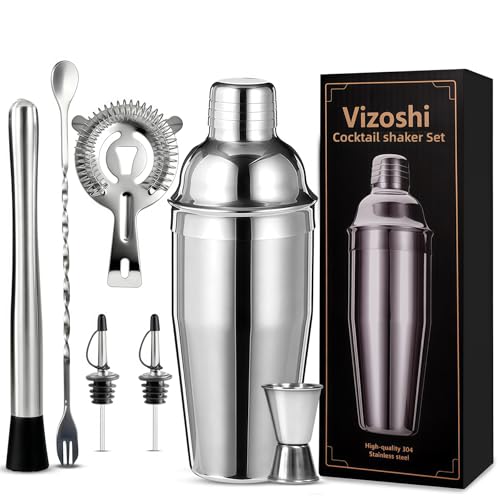

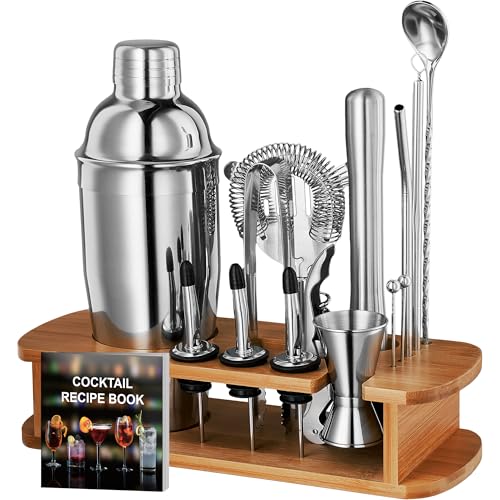
As an Amazon Associate we earn from qualifying purchases at no extra cost to you. Ratings are shown as listed on Amazon.
Quick comparison
| Set or format | Typical pieces | Shaker or glass capacity | Common material | Storage | Approx. price range |
|---|---|---|---|---|---|
| Barfly Essentials 4-Piece Set | Shaker tins, jigger, Hawthorne strainer, bar spoon | About 18 oz per tin | Stainless steel | Usually no dedicated stand | $30–$60 |
| OXO Steel Cocktail Shaker Set | Shaker, jigger, strainer, spoon and accessories vary by bundle | Shaker about 24 oz | Stainless steel | Compact; bundle-dependent | $40–$80 |
| Viski stainless-steel shaker set | Common bundles include shaker, jigger, strainer, spoon and muddler | Often about 24 oz | Stainless steel | Bundle-dependent; some include a stand | $25–$70 |
| Compact cobbler-shaker set | Three-piece shaker, jigger, spoon; extras vary | Usually 16–24 oz | Stainless steel | Often a small stand or none | $15–$40 |
| Modular premium kit, such as Cocktail Kingdom’s | Selected tins, jigger, Hawthorne strainer, spoon and optional tools | Common tins around 18–28 oz | Stainless steel; exact grade varies by item | Usually bought separately | $70–$180+ |
Capacity figures are approximate and refer to the main shaker vessel or tin; a shaker should not be filled to the brim. “Stainless steel” alone does not tell you the precise alloy, thickness, or finish. For a set you expect to use often, check whether the maker identifies the steel grade and whether the pieces are dishwasher-safe.
Choose by how you make drinks
| Your situation | Best fit | Why |
|---|---|---|
| New to cocktails; making one or two drinks now and then | Four-piece shaker set | Covers the essential shake-and-strain workflow without charging you for tools you may not use. |
| Small kitchen or limited drawer space | Compact cobbler set or a stand-free kit | Fewer loose pieces; measure the stand or case as well as the tools before purchasing. |
| Regularly make sours and shaken drinks | Boston-style tins with a separate Hawthorne strainer | Quick to work with once you learn the seal, and flexible for different drink sizes. |
| Often make Manhattans, martinis, or other stirred drinks | Kit that includes a mixing glass, bar spoon, and julep or Hawthorne strainer | A shaker alone does not provide a comfortable vessel for stirring several drinks. |
| Hosting several people at once | Larger-capacity tins plus a separate mixing glass | Lets you choose the right method for each drink; make batches in rounds rather than overfilling one shaker. |
What matters more than a long piece count
Shaker design and capacity
A cobbler shaker has a body, built-in strainer, and cap. It is intuitive and keeps parts together, but the cap can stick after chilling, and the small holes may not strain fine particles well. A Boston set pairs a metal tin with a second tin or glass. It is adaptable and easy to rinse, but requires a little practice to seal and open safely. Many home users find a two-tin Boston set more versatile than a large assortment of add-on gadgets.
For a single serving, a shaker around 18–24 ounces is a useful range. Capacity is not the same as usable drink volume: ice takes up space, and room is needed to shake. For two drinks, use a larger tin or shake separately rather than packing a small shaker tightly.
Steel, seams, and balance
Look for smooth interiors, secure welds, and tins that fit together without excessive force. A sturdy shaker should feel balanced when filled with ice, not so thin that it flexes easily. Heavier steel can feel reassuring but adds weight; it is not automatically higher quality. If you see a stated grade such as 18/8 or 304, that is more informative than an unspecified “premium stainless steel” claim, though construction and care still matter.
Check the jigger markings: clear, durable graduations are more useful than a decorative shape with hard-to-read lines. A common double jigger is 1 ounce on one side and 2 ounces on the other, but many recipes use half-ounce measures, so internal markings can save time and improve consistency.
Useful tools versus filler
The core tools are a shaker, jigger, strainer, and spoon. A muddler helps with mint and fruit; a fine-mesh strainer catches small pulp and ice chips; a mixing glass supports stirred drinks. A bottle pourer can be convenient, but it may not fit every bottle neck. Ice tongs, a corkscrew, and novelty garnishing tools are pleasant extras rather than reasons to choose a set.
For broad cocktail coverage, prioritize a jigger with useful increments and both a shaker and a mixing option. A kit that includes ten accessories but omits a proper strainer may be less capable than a four-piece set with well-chosen essentials.
Shortlist: which set makes sense?
Best starting point: Barfly Essentials 4-Piece Set
Barfly’s compact essentials format suits buyers who want a straightforward toolkit without a countertop organizer. A jigger, tins, spoon, and Hawthorne strainer can cover common shaken drinks and basic stirring. The trade-off is that a mixing glass, fine-mesh strainer, and stand may need to be purchased separately. Confirm the current bundle contents, since retailers can package the same product line differently.
Best for an easy-to-use cobbler: OXO Steel Cocktail Shaker Set
OXO’s shaker-focused approach is a sensible option for someone who values a familiar, contained design. The integrated strainer avoids buying a separate Hawthorne strainer, and the jigger and accessories depend on the particular bundle. It is less adaptable than Boston tins for straining or making multiple drinks, and the cap may need a careful twist after a very cold shake.
Best for a giftable all-in-one look: Viski set
Viski sells cocktail-tool bundles in several configurations, including sets with a stand and extra accessories. That makes it worth considering when presentation and keeping tools together matter. Inspect the included pieces closely: a stand uses counter space, and a high piece count does not guarantee a mixing glass, fine strainer, or clearly marked jigger.
Best for building a durable kit: Cocktail Kingdom, piece by piece
Cocktail Kingdom is better approached as a source for selecting individual bar tools than as a single fixed starter set. A buyer who already knows they prefer Boston tins can choose the shaker, jigger, spoon, and strainer they need, then add a mixing glass later. This can reduce unused accessories, but the total can climb quickly and storage may be an extra purchase.
Cleaning, storage, and what wears first
Rinse sticky ingredients from tools promptly; citrus, syrup, and egg white are harder to remove after drying. Separate shaker parts after washing so moisture can drain, then dry them before storing. Follow the maker’s care instructions: dishwasher compatibility varies, and repeated high-heat cycles can dull finishes or damage wooden muddler parts. Avoid abrasive pads on polished surfaces.
The parts most likely to become annoying are not usually the steel bodies. A loose shaker fit, a jigger with fading markings, a spoon with a rough finish, or a stand that traps water can undermine daily use. Inspect joints and welds, and choose a stand with enough clearance to dry. If a set comes with a wooden muddler, wash it by hand and dry it promptly.
Before ordering, measure the space where you plan to store the set. A stand keeps tools visible but takes more counter area than a drawer; a fitted case is tidier but can hold damp tools if they are put away too soon. For most homes, a small set of essentials stored dry is more practical than a large display kit.
Bottom line
For occasional cocktails, choose a compact set with a usable jigger, shaker, spoon, and strainer. For frequent entertaining, favor Boston tins, a separate Hawthorne strainer, and a mixing glass over a kit padded with novelty extras. Prioritize sound construction, readable measurements, and storage that fits your kitchen; those details matter more over time than the headline piece count.