Key takeaways
- Panel type: OLED gives per-pixel contrast and near-infinite blacks, ideal for dark rooms and movies. QLED/mini-LED gets much brighter (often 1,000+ nits vs. OLED’s 600–800 in real scenes), which matters in sunlit living rooms.
- Local dimming: The budget dividing line. Sets under ~$400 usually lack it or use edge-lit zones, producing gray blacks in dark scenes.
- Refresh rate and ports: Gamers need 120Hz (or 144Hz) native panels with HDMI 2.1, VRR, and low input lag — not “motion smoothing” marketing numbers.
- Smart platform: Google TV, Roku, webOS, Tizen, and Fire TV all work; what matters is whether it stays fast in year three. Roku and Google TV tend to age best on cheaper hardware.
The best 55-inch TV for most buyers in 2026 is a mid-range QLED or entry-level OLED in the $450–$800 range, because that tier now delivers the contrast, 120Hz gaming support, and full smart platforms that used to cost twice as much. Below that price, you’re mostly trading away local dimming and gaming features; above it, you’re paying for brightness headroom and near-perfect blacks that only matter in specific rooms. Here’s how to match a 55-inch set to your space, budget, and use case.
Our top picks
 INSIGNIA 55-inch Class F50 Series LED 4K
- Display Technology: LED
- Resolution: 4K
- Refresh Rate: 60
| Product | Key specs | Amazon rating | |
|---|---|---|---|
| INSIGNIA 55-inch Class F50 Series LED 4K | Display Technology: LED Resolution: 4K Refresh Rate: 60 | 4.4★ | Check price |
 Roku 55-Inch Select Series Smart TV 2026-4K Roku 55-Inch Select Series Smart TV 2026-4K | – | Check price | |
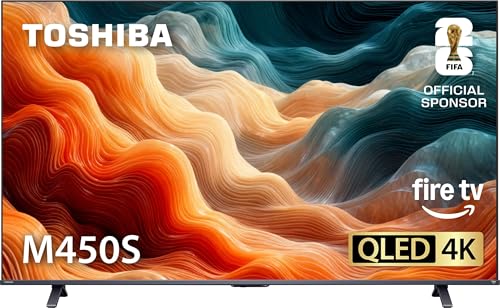 TOSHIBA 55" Class M450 Series QLED 4K TOSHIBA 55" Class M450 Series QLED 4K | – | Check price | |
| INSIGNIA 50" Class F50 Series LED 4K | Display Technology: LED Resolution: 4K Refresh Rate: 60 hertz | 4.4★ | Check price |
As an Amazon Associate we earn from qualifying purchases at no extra cost to you. Ratings are shown as listed on Amazon.
Why 55 Inches Is the Sweet Spot Size
A 55-inch screen suits viewing distances of roughly 6 to 9 feet for movies and TV. If your couch is closer than 5 feet, a 55-inch 4K panel can actually expose compression artifacts in streaming video; farther than 10 feet, the screen starts feeling small and a 65-inch model is worth the modest price jump. Measure the distance from your eyes to the wall before anything else — it’s the single variable that determines whether 55 inches is right at all.
Quick check: multiply your seating distance in inches by 0.84 (the THX-style guideline for cinematic immersion) or 0.6 for a more casual fit. At an 8-foot couch distance (96 inches), 55 inches sits right in the comfortable middle.
What Actually Separates a Good 55-Inch TV From a Bad One
Ignore resolution — every 55-inch TV is 4K now, and 8K content remains irrelevant. The real differentiators:
- Panel type: OLED gives per-pixel contrast and near-infinite blacks, ideal for dark rooms and movies. QLED/mini-LED gets much brighter (often 1,000+ nits vs. OLED’s 600–800 in real scenes), which matters in sunlit living rooms.
- Local dimming: The budget dividing line. Sets under ~$400 usually lack it or use edge-lit zones, producing gray blacks in dark scenes.
- Refresh rate and ports: Gamers need 120Hz (or 144Hz) native panels with HDMI 2.1, VRR, and low input lag — not “motion smoothing” marketing numbers.
- Smart platform: Google TV, Roku, webOS, Tizen, and Fire TV all work; what matters is whether it stays fast in year three. Roku and Google TV tend to age best on cheaper hardware.
Best 55-Inch TVs by Situation
Best Overall for Most Rooms: LG C-Series OLED (e.g., C4/C5)
LG’s C-series OLED has been the default recommendation for years because it does everything well: excellent contrast for films, four HDMI 2.1 ports, 120–144Hz gaming with VRR, and webOS that remains snappy. It sits in the $900–$1,300 range at 55 inches, frequently discounted well below launch pricing. Its one weakness is peak brightness in bright rooms — if your TV faces a window, look at mini-LED instead.
Best for Bright Rooms: Samsung QN-Series or TCL QM8 Mini-LED
Mini-LED sets hit 1,500–2,000+ nits with hundreds of local dimming zones, so HDR actually pops at noon with the curtains open. Samsung’s QN90-series runs Tizen and has a strong anti-glare coating; TCL’s QM8 delivers comparable brightness for noticeably less money, at the cost of a slightly less refined interface.
Best for Gamers: LG C-Series OLED or Hisense U8-Series
For console and PC gaming, prioritize: 120Hz+ native refresh, two or more HDMI 2.1 ports, VRR/ALLM support, and input lag under 10ms in game mode. The LG C-series ticks every box. Hisense’s U8-series delivers 144Hz, mini-LED brightness, and full HDMI 2.1 support at a mid-range price — the value pick for a dedicated gaming room.
Best Budget Pick Under $400: TCL Q-Series or Hisense U6-Series
At the budget tier, TCL’s Q-class and Hisense’s U6 models offer quantum-dot color and basic local dimming where competitors are still edge-lit. You’ll give up HDMI 2.1 bandwidth and peak HDR brightness, but for a bedroom or secondary TV, these are unambiguously the best dollar-per-inch values.
Best Premium Splurge: Samsung S90-Series or LG G-Series OLED
Step-up OLEDs add a brighter panel (QD-OLED in Samsung’s case, MLA-boosted in LG’s G-series), meaning OLED contrast plus enough luminance for moderately bright rooms. Worth it for dedicated media rooms; hard to justify for casual viewing.
Comparison Table: Key Specs at a Glance
| Model (55″) | Panel | Peak Brightness (approx.) | Refresh Rate | HDMI 2.1 Ports | Typical Price Range |
|---|---|---|---|---|---|
| LG C4/C5 OLED | OLED | ~800 nits | 120–144Hz | 4 | $900–$1,300 |
| Samsung QN90 Mini-LED | Mini-LED QLED | ~2,000 nits | 120–144Hz | 4 | $900–$1,200 |
| TCL QM8 Mini-LED | Mini-LED QLED | ~2,000 nits | 120–144Hz | 2 | $600–$800 |
| Hisense U8 Series | Mini-LED QLED | ~1,500 nits | 144Hz | 2 | $550–$750 |
| Hisense U6 Series | QLED w/ dimming | ~600 nits | 60Hz | 0 | $350–$450 |
| Samsung S90 OLED | QD-OLED | ~1,000 nits | 144Hz | 4 | $1,200–$1,600 |
Decision Matrix: Match Your Situation to a Pick
| Your Situation | Recommended Type | Budget |
|---|---|---|
| Dark room, movies first | OLED (LG C-series) | $900–$1,300 |
| Bright living room, daytime sports | Mini-LED (QN90 / QM8) | $600–$1,200 |
| PS5 / Xbox / PC gaming priority | OLED or Hisense U8 (120Hz+, HDMI 2.1) | $550–$1,300 |
| Bedroom or kids’ room, casual use | Budget QLED (U6 / TCL Q) | $350–$450 |
| Couch 10+ feet away | Reconsider — step up to 65″ | Varies |
Ownership Realities Listings Don’t Tell You
- Stand footprint: Many 55-inch TVs use feet placed near the panel edges — check that your console table is at least 44–48 inches wide, or plan to wall-mount.
- OLED burn-in is manageable, not mythical: Modern OLEDs have pixel-refresh cycles; risk mainly exists if you display a static news ticker or game HUD for hours daily for years. Mixed use is fine.
- Budget TVs degrade in software, not hardware: Cheap panels rarely fail — their processors make the smart interface sluggish after 2–3 years. A $30 streaming stick later fixes it.
- HDR on cheap TVs is a checkbox: A 400-nit set technically “supports” HDR10 but can’t show it. Under ~600 nits, don’t pay extra for HDR claims.
- Sound is the first compromise: Every thin TV has weak speakers. Budget $100–$200 for a soundbar if dialogue clarity matters.
FAQ
Is OLED worth it over QLED at 55 inches?
If you watch mostly at night or in controlled lighting, yes — OLED’s contrast is the single biggest picture-quality upgrade available. In bright rooms, a good mini-LED QLED actually looks better because it overpowers ambient light.
How far should I sit from a 55-inch TV?
Between 6 and 9 feet is ideal for mixed content. Gamers sitting closer (4–5 feet) benefit more from 120Hz panels; casual viewers past 9 feet should consider going bigger.
Do I need HDMI 2.1?
Only for 4K/120Hz gaming on a PS5, Xbox Series X, or gaming PC. For streaming and cable, HDMI 2.0 is fully sufficient.