Key takeaways
- A disorganized garage costs you time, space, and money. In 2026, the average two-car garage has lost 30 to 40 percent of its usable floor space to
What's inside
- Watch: How to Organize Your Garage with Smart Storage Solutions — Video Review
- 1. Reclaim Floor Space with Overhead Ceiling Storage
- 2. Get Long-Handled Tools Off the Floor with Wall-Mounted Systems
- 3. Contain Sports Gear and Bulky Balls in One Mobile Station
- 4. Master Small Parts with a Visible Bin System
- 5. Tame Cords, Hoses, and Extension Cables
- Tips for a Garage That Stays Organized
- Frequently Asked Questions
- Conclusion
- Related Articles
- Related Guides
A disorganized garage costs you time, space, and money. In 2026, the average two-car garage has lost 30 to 40 percent of its usable floor space to clutter, and most homeowners spend 10 minutes or more searching for a specific tool, ball, or hardware piece. Smart storage is not about buying more bins — it is about using vertical space, creating zones, and choosing systems rated for real garage weight and conditions.
- Watch: How to Organize Your Garage with Smart Storage Solutions — Video Review
- 1. Reclaim Floor Space with Overhead Ceiling Storage
- 2. Get Long-Handled Tools Off the Floor with Wall-Mounted Systems
- 3. Contain Sports Gear and Bulky Balls in One Mobile Station
- 4. Master Small Parts with a Visible Bin System
- 5. Tame Cords, Hoses, and Extension Cables
- Tips for a Garage That Stays Organized
- Frequently Asked Questions
- Conclusion
- Related Articles
- Related Guides
This guide breaks down how to organize your garage by category and by wall, ceiling, and floor zone so everything has a designated, visible home. The strategies below work whether you have a single-car garage, a large workshop, or something in between, and they scale easily as your storage needs change.
As an Amazon Associate we earn from qualifying purchases.




⚡ Save on Your Next PC — Amazon Prime
Prime members get fast free shipping on the systems above, plus early access to Prime Day & Black Friday PC deals. New members get a 30-day free trial.
Watch: How to Organize Your Garage with Smart Storage Solutions — Video Review
1. Reclaim Floor Space with Overhead Ceiling Storage
The ceiling is the most underused area in almost every garage. If you can still park both cars but have seasonal bins, camping gear, and totes stacked along the walls, moving bulk storage overhead instantly frees 60 to 80 square feet of floor space. Ceiling-mounted racks are ideal for items you access monthly or seasonally, not daily.
- Measure first: You need at least 24 to 36 inches of clearance above your garage door tracks. The FLEXIMOUNTS 4×8 Overhead Garage Storage Rack is a standard 4-by-8-foot platform that mirrors a sheet of plywood, making it easy to use matching bins.
- Check weight ratings: Look for a rack rated for 500 to 600 lbs evenly distributed when mounted into solid ceiling joists with lag bolts, not drywall anchors.
- Keep it safe: Store lighter, bulky items up top — holiday decorations, coolers, and labeled totes. Keep heavy power tools and liquids at ground level. Leave 2 to 3 feet of clearance from the garage door when open.
- Install with help: Overhead racks require two people, a stud finder, and a level. Tighten all hardware and re-torque after the first 30 days of loading.
2. Get Long-Handled Tools Off the Floor with Wall-Mounted Systems
Shovels, rakes, brooms, and leaf blowers create the classic garage avalanche. A wall-mounted rail system turns that pile into a single organized row using 12 to 24 inches of wall depth instead of 8 feet of floor leaning space.
- Choose capacity by tool count: The CRXCRC 48 Inch Garage Tool Organizer provides a 48-inch steel rail with 6 adjustable straight hooks and installs in about 15 minutes into studs or concrete. It is ideal for 10 to 14 long-handled tools in a tight bay.
- For larger collections, the TVKB 68 Inch All Metal Garden Tool Organizer offers a longer 68-inch rail with heavy-duty hooks and hangers rated for yard tools, ladders, and weed trimmers. All-metal construction resists bending and rust in unheated garages.
- Mount at the right height: Install the rail 48 to 60 inches from the floor so tool heads hang clear of the ground and handles are easy to grab. Group by frequency — daily tools at arm level, seasonal tools higher or to the side.
- Leave expansion room: Do not fill every hook on day one. Leave 2 to 3 open hooks for new tools and use S-hooks or spring clips for cords and smaller items.
3. Contain Sports Gear and Bulky Balls in One Mobile Station
Sports equipment is bulky, round, and rarely stackable. Balls rolling across the floor are a tripping hazard and deflate faster when stored improperly against concrete. A dedicated sports organizer corrals everything into one vertical footprint.
- Use a tiered rolling cart: The Faesun Sports Equipment Organizer is a 4-tier ball storage rack with wheels that holds basketballs, soccer balls, footballs, and playground balls in separate tiers while side hooks hold bats, rackets, and helmets.
- Go vertical, not wide: Four tiers use about 6 square feet of floor space versus 15+ square feet if balls and gear are scattered in bins. Look for 2 to 3-inch lockable casters so the cart rolls to the driveway for play and locks against the wall after.
- Indoor/outdoor durability: Powder-coated steel and mesh or bungee sides handle garage humidity and allow airflow so gear dries instead of mildewing.
- Create a family zone: Place the cart near the garage door at kid height. Assign each tier to a sport or child so cleanup takes less than 60 seconds.
4. Master Small Parts with a Visible Bin System
Lost screws, nails, and wall anchors lead to duplicate purchases. Hardware is best stored where you can see it without opening five different containers. A wall-mounted bin rack keeps thousands of small parts sorted and instantly identifiable.
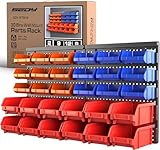
- Sort by project, not just size: The SEDY 30-Bin Wall-Mounted Storage Rack System includes 30 removable bins in multiple sizes on a heavy-duty wall panel. Use small bins for screws, nuts, bolts, and beads, and larger bins for drill bits, anchors, and electrical connectors.
- Label everything: Use a label maker or masking tape on the front of each bin with size and quantity, for example, “#8 x 1-1/4″ Wood Screws – 50 ct.” Keep a master list on the adjacent wall for quick inventory.
- Mount near your workbench: Install the rack 40 to 50 inches high within arm’s reach of where you build or repair. Removable bins let you carry just the hardware you need to the project instead of the whole organizer.
- Plan for growth: A modular panel system lets you add extra bins later. Start with one 30-bin panel and expand horizontally rather than stacking loose containers.
5. Tame Cords, Hoses, and Extension Cables
Tangled extension cords and hoses damage easily, create trip hazards, and waste time to untangle. Cheap plastic ties slip and break, especially in cold garages. Heavy-duty straps designed for hanging solve this permanently.
- Use load-rated straps: The VELCRO Brand Easy Hang Extension Cord Holder Variety Pack includes 3 straps in 10, 14, and 18-inch lengths that hold 60 to 100 lbs each and loop securely over hooks or nails.
- Match length to item: Use 10-inch straps for 25-foot extension cords, 14-inch for 50-foot cords and air hoses, and 18-inch for heavy 100-foot cords and garden hoses. Wrap in loose loops 8 to 10 inches in diameter to prevent kinking copper wire.
- Hang, don’t pile: Hang coiled cords on a single wall hook at eye level. They stay dry, kink-free, and visible. Never daisy-chain multiple cords on one strap beyond its rated weight.
- Color-code or label: Dedicate one strap color or add a tag for indoor vs. outdoor-rated cords and for 12-gauge vs. 16-gauge to avoid overloading circuits.
Tips for a Garage That Stays Organized
- Zone your garage into four quadrants: Tools, Automotive, Sports/Outdoor, and Household/Seasonal. Never mix zones — it doubles search time.
- Purge before you organize: Remove everything, donate or discard anything you have not used in 18 months, then only put back what deserves a labeled home.
- Follow the 12-inch rule: Keep at least 12 inches of clear floor along walls for sweeping, and keep frequently used items between waist and eye level (30 to 66 inches).
- Maintain quarterly: Spend 15 minutes each season returning items to zones, checking overhead rack bolts, and sweeping. A small reset prevents a full-day reorganization later.
Frequently Asked Questions
How much weight can my garage ceiling actually hold?
Most residential garages have ceiling joists rated for 10 to 15 lbs per square foot for storage, but overhead racks like the FLEXIMOUNTS 4×8 distribute weight across multiple joists with vertical supports. Always mount directly into joists or blocking with the included lag bolts, follow the manufacturer’s 500 to 600 lb distributed limit, and consult a contractor if you have truss ceilings or drywall-only coverage.
Should I choose a 48-inch or 68-inch tool rail?
Choose based on tool count and wall width. A 48-inch rail with 6 hooks handles a standard set of 8 to 12 garden tools for a single household. If you store more than 12 tools, have multiple shovels and rakes, or want to hang a ladder and trimmers on the same wall, the 68-inch all-metal system provides about 40 percent more hanging length and stronger hook spacing without overcrowding.
What is the best way to store sports balls so they last longer?
Store balls off concrete, inflated to the manufacturer’s recommended PSI, and out of direct sunlight. A 4-tier rolling rack keeps balls separated so they do not compress each other, allows air circulation to prevent odor, and keeps them at room temperature rather than on a freezing or hot floor, which degrades rubber and seams over time.
How do I keep small hardware from becoming a mess again?
Use a wall-mounted bin system with removable, see-through or open-front bins and commit to one rule: every new hardware purchase is immediately sorted into its labeled bin. Keep bins shallow — 4 to 6 inches deep — so parts do not get buried, and store bulk backup stock in a single labeled tote on your overhead rack, not mixed into daily-use bins.
Conclusion
An organized garage in 2026 is about smart zones, not more square footage. Lift seasonal bulk overhead with a 4×8 ceiling rack, line your walls with 48 to 68-inch tool rails, consolidate sports gear into a single rolling tower, sort hardware into a 30-bin wall system, and hang every cord on a rated strap. Install one zone at a time this weekend and you will park easier, find tools in seconds, and keep the whole system intact for years.